
The Highway as a National Mythology
Few cultural forces have shaped American identity quite like the open road. Long before GPS or interstate rest stops, the act of pointing a vehicle toward a distant horizon carried a weight that was almost spiritual - equal parts restlessness, optimism, and the stubborn belief that something better waited just past the next county line.
That mythology didn't arrive fully formed. It was assembled over decades, paved mile by mile, and handed down through literature, film, music, and the lived memories of families who loaded up station wagons and simply went. Today's iconic road routes are monuments to that layered history, and understanding how road culture evolved helps every traveler appreciate why the urge to drive still feels so elemental.
2,400 mi
Length of Historic Route 66
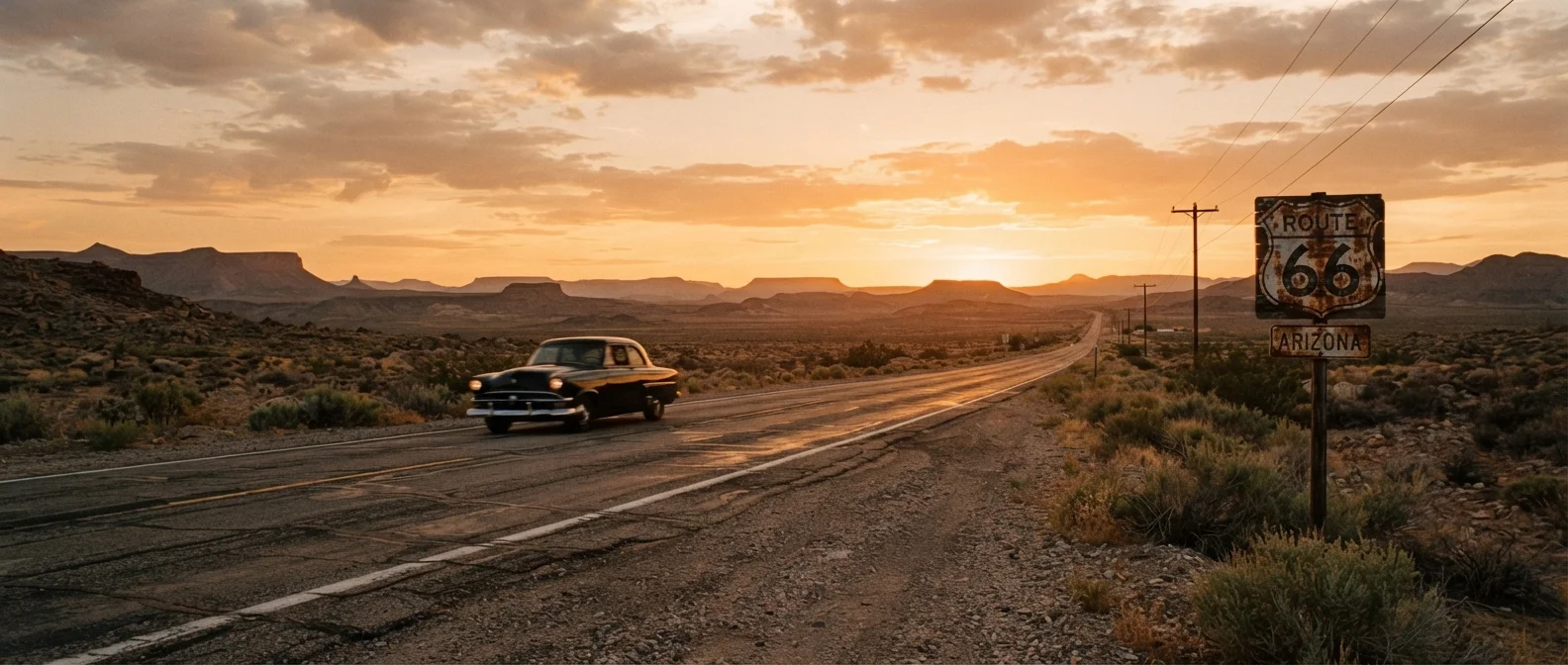
Route 66 ran from Chicago, Illinois to Santa Monica, California when fully paved in 1938.
48,000+
Miles in the US Interstate System
The US Interstate Highway System spans approximately 48,000 miles, making it one of the largest road networks on Earth.
~1M
People estimated living vehicle-nomadic lives in the US
Various housing researchers and nomad community surveys suggest approximately one million Americans live in vehicles at least part of the year.
Route 66 and the Mid-Century Road Trip
When U.S. Route 66 was fully paved in 1938, it stitched together a 2,400-mile corridor from Chicago to Santa Monica - and almost immediately became more than a road. It was a lifeline for Dust Bowl migrants moving west, a post-war pleasure route for families with new money and new cars, and a diner-studded, neon-lit stage for the emerging American consumer.
The 1950s cemented Route 66's mythological status. Drive-in theaters, roadside motels, and chrome-trimmed diners weren't just convenient - they were the architecture of a new kind of leisure. Travelers didn't merely pass through towns; they experienced a choreographed America that had been built expressly for people behind a windshield.
When retracing Route 66, prioritize the unincorporated stretches between major cities - these often preserve original pavement, vintage signage, and intact roadside structures that bypass spurs have left untouched.
The most historically authentic segments of the Mother Road survive precisely because they were bypassed by later highway development, meaning lighter traffic and less commercial redevelopment.
Build a loose day-to-day framework rather than a fully locked itinerary - allow at least one unscheduled afternoon per three days of driving so genuine detours remain possible.
Road travel veterans consistently report that their most memorable experiences came from unplanned stops; a rigid schedule forecloses the spontaneity that defines road culture at its best.
Today, driving historic stretches of the Mother Road still rewards curious travelers with intact vernacular architecture, murals, and communities that take genuine pride in their highway heritage. For those planning around these stops, our road trip planning hub covers the logistical side of building a route around historic landmarks.
Counterculture, Kerouac, and the Road as Rebellion
By the late 1950s, another road tradition was taking shape - one that deliberately rejected the cheerful consumer script. Jack Kerouac's On the Road (1957) crystallized a vision of highway travel as flight: from convention, from routine, from the expectation that a responsible adult stays put. The Beat Generation recast the driver as seeker rather than tourist.
That spirit rippled through the 1960s and '70s. Converted VW buses became rolling communes. Road travel merged with protest marches, music festivals, and an appetite for landscapes that the new interstate system was beginning to bypass. The road was no longer about arriving somewhere comfortable - it was about what the journey itself could loosen in you.
“The road is life. There's nothing to figure out - you just get in the car and go, and see what comes.”
— Jack Kerouac, Author of On the Road (1957)
This era planted seeds that are still growing. The tension between structured itinerary and unplanned discovery - between the motel reservation and the sleeping bag on public land - defines much of what separates long-haul travelers from vacationers today.
The Interstate Era and the Family Vacation
The Interstate Highway System, substantially complete by the 1980s, democratized long-distance driving while quietly homogenizing it. Chain restaurants and branded motels replaced idiosyncratic roadside stops. Speed and predictability became the dominant values - a different kind of freedom, but freedom nonetheless.
For millions of families, the interstate road trip became a rite of passage: the minivan loaded to the ceiling, a paper atlas in the glove box, the backseat negotiations over cassette tapes. These trips generated their own rituals, their own arguments, and their own formative memories. Whether it felt like adventure or ordeal often depended on who was driving.
Nostalgia Has a Selective Memory
The golden age of American highway travel was not golden for everyone. Sundown towns, racial segregation on the road, and the economic displacement caused by interstate routing all shaped who could travel safely and freely. Engaging honestly with this history enriches rather than diminishes the road trip experience, and several roadside heritage sites and museums now document these fuller stories.
The car camping versus motel hopping debate traces directly to this era - two philosophical camps that emerged from different experiences of highway travel and have never fully reconciled.
Van Life and the Modern Nomad
Van life - the practice of converting a cargo van or camper van into a mobile living space and using it as a primary or extended residence - entered mainstream awareness around the mid-2010s, amplified by social media communities that made the aesthetic globally visible. But the underlying impulse is old: live simply, move freely, own less.
What distinguishes the contemporary van life movement is its intersection with remote work. High-speed mobile data and the expansion of location-independent employment have made it genuinely viable for a larger population than any previous nomadic road tradition. Road trip communities - from overlanding groups to van life forums - have built robust support networks around shared resources, convoy meetups, and hard-won practical knowledge.
That said, van life carries real logistical and legal complexity that the polished social media version often underplays. Parking regulations, water access, mail forwarding, and vehicle maintenance demand serious planning. Our sister piece on myths about road trip freedom addresses several of these realities head-on.
Starting Out with Van Life? Research First
Before committing to a full-time vehicle conversion, spend several weekends car-camping or renting a camper van to test how you genuinely feel about compact living. Many experienced van-lifers recommend a 30-day trial run before selling lease agreements or investing in costly builds. Local van and overlanding clubs are a practical first stop for unfiltered, experience-based advice.
What Unites Every Generation of Road Travelers
Strip away the specific vehicles, eras, and aesthetics, and a consistent thread emerges: road travel is, at its core, about agency. The ability to choose your direction, adjust your pace, and engage with the country at ground level rather than from 35,000 feet connects the Dust Bowl migrant, the 1960s wanderer, the minivan family, and the van-lifer equally.
The rituals that define road trip culture - the diner breakfast, the roadside overlook, the spontaneous detour - are expressions of that agency. So are the relationships forged inside a car: see how shared drives shape the people you travel with for a deeper look at how miles clarify connection.
Road trip culture isn't a fixed artifact. It's a living conversation between restlessness and belonging, between the known and the unknown - one that every generation rewrites with whatever vehicle, technology, and hunger for the horizon it happens to carry.
Road Culture Evolves - Keep Checking In
The van life aesthetic, overlanding trends, and even highway policy change year to year. Regulations around dispersed camping on Bureau of Land Management land, for instance, vary by region and are subject to revision. Always verify current rules with the relevant land management agency before planning an extended off-grid stop.