
What the Open Road Actually Tests
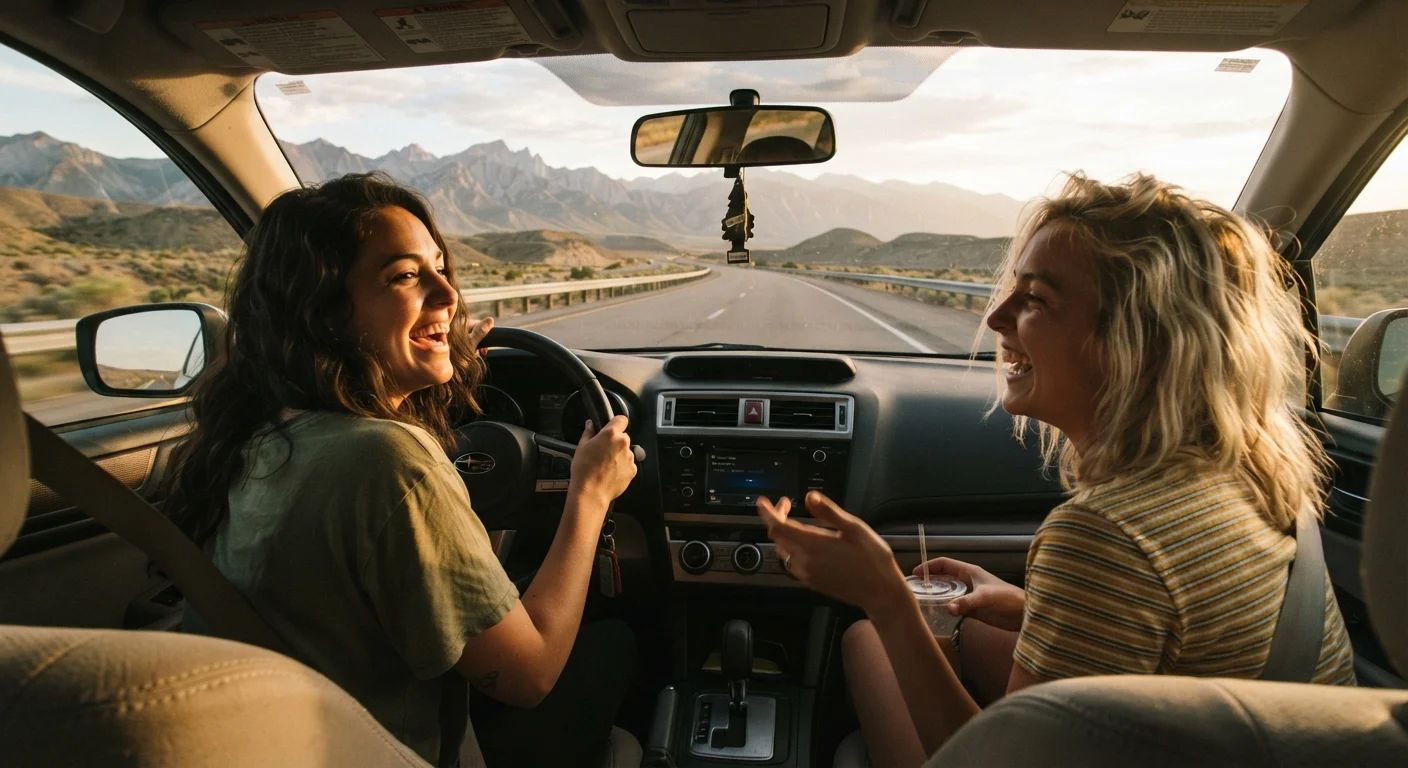
A road trip is a relationship accelerator. Two weeks in a car can surface more about a person's character than a year of weekly dinners - their response to getting lost, their relationship with money, how they communicate when tired, whether they need silence or conversation to decompress. None of this is theoretical. It shows up at mile 400 when the GPS loses signal and one person wants to improvise while the other wants to find Wi-Fi first.
What the road tests, specifically, is tolerance for ambiguity. Long drives are full of unresolved questions: where to stop, when to stop, what counts as worth the detour. People who share a high comfort level with uncertainty tend to travel together fluidly. Those who don't can still make excellent companions - but only if they've talked about their defaults before departure rather than discovering them in the middle of nowhere.
Pace alignment matters more than shared interests
It might seem like shared enthusiasm for a destination is the key to road trip harmony - but experienced travelers consistently point to pace expectations as the deeper compatibility factor. Someone who shares your love of national parks but wants to sprint through three in a day may create more friction than someone with different taste who simply wants to move at the same speed you do.
Seasoned road travelers consistently point to pace alignment as the single most underestimated compatibility factor. It's not whether you like the same music or have similar senses of humor - it's whether you both feel the same urgency (or lack of it) about covering miles versus lingering.
The Architecture of a Shared Drive
Road trips have a rhythm that's different from any other travel format. The first day carries excitement and novelty. By the third or fourth day, the experience becomes something closer to ordinary life - just lived in motion. This is precisely when the relationship deepens or starts to fray. Small habits become visible: who leaves coffee cups on the dashboard, who checks their phone at every red light, who controls the radio without asking.
These aren't trivial details. They're data points about how someone shares space. The travelers who navigate this well are usually those who build small rituals early - a tradition of stopping for breakfast at a diner before 8 a.m., rotating who picks the music each hour, a shared rule about no phones during the golden hour sunset stop. Rituals create structure without rigidity, and on a long drive, that balance is everything.
72%
Travelers who road tripped with a companion
According to a AAA Foundation survey, the large majority of American road trips involve at least one travel companion rather than solo driving.
2-3x
Speed of relationship development in travel
Research in social psychology suggests that novel, shared experiences can build interpersonal closeness several times faster than routine social contact.
Top 3
Road trips rank among most bonding travel types
In multiple traveler surveys, extended road trips consistently rank among the travel formats people cite as most formative for their close relationships.
The distinction between long-haul road travelers and vacationers often comes down to exactly this: the willingness to build a shared daily rhythm rather than treating each day as a highlight reel.
Conflict, Communication, and the Miles Between
Arguments happen on road trips. Pretending otherwise is one of the myths that sends unprepared travelers into friction they weren't expecting. The question isn't whether conflict will arise - it's whether the people involved have the communication tools to work through it in a moving vehicle, possibly on three hours of sleep and a gas station breakfast.
Experienced road companions tend to develop what might be called low-stakes negotiation: a habit of raising small irritations before they compound into larger ones. "I'd actually love to stop and walk around here" is easier to say at mile 50 than at mile 300 when resentment has had time to build. This kind of communication isn't a sign of incompatibility - it's a sign of investment in the trip and the relationship.
Have the pre-trip planning conversation
Before departure, align on a few non-negotiables: daily mileage targets, budget range for food and lodging, and how much flexibility each person wants in the daily schedule. This isn't about removing spontaneity - it's about making sure spontaneity doesn't become a source of conflict. Even a 30-minute conversation can prevent hours of frustration on the road.
For a broader look at how road travel communities build similar trust and shared language among strangers, the story of road trip communities forming on the open road offers a fascinating parallel to what happens inside a single car.
What Stays With You After the Miles End
Long after the photos fade and the mileage is forgotten, what road companions carry is a catalog of shared moments that don't always make it onto social media: the two-hour traffic standstill where they talked about things they'd never brought up before, the wrong turn that led to the best meal of the trip, the evening they sat on a tailgate watching a thunderstorm move across a flat horizon with nothing to say that needed saying.
These are the moments that redefine a relationship. Not the destinations - the in-between. The road trip doesn't just give you a story to tell together; it gives you a private shorthand, a set of references that belong only to the people who were there.
Whether a shared drive brings two people closer or reveals that they travel better apart, it delivers something most relationships rarely get: an honest, unfiltered look at who each person actually is. That's worth every mile, difficult or otherwise. And for those who find the road feels better alone, the realities of solo road travel are just as rich and revealing in their own right.