
What 'Going Without a Fixer' Actually Means Here
In Western travel contexts, a fixer is often understood as a journalist's local contact. In Central Asia, the term is used more loosely to describe anyone - local guide, logistics coordinator, or in-country tour operator - who smooths the gap between a foreign traveler and a region where infrastructure, language, and bureaucracy create real friction.
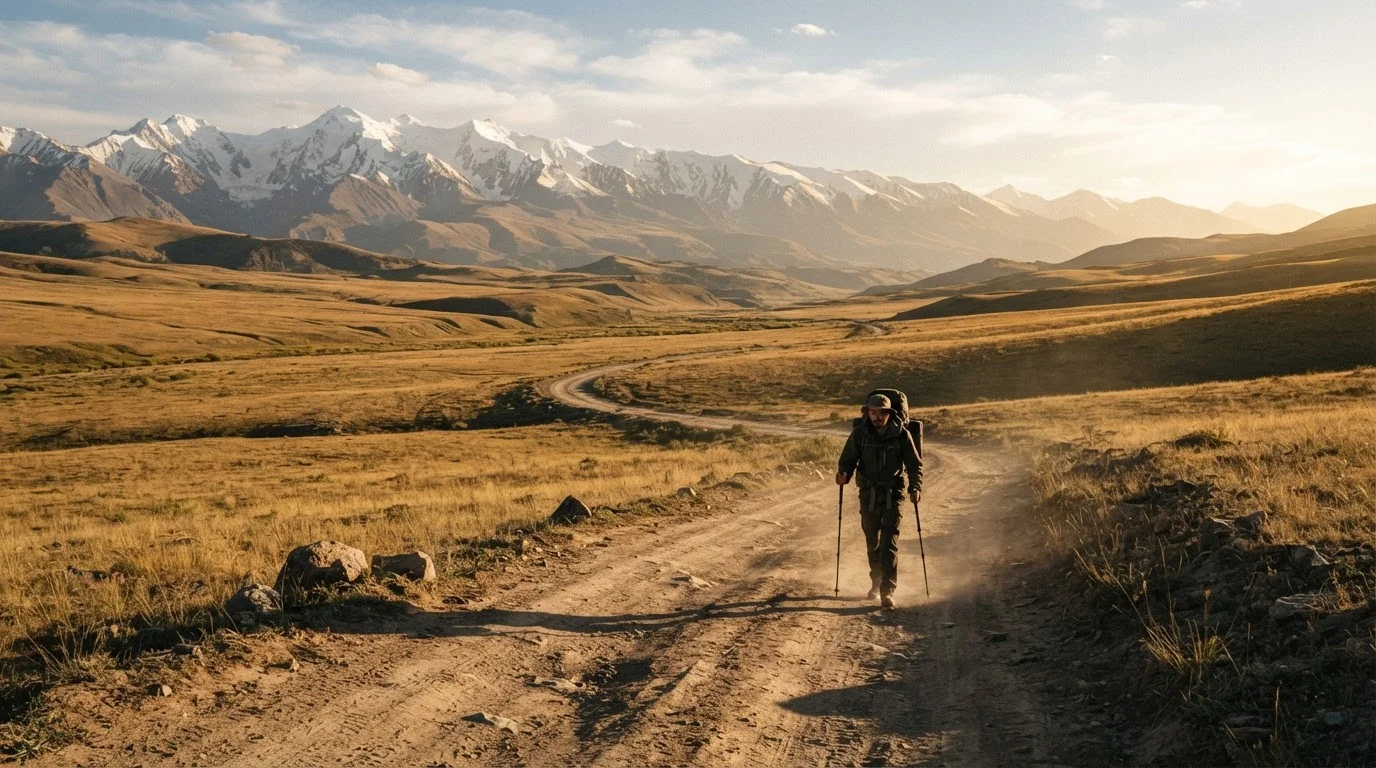
The question of whether to hire one is not simply a matter of budget or independence preference. Uzbekistan's Fergana Valley, Kyrgyzstan's Tian Shan highlands, and Tajikistan's Pamir plateau each present distinct logistical environments. The Pamir Highway carries a specific reputation for remoteness that travel blogs frequently understate. The same is true of the Wakhan Corridor, where terrain and access restrictions change the calculus entirely - see a ground-level breakdown of what that route demands.
This piece focuses on independent land travel - not luxury package tours - and the honest tradeoffs that come with navigating these regions on your own terms.
The Genuine Advantages of Independent Travel
Unscripted access to authentic local encounters
Without an intermediary managing interactions, travelers often find themselves invited into homes, workshops, and community spaces that structured tours bypass entirely. The chai house conversation that turns into a two-hour Uzbek language lesson happens more readily when you arrive without an entourage.
Full control over pace and itinerary pivots
Independent travelers can linger in the Arslanbob walnut forest or cut south toward Osh on a day's notice without renegotiating a contracted itinerary. This flexibility is particularly valuable in a region where weather and road conditions frequently rewrite plans.
Lower daily costs in accessible areas
In Kyrgyzstan's Community Based Tourism (CBT) network - which connects travelers directly with homestay families - going independently removes a layer of operator margin and keeps more money with host families.
Deeper navigational engagement with the region
Managing your own logistics - decoding Cyrillic timetables, negotiating shared taxis, reading topographic maps - builds a granular understanding of place that curated travel rarely provides.
The most frequently cited reward of going fixer-free is also the most truthful: unmediated contact. In a Kyrgyz village guesthouse along the Naryn River or at a chai house outside Rishtan in the Fergana Valley, you are simply a traveler - not a client being escorted through a curated experience. That distinction matters to how locals engage with you, and it matters to what you take home.
There is also a navigational intimacy that develops when you are responsible for every decision. Reading road signs in Cyrillic, negotiating shared taxis at a regional bus station, or working out a homestay arrangement with hand gestures and a translation app - these interactions, frustrating in the moment, tend to become the defining memories. Understanding where logistics go wrong in advance is what separates travelers who find this rewarding from those who find it overwhelming.
3,000m+
Elevation of many key Central Asian passes
Multiple road passes across Kyrgyzstan and Tajikistan exceed 3,000 meters, with some surpassing 4,600 meters, creating altitude and weather risks that require route-specific knowledge.
~40%
Kyrgyzstan roads classified as unpaved
According to general infrastructure assessments of the region, a substantial portion of Kyrgyzstan's road network remains unpaved, making vehicle and driver selection a non-trivial logistical decision.
Where the Absence of a Fixer Creates Real Problems
Permit acquisition is genuinely difficult alone
Several restricted zones in Tajikistan and Kyrgyzstan require permits issued through in-country sponsors or specific government offices. The process involves paperwork, lead time, and knowledge of which checkpoints will enforce requirements - information that local fixers hold and update regularly.
Transport sourcing in remote areas carries real risk
In high-altitude corridors without scheduled transport, sourcing a reliable vehicle independently can mean days of delay or accepting a driver and vehicle of unknown condition. A fixer's established relationships with trusted drivers is a practical safety asset in these areas.
Language barriers extend well beyond phrasebook range
Russian functions as a lingua franca in urban areas, but in remote valleys, Kyrgyz, Tajik, or Uzbek dialects dominate. Negotiating accommodation, medical needs, or emergency situations without any shared language is a qualitatively different challenge than navigating a city with Google Translate.
Cultural missteps are easier and costlier without context
A fixer provides real-time cultural interpretation - knowing when a host's refusal is polite deflection, when photography is genuinely unwelcome, or when a religious site requires specific protocols. Without that layer, well-intentioned travelers can inadvertently cause offense in communities that receive few visitors.
Emergency response infrastructure is minimal
Across much of the Pamir and Tian Shan, reliable mobile coverage is absent for stretches of 100 kilometers or more. Without a local contact who knows the terrain, emergency response options are severely limited and evacuation planning requires advance coordination.
The permit landscape across Central Asia is among the most complex in the region. Restricted zones along Tajikistan's borders with Afghanistan and China, certain highland areas of Kyrgyzstan, and sections of Uzbekistan near sensitive infrastructure require paperwork that is difficult to obtain without an in-country contact. A factual permit reference for Asia's restricted zones outlines the issuing authorities and lead times involved - but knowing what's needed and actually securing it independently are different challenges.
Transport is the other major variable. In areas without paved roads or reliable public marshrutka (shared minibus) schedules, a fixer's ability to source a reliable 4WD and driver at fair rates is not a luxury - it's a safety consideration. Medical evacuation logistics, emergency contacts, and communication plans deserve serious attention before departure; see the pre-departure checklist for remote Asia travel for a structured approach.
Visa and Entry Rules Change Frequently
Central Asian visa regimes - particularly for Tajikistan's GBAO (Gorno-Badakhshan Autonomous Oblast) permit and Uzbekistan's evolving e-visa system - are subject to revision with limited advance notice. Always verify current entry requirements through your government's official travel advisory and the destination country's embassy before departure. Do not rely on blog posts or forum advice for permit specifics, as these go out of date quickly.
What Experience and Preparation Actually Change
The fixer question is ultimately a preparation question. A traveler who has navigated rural Southeast Asia or the Caucasus independently, who carries offline maps (Maps.me and Soviet-era topographic scans are both used by experienced travelers in this region), and who has at minimum passive Cyrillic reading ability operates in a fundamentally different environment than someone for whom this is a first off-grid trip.
Itinerary matters too. The Silk Road cities - Samarkand, Bukhara, Khiva - have enough tourism infrastructure that independent navigation is straightforward. The deeper you move into high-altitude or politically sensitive corridors, the more a fixer's local knowledge becomes operationally significant rather than simply convenient. For comparison, how Kyrgyzstan compares to Patagonia and Iceland as a trekking destination illustrates why infrastructure assumptions from other wilderness regions do not transfer cleanly here.
None of this means a fixer is always the right answer. It means the decision should be made deliberately, with accurate information rather than either bravado or excessive caution.