
The Reputation Gap
Ask any well-traveled friend to name a Belgian city worth visiting and the answer arrives fast: Bruges. Its canals, its belfry, its chocolate-scented lanes - Bruges has spent decades as the unchallenged headline act of Flemish tourism. Ghent, just 35 kilometers east, watches all of this from a position of mild, confident indifference.
That indifference is earned. Ghent has been a significant European city since the Middle Ages - at points the largest city north of the Alps after Paris - and it carries that history without leaning on it for survival. Where Bruges is sustained almost entirely by tourism, Ghent runs on universities, biotech research, and a food culture that has developed its own identity entirely apart from visitor expectations. The distinction matters enormously for the traveler who has already done Bruges and wonders what Belgium is actually like when it isn't performing.
For readers already attuned to looking beyond the well-worn trail, this tension between Ghent and Bruges echoes a broader question explored in Europe's overlooked destinations: why do certain places accumulate all the attention while equally compelling neighbors remain serenely undiscovered?
| Criterion | Ghent | Bruges |
|---|---|---|
| Annual visitors | Approx. 2-3 million | Approx. 8 million |
| UNESCO World Heritage status | No (city center) | Yes (historic center) |
| University presence | Major - Ghent University (~50,000 students) | Limited |
| Train from Brussels | ~30 minutes | ~60 minutes |
| Signature artwork | Van Eyck Altarpiece (1432) | Flemish Primitives collection |
| Nightlife & dining scene | Diverse and locally driven | Primarily tourist-oriented |
| Canal network | Extensive, less curated | Compact, highly scenic |
| Crowd density (peak season) | Moderate | Very high |
What Ghent Actually Offers
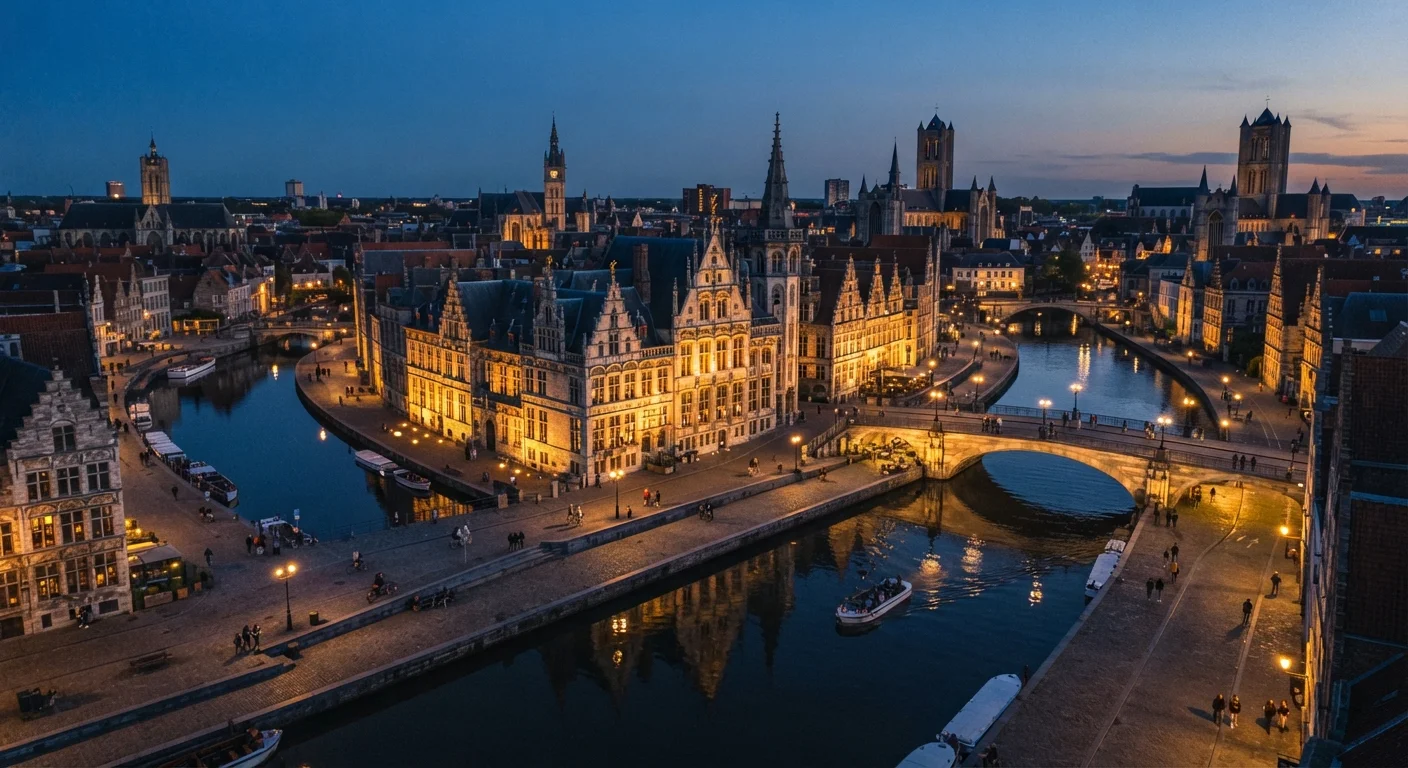
The city's medieval core is anchored by three towers - St. Bavo's Cathedral, the Belfry, and St. Nicholas' Church - visible from the Korenmarkt square in a single glance. It's an urbanist's fantasy and a photographer's reliable headline shot. But the real texture of Ghent begins one or two streets back from the postcard angle.
The Patershol neighborhood, a tangle of cobbled lanes northwest of the Gravensteen castle, houses some of the most serious restaurants in Belgium in buildings that date to the 17th century. The Vrijdagmarkt square hosts a genuine weekly market used by Ghent residents, not purely staged for visitors. The Design Museum Ghent and SMAK (the Municipal Museum of Contemporary Art) give the city serious cultural weight that goes well beyond ecclesiastical heritage.
~8M
Annual tourists to Bruges
Bruges consistently ranks among Europe's most-visited small cities, drawing roughly eight million visitors per year to a population of under 120,000.
50,000+
Students at Ghent University
Ghent University is one of Belgium's largest and most research-intensive institutions, giving the city a permanently youthful demographic and active cultural calendar.
1432
Year the Ghent Altarpiece was completed
The Adoration of the Mystic Lamb by Hubert and Jan van Eyck, housed in St. Bavo's Cathedral, is considered one of the earliest and most influential oil paintings in Western art.
Then there is St. Bavo's Cathedral and the Van Eyck Altarpiece. The Adoration of the Mystic Lamb, completed in 1432, survived wars and theft and a Nazi art-looting operation - its panels have more adventure in their provenance than most thrillers. Seeing it in the cathedral's baptismal chapel, in the city where it was commissioned, is an experience that requires no hyperbole.
Where Bruges Still Wins
Honesty serves travelers better than advocacy. Bruges is extraordinary. The historic center, a UNESCO World Heritage Site, is coherent in a way that few medieval cities in Europe still manage - the canals, the Beguinage, the Markt square, the Groeningemuseum with its collection of Flemish Primitives, all within comfortable walking distance. For travelers with limited time in Belgium, that concentration is a genuine advantage.
Bruges also rewards the visitor who times it correctly. Midweek arrivals in March or November reveal a quieter city - early mornings on the Rozenhoedkaai deliver that mirror-canal reflection without the selfie-stick forest. The city is not ruined by tourism; it simply requires more intentional navigation around it.
Timing Your Bruges Visit
Bruges's historic center can feel overwhelmed on summer weekends and public holidays, when cruise passengers from Zeebrugge port add to the already substantial tourist flow. Visiting on a Tuesday or Wednesday, or arriving before 9am, meaningfully changes the experience. The city's off-season months - November through February - offer the most atmospheric, crowd-reduced version of Bruges, though some smaller museums and seasonal businesses may have reduced hours. Always verify opening times directly before visiting.
The practical case for Bruges also holds for travelers combining it with the Belgian coast. The Kusttram (coastal tram) runs from De Panne to Knokke-Heist and Bruges sits near enough that a morning in the city followed by an afternoon at the North Sea is a legitimate day-trip itinerary.
Getting There and Making a Choice
Both cities are served by frequent direct trains from Brussels-Midi station. Ghent-Sint-Pieters is approximately 30 minutes from Brussels; Bruges runs to around 60 minutes. Neither requires a car, and neither benefits from one inside the historic center. Ghent's city bike-share network is extensive and well-integrated with the main station.
For travelers building a Belgium itinerary of more than two days, the practical answer is not Ghent or Bruges - it's Ghent first, Bruges after. Spending two nights in Ghent gives you the canal city experience in its most livable form, and a day-trip to Bruges from there by train takes about 55 minutes and costs a fraction of an overnight hotel stay in the more tourist-pressured city. You arrive in Bruges having already understood the Flemish medieval context, which means you spend less time orienting and more time actually seeing.
Ultimately the question of which city to prioritize comes down to what kind of travel you are doing. If the goal is the most concentrated, visually coherent medieval experience in the fewest hours, Bruges delivers. If the goal is to understand how a Flemish city actually lives - to eat in restaurants that depend on returning local customers, to wander neighborhoods with genuine residential texture - Ghent is the more rewarding choice, and it remains, astonishingly, the less visited one.