
Three Wilderness Traditions, Three Very Different Demands
Patagonia, Iceland, and Kyrgyzstan each occupy their own tier in the global wilderness trekking hierarchy - beloved by expedition travelers, but radically different in what they ask of you. Comparing them means looking beyond scenic photography and examining terrain, infrastructure, cultural context, seasonal windows, and the specific kind of physical and logistical effort each region demands.
This comparison is aimed at travelers who have already conquered the standard bucket-list treks and are weighing where to invest a serious multi-day commitment next. If you're at the planning stage, see our guide to multi-day wilderness expedition planning for the practical groundwork each of these regions will require.
| Patagonia | Iceland | Kyrgyzstan | |
|---|---|---|---|
| Terrain Type | Granite peaks, glaciers, steppe | Volcanic fields, rhyolite, geothermal | High alpine, glaciated passes, jailoo |
| Trail Infrastructure | Moderate - refugios on main routes | High - huts, signs, ranger presence | Low to moderate - variable marking |
| Physical Difficulty | High - weather and terrain exposure | Moderate - manageable distances | High - altitude and remote navigation |
| Peak Season | November - March | Late June - early September | July - August |
| Relative Cost | Moderate to high | High | Low to moderate |
| Cultural Immersion | Low on main circuits | Low outside small towns | High - nomadic community contact |
| Crowd Levels | Moderate - permit system limits | High on Laugavegur in peak weeks | Low to none on remote routes |
Terrain and Scenery: What the Landscape Actually Looks Like on the Ground
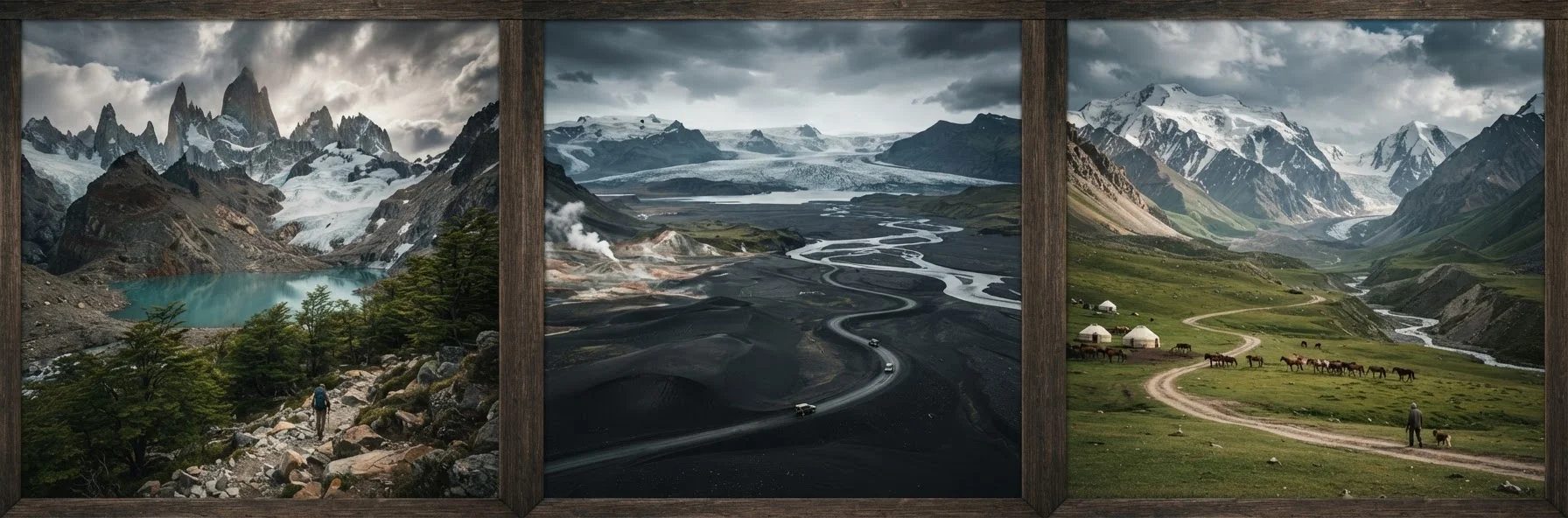
Patagonia (spanning southern Chile and Argentina) is defined by verticality and volatility. The Torres del Paine and Los Glaciares circuits expose trekkers to granite spires, turquoise glacial lakes, and windswept steppe - often all in a single day. Weather can shift from calm to gale-force within hours; this is not exaggeration but a documented feature of the regional climate. The W Trek and the full Circuit are well-marked, but the terrain is physically demanding and the exposure is real.
Iceland's highland routes - particularly the Laugavegur Trail and the Fimmvörðuháls connector - traverse a geology that feels genuinely alien: rhyolite mountains in rust and ochre, steaming fumaroles, obsidian lava fields, and glaciers descending into verdant valleys. The dramatic contrasts are compressed into relatively short distances, making Iceland particularly rewarding for those who want maximum visual variety within a shorter route. For a deeper Atlantic-island comparison, Iceland versus the Faroe Islands explores how these neighboring regions diverge in character.
Kyrgyzstan's Tian Shan range offers high-altitude alpine terrain - glaciated peaks, high passes above 3,500 meters, and vast jailoo (summer pasture) valleys still used by seminomadic herders. Routes like the Ak-Suu Traverse and the CBT (Community Based Tourism) trails through Son-Kul and Karakol operate in a landscape where permanent human settlement is sparse and the wilderness genuinely unmanaged in stretches.
Match Your Footwear to the Terrain Type
Each of these regions punishes the wrong boot choice differently. Iceland's lava fields and river crossings demand waterproof mid-cut boots with solid ankle support. Patagonia's wet trails and exposed ridgelines reward full-grain leather or robust synthetic hiking boots. Kyrgyzstan's high passes and loose scree require stiff soles and reliable ankle stability - lightweight trail runners are insufficient above 3,000 meters. Test your chosen footwear on sustained elevation gain before committing to any of these routes.
Infrastructure, Access, and On-Trail Logistics
Infrastructure is where these three destinations diverge most sharply. Iceland is the most trekker-ready: established huts with reservations, ranger presence on key routes, well-signed trails, and international flight connections that make arrival and departure straightforward. The tradeoff is that this accessibility has driven trail saturation on the Laugavegur during peak weeks.
Patagonia sits in the middle. CONAF (Chile's national parks authority) manages Torres del Paine with a permit and quota system, refugios dot the W Trek, and the broader Chilean and Argentine Patagonia circuits are well-documented. However, remoteness increases rapidly once you leave the core circuits, and the sheer distance from major hubs (flying into Punta Arenas typically involves connections through Santiago) raises logistical overhead.
Kyrgyzstan requires the most self-directed planning. While the Community Based Tourism network has expanded significantly, trail marking remains inconsistent outside established CBT corridors, GPS navigation is strongly advisable, and resupply options are limited once in the mountains. Traveling independently here has genuine rewards but real tradeoffs - our honest assessment of going without a fixer in Central Asia lays out exactly what experience level that independence demands.
80 km
Length of Iceland's Laugavegur Trail
The Laugavegur, typically completed in four to five days, is considered one of the most accessible multi-day wilderness routes in the Northern Hemisphere.
3,700 m+
Typical high-pass elevation in Kyrgyzstan's Tian Shan
Several standard trekking routes in the Karakol region cross passes above 3,700 meters, requiring solid acclimatization planning.
~80 km/h
Average wind gusts recorded in Patagonia's core season
Wind speeds in Torres del Paine regularly exceed 80 km/h during summer months, making weather gear selection a critical safety consideration.
Seasonality, Cost, and the Decision Framework
Each region has a narrow optimal window. In Patagonia, November through March constitutes the austral summer - anything outside that range risks trail closures and dangerous conditions. Iceland's highland trails are typically accessible from late June through early September, with snowpack dictating the precise open dates each year. Kyrgyzstan's high-altitude routes open roughly mid-June through September, with July and August offering the most stable conditions.
Cost profiles differ dramatically. Iceland is among the most expensive trekking destinations globally, with hut fees, food, and transport adding up quickly. Patagonia falls in the moderate-to-high range, particularly if accessing Chilean parks and paying park entry fees. Kyrgyzstan remains genuinely affordable by international standards - guesthouse and yurt-stay accommodation along CBT routes provides cultural immersion at low cost, and the off-grid Asia travel network continues to develop supportive infrastructure for independent trekkers.
If you find yourself drawn to extreme-latitude wilderness but prefer not to trek at all, expedition cruising in Antarctica and the Arctic offers a compelling alternative mode of access to comparable wild environments.
Ultimately, the most important variable is not which destination is objectively superior - it's which one matches your current fitness level, risk tolerance, cultural curiosity, and logistical appetite. All three will challenge and reward in ways that mainstream destinations simply cannot replicate.