
Oxygen at Altitude: The Hypoxia Effect
The most immediate physiological consequence of cruising altitude is reduced oxygen availability. Although cabin air contains the same 21% oxygen as ground-level air, the lower pressure means each breath delivers fewer oxygen molecules to your lungs. Blood oxygen saturation - typically 96-99% at sea level - can fall to 93-95% during flight for many healthy adults.
This state is called hypobaric hypoxia: reduced oxygen driven by lower atmospheric pressure rather than depleted oxygen in the air itself. The body compensates by slightly increasing heart rate and breathing depth, but the net result is measurable: reduced cognitive sharpness, increased fatigue, and a general sense of heaviness that seasoned flyers often attribute simply to "travel tiredness."
For healthy passengers the effect is mild and reversible. However, those with pre-existing cardiovascular or pulmonary conditions may experience more significant impacts. Always consult a physician before flying if you have a relevant health history.
Pressurization Is Intentional, Not a Compromise
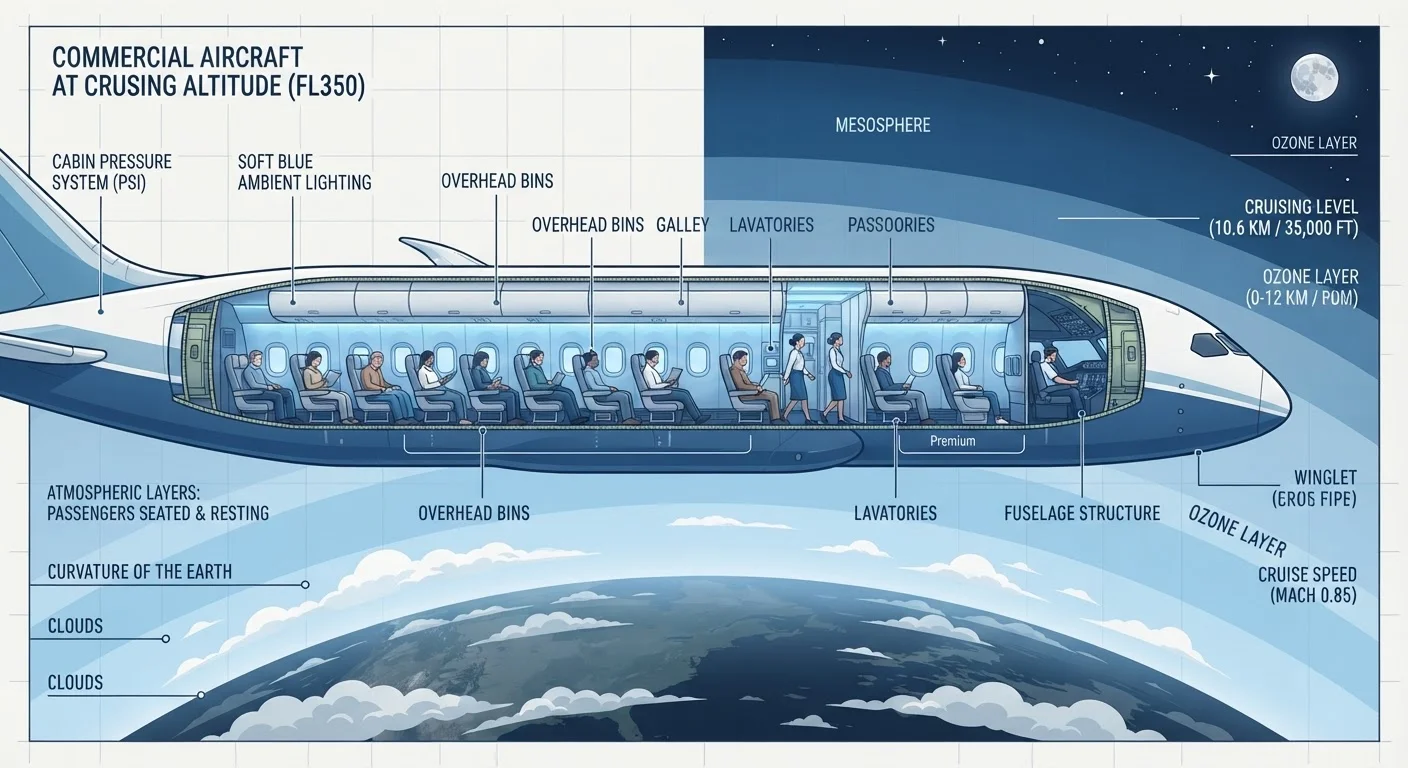
Aircraft are not pressurized to sea level because maintaining sea-level pressure at 35,000 feet would require a dramatically heavier and more expensive airframe. Regulating to an equivalent altitude of 6,000-8,000 feet is the industry-standard engineering balance between passenger comfort and structural feasibility. Newer wide-body aircraft, such as those using composite fuselages, can maintain slightly lower cabin altitudes - closer to 6,000 feet - which some passengers report as more comfortable on long-haul routes.
Dehydration, Humidity, and the Invisible Drain
Aircraft cabins are extraordinarily dry environments. Outside air drawn in at altitude contains almost no moisture, and while recirculation systems help modestly, typical cabin relative humidity sits between 10% and 20% - drier than most deserts. Your respiratory tract, skin, and eyes lose water continuously and silently throughout a flight.
Dehydration compounds the hypoxia effect: blood becomes slightly more viscous, circulation becomes marginally less efficient, and the sense of fatigue deepens. Mucous membranes in the nose and throat dry out, potentially reducing their effectiveness as a first barrier against airborne pathogens.
For a deeper look at what cabin dryness specifically does to your body and which interventions genuinely help, see why cabin air is so dehydrating.
Hydrate Proactively, Not Reactively
Thirst is a lagging indicator of dehydration - by the time you feel it at altitude, you are already behind. Sipping water steadily throughout a flight, rather than waiting until you feel thirsty, is one of the most evidence-supported ways to blunt the compounding effects of cabin dryness and mild hypoxia. Limiting alcohol and caffeine during flight further reduces fluid loss.
Circulation, Pressure, and Prolonged Sitting
Reduced cabin pressure causes gases in body cavities to expand by roughly 25-30%. This is why your ears need to equalize during ascent and descent - a process explained in detail in our guide to managing ear pressure and barotrauma. It also contributes to the abdominal bloating many passengers notice mid-flight, and affects taste perception - altitude dulls your sensitivity to saltiness and sweetness, as explored in how altitude changes taste and digestion.
Prolonged immobility in a pressurized cabin also slows venous blood return from the legs. For most travelers, this manifests as swollen ankles and general stiffness. On longer flights, reduced circulation is a more serious consideration. For an evidence-grounded assessment of clot risk on long-haul flights, see what the research actually says.
10-20%
Typical cabin relative humidity at cruise altitude
Compared to a comfortable indoor range of 30-60%, aircraft cabins are among the driest enclosed environments most people regularly occupy.
93-95%
Blood oxygen saturation during typical flight
Healthy adults at sea level average 96-99%; mild hypoxia during flight is normal but contributes measurably to fatigue and reduced alertness.
~25-30%
Gas expansion in body cavities at cruise altitude
The drop in cabin pressure from sea level to equivalent cruise altitude causes trapped gases in ears, sinuses, and the gut to expand noticeably.
Radiation, Sleep Disruption, and the Bigger Picture
Flying at high altitude means less atmospheric shielding from cosmic radiation - high-energy particles originating from solar events and deep space. A single transatlantic flight delivers a dose in the range of 0.05-0.1 millisieverts, according to general estimates from radiation protection bodies such as the International Commission on Radiological Protection. For infrequent travelers, this exposure is considered negligible. For crew members and very frequent flyers - particularly on polar routes where geomagnetic shielding is thinner - cumulative exposure warrants more attention.
Sleep is also meaningfully disrupted at altitude. Hypoxia can fragment sleep architecture, reducing time spent in restorative slow-wave and REM stages. Combined with time-zone crossing and the psychological demands of confinement, the physiological toll of a long flight extends well beyond landing. Understanding the mental dimension is equally important - managing anxiety and mental wellbeing on long flights addresses the psychological side of this equation with practical, evidence-informed strategies.
This article provides general health information for educational purposes only and is not a substitute for professional medical advice. Consult a qualified healthcare provider regarding any personal health concerns before flying.