
Why Flight-Related Clot Risk Gets Oversimplified
Every few years, a news cycle amplifies a story about a traveler suffering a blood clot after a long flight, and the takeaway tends to swing between two extremes: either flying is secretly dangerous, or the risk is pure myth drummed up by compression-sock marketers. Neither framing serves the informed traveler well.
Deep vein thrombosis (DVT) - the formation of a blood clot in a deep vein, typically in the leg - and its more serious complication, pulmonary embolism (PE), are genuine medical conditions. The question worth asking is not whether flying can contribute to clot formation, but how significant that risk actually is for different people, and what protective steps are grounded in evidence.
Understanding the science behind circulation at altitude is also closely connected to other in-flight wellness factors. Cabin dehydration and prolonged stillness interact to affect your blood's flow and viscosity - both worth managing proactively on any journey over four hours.
Myth
Cabin air pressure and low oxygen levels during flight are what cause blood clots.
Fact
Prolonged immobility is the dominant mechanism - not cabin pressure or reduced oxygen in isolation.
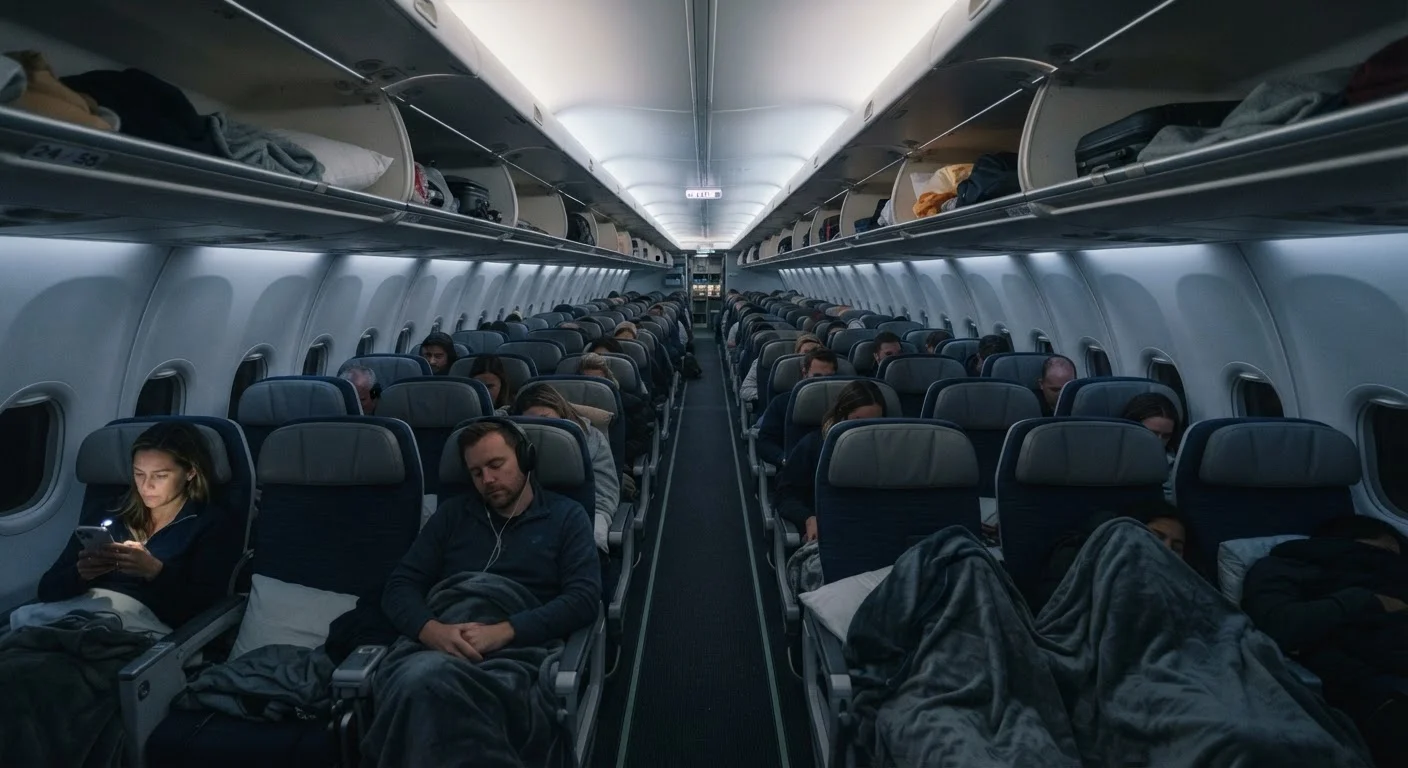
Commercial aircraft cabins are pressurized to the equivalent of roughly 6,000-8,000 feet altitude, which does slightly reduce blood oxygen saturation. However, research has not established low cabin pressure as a direct, independent cause of DVT in healthy individuals. The stronger evidence consistently points to immobility: sitting still for hours allows blood to pool in the lower legs, slowing venous return and increasing clotting risk. Addressing immobility through movement and compression is therefore more evidence-grounded than attributing the risk primarily to altitude.
Myth
Only very long flights - think 12 hours or more - carry meaningful DVT risk.
Fact
Research suggests risk begins to rise meaningfully on flights exceeding roughly four hours, not just ultra-long-hauls.
The four-hour threshold appears in multiple studies and is widely referenced in aviation medicine literature. While ultra-long-haul flights do carry greater cumulative risk due to extended immobility, travelers on medium-length routes should not assume they are categorically exempt. If you have significant clotting risk factors, even a six- or seven-hour flight warrants some protective consideration and a conversation with your doctor beforehand.
Myth
Swollen ankles and feet after a flight mean you probably have a blood clot.
Fact
Post-flight leg swelling is most commonly benign edema - fluid accumulation from gravity and inactivity, not DVT.
Bilateral puffiness affecting both legs and ankles that decreases after walking or elevating your legs is characteristic of dependent edema, a very common and clinically benign consequence of prolonged sitting. DVT, by contrast, more typically presents as unilateral (one-sided) swelling, often accompanied by localized pain, warmth, or redness in the calf. While any persistent or unusual swelling should be evaluated by a clinician, symmetrical post-flight puffiness alone is rarely a sign of thrombosis.
Myth
Drinking alcohol during a flight raises your DVT risk directly.
Fact
Alcohol's main risk is indirect: it promotes dehydration and discourages movement, both of which can worsen circulation.
No strong clinical evidence directly links in-flight alcohol consumption to DVT as a standalone cause. However, alcohol is a diuretic and can contribute to dehydration, and passengers who drink tend to sleep more deeply and move less - both of which compound immobility-driven risk. Moderating intake and alternating with water is sensible general advice for managing cabin dehydration, though it isn't a direct anticoagulant measure.
Myth
Compression socks are only necessary if you've already had a clot.
Fact
Graduated compression stockings are broadly recommended for long-haul travelers as a general preventive measure, not only for high-risk individuals.
Clinical guidelines from aviation medicine and travel health bodies generally support the use of properly fitted, below-knee graduated compression stockings for all travelers on long-haul flights, not just those with a prior DVT history. The evidence shows they reduce superficial vein dilation and help maintain venous return. The key qualifier is fit: ill-fitting compression can actually impair circulation. Stockings should be properly sized and worn from before boarding. Travelers with arterial circulation problems should check with a physician before using compression garments.
What the Evidence Actually Supports
Research, including studies published by the World Health Organization's WRIGHT project, found that the risk of venous thromboembolism approximately doubles on flights longer than four hours. That sounds alarming until you look at baseline numbers: for a healthy traveler with no additional risk factors, the absolute risk per long-haul flight remains very low - estimated in the range of 1 in several thousand flights.
~2×
Increased DVT risk on flights over 4 hours
According to findings from the WHO WRIGHT project, venous thromboembolism risk approximately doubles on long-haul flights compared to non-travel periods.
6,000-8,000 ft
Equivalent cabin pressure altitude
Most commercial aircraft maintain cabin pressure equivalent to this altitude range, modestly reducing blood oxygen but not directly proven to cause DVT in healthy individuals.
4 hours
Flight duration where risk begins to rise
Multiple studies identify approximately four hours of continuous immobility as the threshold where circulatory risk becomes more clinically relevant.
The more meaningful risk picture emerges when travelers have compounding factors: a personal or family history of clotting disorders, recent surgery, active cancer, pregnancy, use of hormonal contraceptives, obesity, or prior DVT. For these individuals, the relative risk increase becomes clinically significant, and pre-travel consultation with a physician is strongly advised rather than optional.
Practical, evidence-supported steps for the general traveler include walking the aisle periodically, performing seated calf raises and ankle circles, staying adequately hydrated, and wearing properly fitted below-knee compression stockings. These are also consistent with the broader guidance on avoiding common long-haul flight mistakes that make flights harder on the body than they need to be.
Knowing when to be concerned post-flight matters too. Generalized leg puffiness that resolves with elevation and movement is almost always benign edema - fluid pooling due to gravity and inactivity, not clotting. Unilateral calf pain, redness, warmth, or swelling that persists or worsens after travel warrants prompt medical evaluation. A pulmonary embolism may present as sudden shortness of breath, chest pain, or rapid heart rate and is a medical emergency. If you experience these symptoms, seek care immediately rather than waiting to see if they resolve.
For those managing anxiety about health during travel, including flight-related fears, mental wellbeing strategies for long flights can help place medical uncertainty in a calmer, more proportionate frame.
Seek Immediate Care for These Symptoms
Sudden shortness of breath, chest pain, or a rapid unexplained heartbeat following a flight are potential signs of pulmonary embolism and require emergency medical attention - do not wait for symptoms to resolve on their own. Persistent unilateral calf pain, redness, or swelling that does not improve after moving around should also prompt prompt evaluation by a clinician rather than self-management.
This article is for general informational purposes only and does not constitute medical advice. Readers with personal health concerns, existing clotting risk factors, or questions about medications should consult a qualified healthcare professional before traveling.