
Why Long Flights Are Psychologically Demanding
A 10- or 14-hour flight isn't just a physical endurance test - it's a sustained psychological one. Compressed personal space, limited autonomy, cabin noise, unpredictable turbulence, and the abstract discomfort of being airborne for hours combine to create conditions that genuinely challenge mental equilibrium. Understanding what's actually happening helps travelers respond to it rather than just endure it.
Reduced cabin pressure (typically equivalent to an altitude of 6,000-8,000 feet) lowers blood oxygen saturation slightly, which can contribute to fatigue and mild cognitive dulling. This is separate from anxiety, but the two can amplify each other. For a deeper look at how altitude affects your body, see the physiology of flying overview.
For travelers who already experience situational anxiety, the combination of confinement, noise, and loss of control can escalate quickly. Recognizing that these triggers are environmental - not a sign of weakness - is the first step toward managing them effectively.
When to Speak With a Professional
If flying triggers severe anxiety, panic attacks, or avoidance behavior that affects your travel plans, that experience deserves professional attention beyond in-flight coping strategies. A qualified mental health professional can work with you on exposure-based approaches or other evidence-supported interventions. General in-flight tips are not a substitute for that support.
Best Practices for Managing In-Flight Anxiety
Anxiety responses on flights are common. The following approaches are grounded in cognitive-behavioral and mindfulness-based principles used broadly in anxiety management:
Use diaphragmatic breathing to interrupt an anxiety spiral.
Slow, deep breathing directly activates the parasympathetic nervous system, counteracting the fight-or-flight response. Even a few minutes of controlled breathing can measurably reduce perceived anxiety and lower heart rate. It requires no equipment and works in any seat.
Use grounding techniques to reconnect with the immediate physical environment.
Anxiety often involves catastrophic mental projection - imagining worst-case scenarios rather than engaging with present reality. Grounding exercises redirect attention to concrete sensory experience, breaking the cycle. They're discrete enough to use without drawing attention.
Pre-flight preparation: know your seat, route, and flight time before boarding.
Uncertainty amplifies anxiety. Travelers who board with a clear mental picture of what the flight entails - duration, expected turbulence zones, meal times - have fewer unpredictable surprises to process in a confined, unfamiliar environment.
Set deliberate boundaries around news and stressful media during flight.
Consuming distressing content - news headlines, intense thrillers, contentious social media - in a confined environment with no exit option heightens emotional arousal without any outlet. The cabin context removes the normal environmental cues that signal 'now is not the time.'
Limit alcohol consumption and prioritize hydration.
Alcohol dehydrates and, at altitude, its sedative and anxiogenic effects are amplified. While it may initially reduce inhibitions, it disrupts sleep architecture and can leave travelers feeling more anxious and disoriented mid-flight. Water and non-caffeinated drinks support clearer cognition and calmer mood.
Physical movement also plays a direct role in regulating anxiety. Cabin-appropriate stretches and circulation-focused movements help discharge nervous energy - see the in-flight stretch guide for low-profile options that work in any seat class.
Beating Boredom and Confinement Through Intentional Structure
Boredom intensifies the subjective sense of confinement. Travelers who mentally structure their flight - rather than leaving hours open-ended - consistently report a more tolerable experience.
Download content before departure. Relying on in-flight Wi-Fi for streaming adds friction and uncertainty. Pre-loading podcasts, audiobooks, films, and offline articles eliminates that variable entirely. Mix passive and active content: alternate between a film and a mentally engaging task like journaling or a puzzle to prevent cognitive fatigue from passive consumption alone.
Also consider what you eat and when. Altitude subtly dulls taste perception and slows digestion, which can compound lethargy and low mood. The altitude and digestion guide covers how to make food choices that support rather than undermine your mental state mid-flight.
~20%
Adults with significant fear of flying
Research estimates suggest roughly 20% of adults experience notable anxiety related to flying, with a smaller proportion meeting clinical thresholds for flight phobia.
6,000-8,000 ft
Equivalent cabin pressure altitude
Most commercial aircraft cabins are pressurized to an equivalent of 6,000-8,000 feet above sea level, which can subtly reduce blood oxygen and contribute to fatigue.
For a consolidated reference across all comfort dimensions - seating, sleep, hydration, and wellness - the in-flight comfort reference is a practical companion for long-haul planning.
Rest as a Mental Health Strategy
Sleep is the single most effective reset for both anxiety and boredom mid-flight. Even partial, light sleep reduces psychological fatigue measurably. Most travelers in standard economy seats underestimate what's achievable with deliberate preparation.
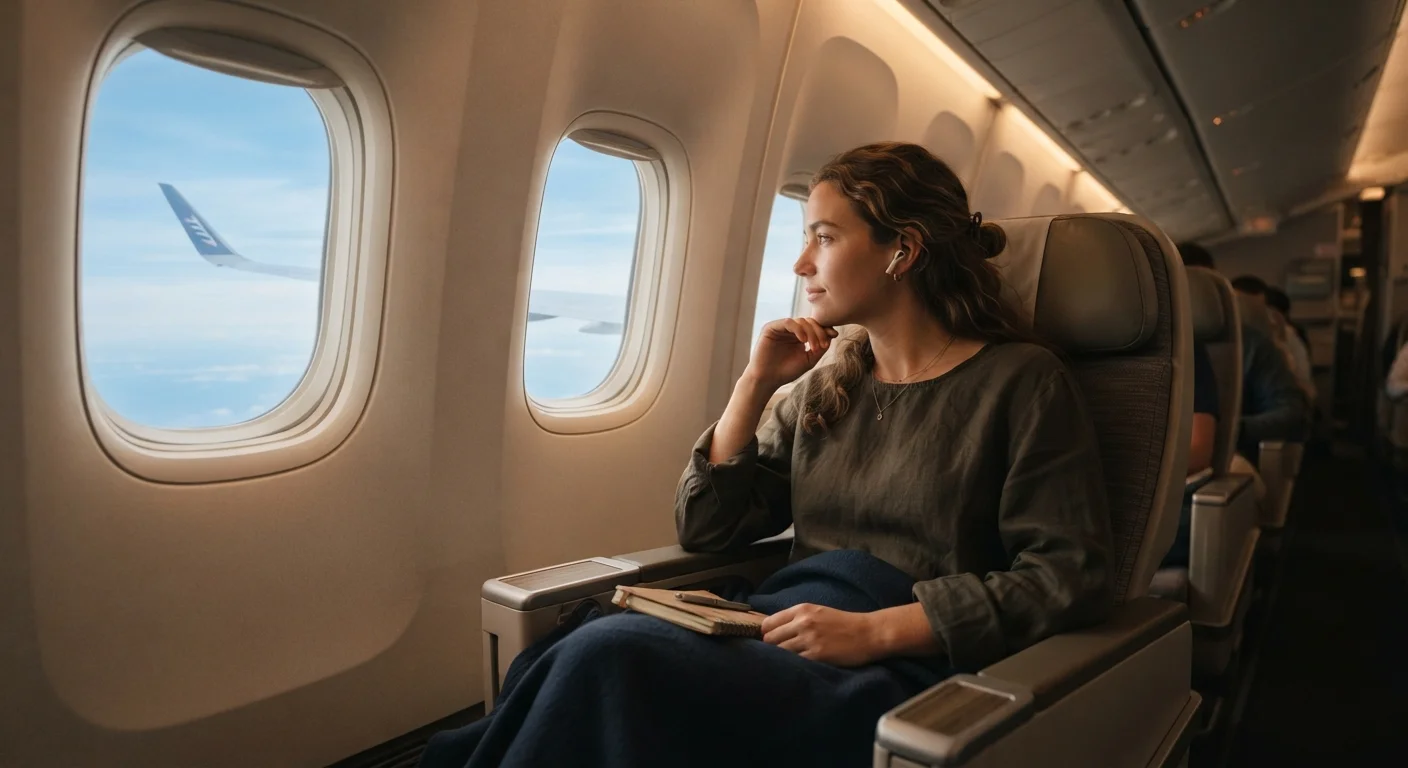
Noise-canceling headphones reduce the ambient roar that keeps the nervous system in a low-grade alert state - one of the most evidence-supported investments a frequent long-haul flyer can make. Paired with an eye mask and strategic seat selection (window seat for a wall to lean against, away from galley noise), rest becomes significantly more attainable.
For a realistic, evidence-informed approach to sleeping without a lie-flat bed, see sleeping on a plane in economy. Sleep strategy and anxiety management overlap more than most travelers realize - a well-rested mind is substantially more resilient to in-flight psychological stress.
Use Noise Cancellation Strategically
Noise-canceling headphones do more than improve audio quality - they reduce the constant low-frequency roar of aircraft engines that keeps your nervous system subtly elevated. Even without playing anything through them, wearing them during rest phases can meaningfully reduce auditory fatigue and anxiety. Consider pairing them with ambient soundscapes or binaural audio designed for relaxation.
This article provides general information for educational purposes and is not a substitute for professional mental health advice. If you experience significant anxiety related to flying, consider speaking with a qualified healthcare professional before your next trip.