
Why Economy Sleep Is Hard - and What You Can Actually Control
Economy and premium economy seats recline between 10 and 40 degrees at best, leaving the body far from the supine position most conducive to sleep. Combined with cabin pressure equivalent to an altitude of roughly 6,000-8,000 feet, lower humidity, unpredictable lighting, and engine noise, the conditions work against the brain's natural sleep architecture. Understanding what you cannot change - seat pitch, cabin crew schedules, fellow passengers - focuses your energy on variables that are genuinely within your control.
The controllable factors fall into three categories: your physical environment (seat, accessories, clothing), your behavioral choices (food, alcohol, screen time), and your mindset (realistic goals, pre-flight preparation). The steps below address each category in sequence. For a broader look at comfort across all aspects of a long flight, the complete in-flight comfort reference covers everything from hydration to mental wellbeing in one consolidated resource.
Calibrate Your Expectations First
Economy sleep will rarely match what you get in a bed. Targeting two to four hours of lighter, broken rest - rather than a full eight-hour block - is more realistic and psychologically easier to manage. Arriving with lower expectations often means less tossing, turning, and frustration, which paradoxically results in better rest.
Before You Board: Planning for Rest
Good in-flight sleep begins well before takeoff. Seat selection, pre-flight rest habits, and packing the right accessories are all decisions that can be made days in advance. Approaching your flight as a sleep environment - one that requires deliberate setup - shifts the outcome significantly compared to boarding unprepared and hoping fatigue carries you through.
What you will need
If you're interested in how sleep is increasingly becoming the primary purpose of travel itself, sleep tourism explores that emerging field. For the practical logistics of securing better seats from the moment you book, flight planning fundamentals can guide your process.
Supportive travel pillow
Keeps your head and neck from dropping forward or sideways, reducing the muscle tension that disrupts sleep.
Sleep eye mask
Blocks cabin lighting and natural light through windows to support melatonin production and sustained sleep.
Earplugs (foam or silicone)
Attenuates engine noise and cabin chatter to reduce sleep-disrupting sound stimulation.
Noise-cancelling headphones
Actively reduces low-frequency engine drone, which earplugs alone may not fully address.
Compression socks
Supports healthy circulation during prolonged seated immobility, reducing discomfort that can interrupt sleep.
Light blanket or travel wrap
Provides warmth as cabin temperature drops during cruise altitude, a common cause of mid-flight waking.
Choose your seat strategically before you board
Your seat assignment is the single biggest factor you control before stepping onto the plane. A window seat gives you a wall to lean against and lets you control whether the shade is open - critical for blocking light during overnight flights. It also means you won't be disturbed by seatmates needing to pass. The trade-off is that reaching the aisle requires climbing over others. See the full comfort analysis for how to weigh this against your specific sleep style.
Avoid seats directly in front of exit rows (often non-reclining), near galley areas, and in the last row - all are associated with higher noise levels and restricted recline. For premium economy, bulkhead seats offer extra legroom but eliminate under-seat storage and may expose you to more foot traffic.
Adjust your sleep schedule in the days before the flight
If your flight crosses five or more time zones, shifting your sleep window gradually in the days before departure reduces the abruptness of the adjustment. Moving bedtime 30-60 minutes earlier or later each day - depending on whether you're traveling east or west - helps prime your circadian rhythm. This isn't a cure for jet lag, but it can lower the barrier to falling asleep at the right point mid-flight.
On the day of travel, aim to be well-rested before you board rather than sleep-deprived. The intuition that exhaustion guarantees in-flight sleep often backfires: overtired travelers frequently experience more fragmented, lower-quality rest.
Manage food, alcohol, and caffeine intake thoughtfully
Cabin pressure lowers the effective partial pressure of oxygen, which already stresses the body mildly. Adding alcohol amplifies dehydration and disrupts sleep architecture - specifically the restorative deeper stages - making post-drink sleep lighter and less refreshing. Limiting or skipping alcohol before and during your sleep window is one of the most evidence-supported adjustments you can make.
Similarly, avoid heavy, high-fat meals within two to three hours of your intended sleep period. Caffeine has a half-life of roughly five to six hours in most adults, so a coffee consumed mid-afternoon before an evening departure may still be active when you try to sleep. Prioritize water throughout the flight to counter the low-humidity cabin environment.
Set up your sleep environment once cruising altitude is reached
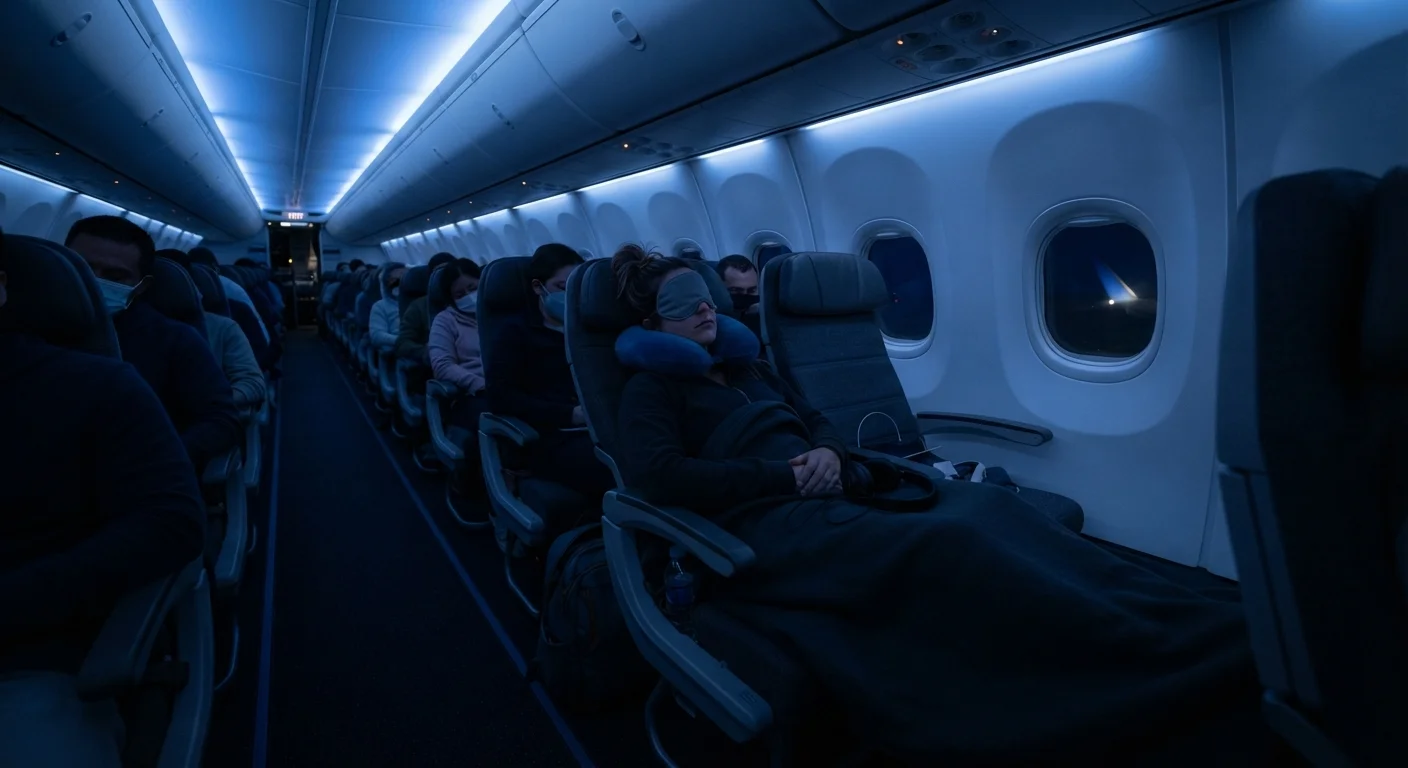
Once the seatbelt sign is off and the crew has completed the initial service, treat the transition like a bedtime ritual. Put on your eye mask and noise-cancelling headphones or earplugs, recline your seat to its full - if modest - extent, and position your travel pillow so your head has lateral support. Stow your tray table and ensure nothing is pressing against your legs or torso.
Dress in layers you can adjust: cabin temperature typically drops during the cruise phase and fluctuates based on aircraft type and occupancy. A light travel blanket or large scarf adds warmth without bulk. Matching your pillow type to your natural sleep position makes a meaningful difference in how long you can sustain comfort.
Use light and sound control to protect your sleep window
Cabin lighting is the most unpredictable disruption source. Even with an eye mask, bright overhead lights activated by nearby passengers can break sleep. Closing your window shade blocks natural light, which shifts rapidly on flights crossing multiple time zones. If you're sensitive to ambient light, a contoured mask that doesn't press flat against your eyelids is more comfortable for extended wear.
For sound, the continuous low-frequency hum of jet engines is surprisingly tiring. Noise-cancelling headphones address this more effectively than foam earplugs alone. Comparing noise-cancelling headphones with earplugs in depth can help you decide which investment is right for your travel frequency.
Move and stretch at intervals to prevent discomfort from interrupting sleep
Prolonged immobility increases lower-back stiffness and leg discomfort - both common causes of waking. Plan to stand and walk briefly every 90 minutes to two hours during long sleep attempts, timing these movement breaks between sleep cycles rather than mid-sleep. Gentle seated stretches - ankle rolls, calf raises, shoulder rolls - can be performed without leaving your seat or disturbing neighbors. Discreet in-flight stretches are covered in detail in a dedicated guide.
Wearing compression socks during the flight supports venous return from the lower legs, which may reduce the heaviness and achiness that interrupts sleep. For evidence on circulation risk during long-haul travel, see what the research actually shows.
Managing Mental Stress That Disrupts In-Flight Sleep
Physical discomfort isn't the only obstacle. Anxiety about the flight itself, restlessness from confinement, or an overactive mind after screen time can prevent sleep onset even when the physical environment is well-configured. Dimming screen brightness and switching devices to night mode at least 30 minutes before your sleep attempt reduces blue-light exposure, which research links to delayed melatonin onset.
Breathing exercises - slow, diaphragmatic breaths with extended exhales - activate the parasympathetic nervous system and can lower arousal levels without any equipment. If psychological aspects of long flights are a persistent challenge for you, managing anxiety and mental wellbeing mid-flight offers structured, evidence-informed approaches.
Sleep Aids Require Medical Guidance
Over-the-counter antihistamine-based sleep aids and prescription sleep medications behave differently at altitude and in combination with other factors like dehydration or alcohol. Never begin using a sleep aid for flights without discussing it with a qualified healthcare provider. This article provides general information only and is not medical advice.
Always Keep Your Seatbelt Accessible
Aviation safety guidelines recommend keeping your seatbelt fastened and visible over your blanket while seated, even when sleeping. Unexpected turbulence can occur without warning and without time for a seatbelt sign to illuminate. Follow all crew instructions throughout the flight regardless of your sleep state.
This article is for general informational purposes only and does not constitute medical advice. Consult a qualified healthcare professional before making any health-related decisions, including the use of sleep aids or any changes to medication.