
Why Movement Matters More Than You Think at Altitude
Sitting still for six, ten, or fourteen hours in a pressurized cabin does measurable things to your body. Blood pools in the lower limbs, hip flexors shorten, thoracic muscles tighten, and the low humidity accelerates dehydration - all of which compound fatigue. For a deeper look at how cabin air affects your physiology, see why cabin air is so dehydrating and what actually helps.
The good news is that you don't need an aisle, extra space, or any equipment to counteract most of this. The stretches below are designed for the physical constraints of a standard economy seat - discreet enough that no one notices, effective enough that your body will feel the difference on arrival. Aim to cycle through a few of them every 60 to 90 minutes rather than saving everything for one block at the end of a long leg.
A Note on Medical Conditions and Long-Haul Travel
Passengers with a history of deep vein thrombosis, varicose veins, recent surgery, or other circulatory or musculoskeletal conditions should consult a qualified healthcare professional before undertaking long-haul flights. The movements described here are general wellness strategies for healthy adult travelers and are not medical advice or treatment.
For a broader picture of how long-haul flight affects circulation specifically, including when discomfort may warrant medical attention, the article Circulation, Clots, and Long-Haul Flights provides an evidence-grounded overview. This article covers general movement strategies for healthy adult travelers and is not a substitute for medical advice.
Ankle Circles and Pumps
Lift one foot slightly off the floor and rotate the ankle slowly - ten rotations clockwise, ten counterclockwise - then switch feet. Follow with ankle pumps: flex the foot upward toward the shin, hold briefly, then point the toes down. Repeat 15 to 20 times per foot.
These movements activate the calf-muscle pump, which assists venous return from the lower leg. They are invisible to anyone not looking directly at your feet and require no change in sitting posture.
Ankle pumps activate the calf-muscle pump without requiring you to leave your seat.
Seated Knee Lifts
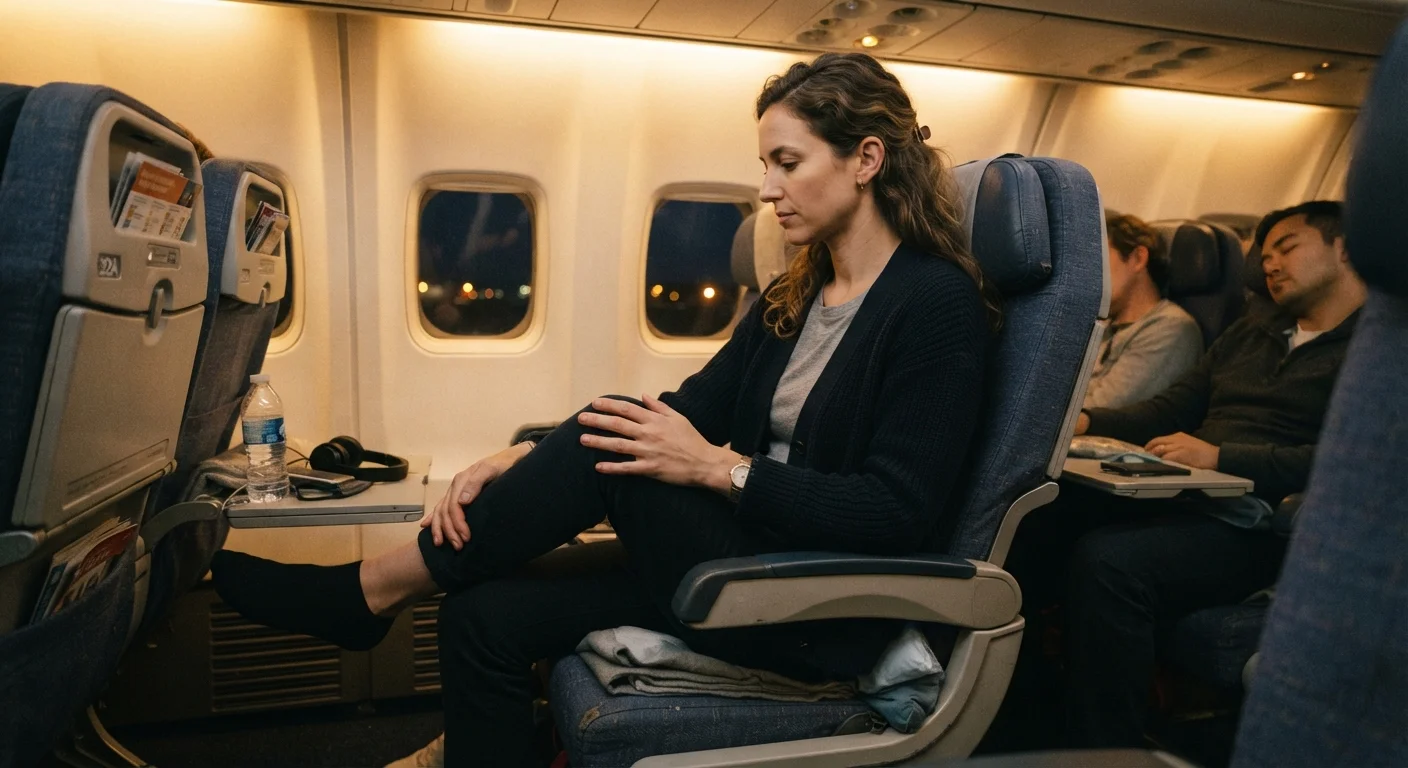
With your back against the seat, slowly lift one knee toward your chest, hold for three to five seconds, then lower it. Alternate legs for ten repetitions each. If the seat pitch is tight, a slight forward lean from the hips - rather than rounding your lower back - gives your knee the clearance it needs.
This engages the hip flexors and glutes in a small active range of motion, countering the shortening that happens when those muscles stay in a fixed position for hours.
Alternating knee lifts counter hip-flexor shortening that accumulates over hours of sitting.
Seated Spinal Twist
Sit upright with both feet flat on the floor. Place your right hand on your left knee and your left hand on the armrest or seat back. Exhale and rotate your torso gently to the left, keeping your hips squared forward. Hold for 20 to 30 seconds, then repeat on the opposite side.
This addresses thoracic stiffness - the mid-back tightness that builds when you are locked into the same forward-facing position. Keep the movement slow and pain-free; if you feel sharp discomfort, ease out of the twist immediately.
A slow spinal twist relieves thoracic stiffness without requiring any extra space around you.
Shoulder Rolls and Chest Opener
Roll your shoulders backward in large, slow circles - five repetitions - then reverse direction. Follow with a simple chest opener: interlace your fingers behind your head (or simply draw your shoulder blades together), lift your chest slightly, and hold for ten seconds. This works well between episodes of a film or whenever you notice your upper back rounding.
Prolonged use of a headrest and in-seat screen tends to push the head forward and the shoulders inward. These two movements partially offset that pattern without requiring any visible effort.
Shoulder rolls and a chest opener counteract the forward-head posture that screens reinforce.
Neck Side Stretch
Drop your right ear toward your right shoulder until you feel a gentle pull along the left side of the neck. Hold for 20 to 30 seconds. Return to center, then repeat on the left side. You can add a light assist by placing one hand on the opposite temple - apply only gentle pressure.
Avoid full neck circles, which can compress cervical structures in some individuals. The side stretch covers the muscles most likely to tighten from sleeping against a window or holding a fixed viewing angle. It is subtle enough to perform mid-conversation without drawing attention.
A lateral neck stretch is the quietest way to address the stiffness that builds from fixed head positions.
Standing Calf Raise at the Galley
When a natural break arises - a bathroom visit, a stretch between meal services - step to an open section near the galley, place your fingertips lightly on a stable surface for balance, and rise up onto the balls of both feet, hold for two seconds, then lower. Ten to fifteen repetitions is enough.
This is the one movement that benefits from standing, so reserve it for moments when the aisle is naturally clear. It is considerably more effective for calf activation than the seated version and takes under a minute. Avoid lingering in the aisle or leaning against crew workstations.
A brief standing calf raise at the galley is the most effective lower-leg movement available on any flight.
Putting It All Together Mid-Flight
The simplest system is a loose rotation: start at the feet, work upward through calves and knees, address the hips and spine, then finish with the neck and shoulders. The full circuit takes under five minutes seated. If you have the aisle seat - which offers genuine movement advantages explored in Aisle Seat vs. Window Seat - you can supplement seated work with a brief standing calf raise against the galley wall on longer hauls.
Build a Simple Mid-Flight Routine
Set a quiet phone reminder every 75 minutes as a movement prompt. Cycling through just three or four of these exercises per interval - ankles, knees, spine, shoulders - takes under four minutes and adds up significantly over a ten-hour flight. Pairing movement with hydration stops makes the habit easier to sustain.
Pair seated exercises with the rest and sleep strategies in Sleeping on a Plane: A Realistic Approach for Non-Lie-Flat Seats to build a coherent in-flight wellness routine. A complete reference covering seating, hydration, and comfort is also available in In-Flight Comfort From Takeoff to Landing.
Passengers with known circulatory, joint, or musculoskeletal conditions should discuss long-haul travel protocols with a qualified healthcare professional before flying. These movements are general wellness strategies for healthy adults, not medical treatment.