
Why Stay Format Is Part of the Journey
The room you sleep in shapes how you experience a destination. Not just in comfort terms, but in the rhythms of daily life it exposes you to - the breakfast ritual, the courtyard light at a particular hour, the sound of rain on a centuries-old roof. For experienced travelers, accommodation itself has become a lens through which a place reveals itself.
The formats below span continents and construction traditions. Some descend from aristocratic or merchant housing; others emerged from nomadic or agricultural life. All of them offer something the standard hotel room cannot: a sense of being inside local history rather than adjacent to it. For a broader framework on what distinguishes character-led stays from chain properties, see our comparison of boutique and international chain stays.
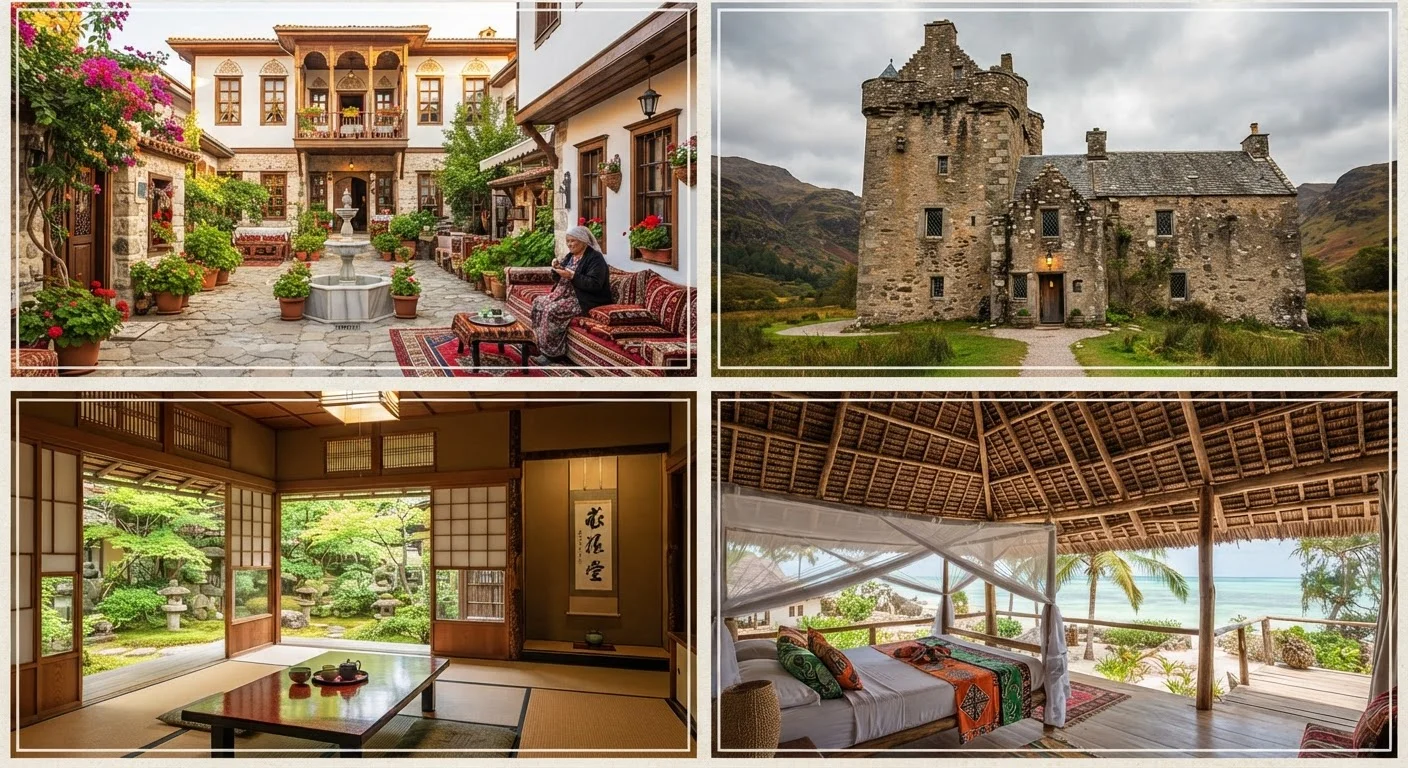
Turkish Konak (Ottoman Mansion)
The konak is the Ottoman-era urban mansion, built around a central hall called the sofa that functioned as the primary gathering space for the household. Typically two or three stories, with overhanging upper floors that shade the street below, these structures were designed to balance private family life with gracious reception of guests - a duality still felt in converted konak guesthouses today.
Common in cities like Safranbolu, Gaziantep, and parts of Istanbul's older districts, restored konaks tend to offer carved wooden ceilings, bay windows fitted with low cushioned seating, and a quiet interior courtyard. The spatial experience is deeply domestic in the best sense: generous but intimate, ornate without being impersonal. Guests staying in konak properties often report that the building itself becomes the point of interest.
The konak's central sofa hall was designed for hospitality - a quality that survives into its modern accommodation use.
Japanese Ryokan (Traditional Inn)
The ryokan is perhaps the world's most thoroughly codified accommodation tradition. Every element - the tatami mat flooring, the futon bedding laid out by staff each evening, the kaiseki multi-course dinner, the communal or private onsen (hot spring bath) - follows a considered sequence designed around the guest's restoration.
What makes a ryokan experience distinct is that the format asks something of the guest, too: removing shoes at the entrance, wearing the provided yukata robe, adhering to meal times, and engaging with the okami (the inn's lead host) with appropriate formality. For travelers accustomed to hotel anonymity, this can initially feel structured - and that structure is precisely the point. The ryokan traditions offer lessons in guest etiquette across cultural contexts that extend well beyond Japan.
A ryokan asks participation from the guest - and that reciprocity is what makes the experience irreplaceable.
Scottish Tower House
The Scottish tower house emerged from the medieval and early modern period as a defensible yet livable form of domestic architecture - tall, narrow, built in stone, with rooms stacked vertically rather than spread laterally. Hundreds survive across the Scottish Highlands and Borders, many still privately owned. A smaller number operate as self-catering or B&B accommodations.
Staying in a tower house is a tactile encounter with the weight of Scottish history: thick walls that retain cool in summer and warmth in winter, turnpike (spiral) staircases worn smooth by centuries of use, windows that frame views across moorland or sea. The footprint is usually modest - these are not grand estate houses - but the vertical drama and material honesty of the architecture make them memorable. Travelers interested in how heritage architecture becomes accommodation will find related context in our piece on heritage properties versus new-build boutiques.
A tower house compresses centuries of Scottish domestic life into a vertical sequence of stone rooms that no replica could approximate.
East African Banda (Thatched Cottage)
Across Kenya, Tanzania, and Uganda, the banda refers to a simple standalone sleeping structure - typically circular or rectangular, built with local timber and topped with a deep thatched roof that insulates against both heat and rain. In safari and wilderness contexts, bandas are usually arranged in small clusters on private conservancies or near national park boundaries.
The format privileges connection to landscape over interior luxury. Mesh-screened open walls or wide shuttered windows mean the sounds, smells, and morning light of the surrounding ecosystem arrive unfiltered. Amenities vary considerably: some bandas offer ensuite bathrooms and solar electricity; others share central facilities and function by lantern light. The degree of rusticity is worth researching ahead of booking, particularly for travelers with specific accessibility or comfort requirements.
The banda's open, porous design makes the surrounding wilderness a genuine part of the accommodation - not just a view.
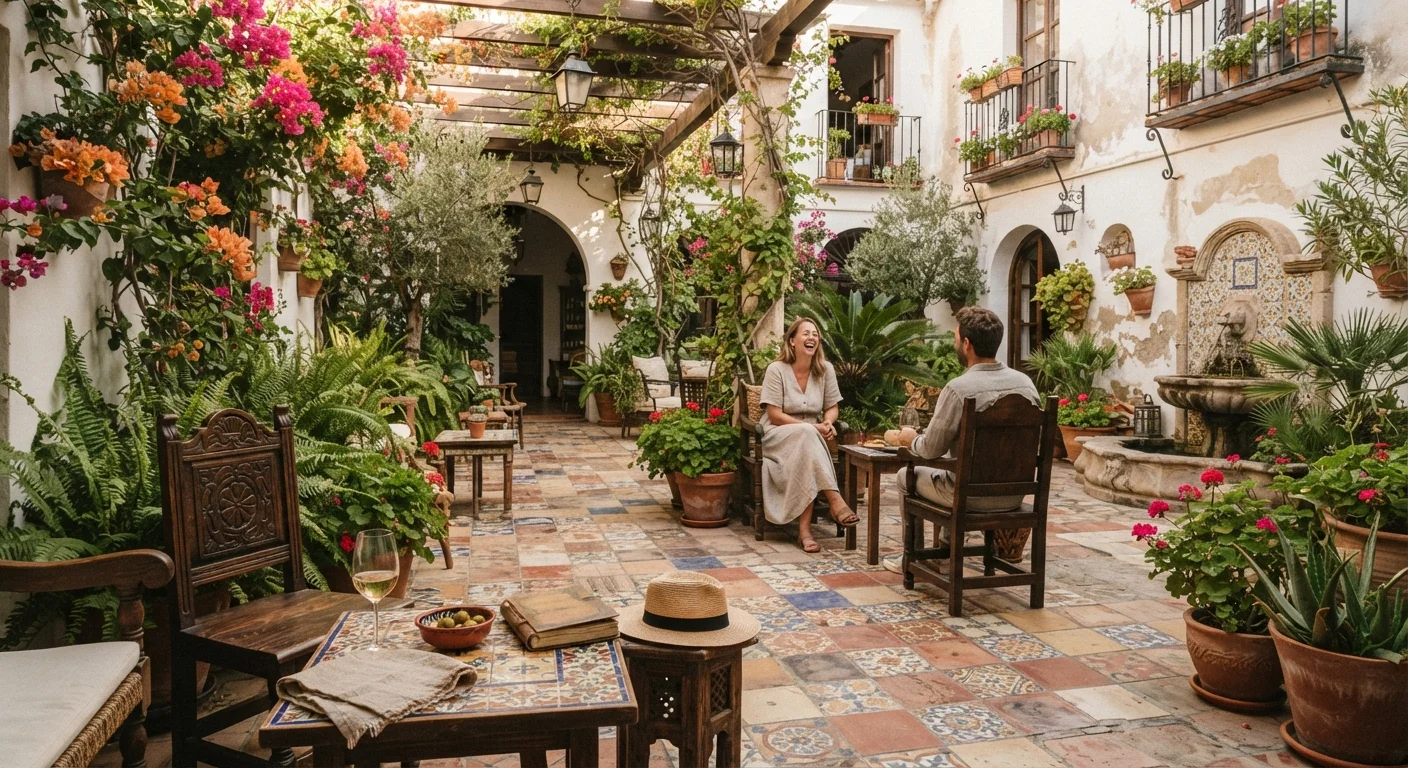
Moroccan Riad (Inward-Facing Courtyard House)
The riad is defined by its inward orientation: a blank or near-blank exterior wall concealing an interior life organized around a central courtyard, often with a fountain or garden. Originating in North African and Andalusian architectural traditions, the layout reflects both the privacy values of traditional domestic life and a sophisticated approach to natural ventilation in a hot, dry climate.
Converted riads - particularly concentrated in the medinas of Marrakech, Fez, and Essaouira - range from modest family guesthouses to elaborately restored mansions with zellige tilework, carved plaster (stucco), and cedar-wood ceilings. The experience of navigating the medina's unmarked lanes to find your riad's unremarkable door, then stepping into a light-filled courtyard, is itself a form of arrival that no street-facing hotel can replicate. The spatial storytelling at work connects to ideas explored in how boutique hotels use architecture to create atmosphere.
The riad's blank exterior is deliberate - the entire experience hinges on crossing the threshold into a hidden interior world.
Norwegian Rorbu (Fisherman's Cabin)
The rorbu is a working fisherman's cabin, historically built on stilts over the water's edge to give crews immediate access to the sea during the cod season. Originating along the Norwegian coast - particularly in the Lofoten archipelago - these red-painted timber structures were functional, spare, and close to the elements by design.
Contemporary rorbuer (the plural form) have been adapted for tourism without losing their essential character: the proximity to the sea, the maritime materiality of weathered timber and corrugated metal, and the dramatic Arctic or sub-Arctic landscape as an immediate backdrop. Some operate as self-catering units; others include services. The experience of waking to water on three sides, with mountains rising directly from the fjord, is specific to this format and this landscape - and it's one that has drawn a growing number of travelers away from more conventional Norwegian hotel options. Those considering extended stays in atmospheric properties may find useful context in our guide to what changes during long-term hotel stays.
A rorbu places you over the water, not merely beside it - a distinction that defines the entire sensory experience.
Finding and Evaluating These Stays
Distinctive stay formats are rarely found through the same search habits that surface familiar chain hotels. Local heritage tourism boards, specialist booking platforms focused on traditional properties, and destination-specific guesthouses often require more research - but that effort is part of the process. Look for properties that can speak to their building's history, staff their operation with local knowledge, and maintain authentic fabric rather than cosmetically restored interiors.
Ask About the Building's History Directly
When inquiring about a distinctive stay format, ask the property how they acquired and restored the structure, what original fabric has been retained, and what aspects of the traditional format they've preserved in daily operations. Properties with genuine depth in these answers are usually the ones worth booking. Those that deflect or give vague marketing responses may be trading on aesthetic rather than authenticity.
It's also worth factoring in the realities each format presents: tower houses may have narrow staircases; ryokans often require floor sleeping; bandas in remote locations may have limited climate control. These aren't flaws - they're features of the format - but knowing them in advance helps you choose wisely. Our complete guide to boutique and unique stays covers the practical side of finding, vetting, and making the most of distinctive accommodations globally.
Travel conditions, property operations, visa requirements, and local regulations change. Always verify entry requirements and safety considerations with official government sources before travel. Accessibility and seasonal availability vary by property - contact accommodations directly for current details.