
Why Mustang Still Demands a Restricted Area Permit
Nepal opened most of its trekking routes to independent travelers decades ago, but Upper Mustang - the former Kingdom of Lo - remains firmly behind a bureaucratic gate. To enter beyond Kagbeni, travelers must hold a Restricted Area Permit (RAP) issued by Nepal's Department of Immigration, currently priced at roughly $500 USD per person for the first ten days, with additional fees for extended stays. This isn't an administrative quirk; it's a deliberate policy rooted in both geopolitical sensitivity and cultural preservation.
The region shares a long, porous border with Tibet, and Nepal has historically controlled access here in coordination with its relationship with China. That political geography shapes everything from permit costs to the requirement that every visitor be accompanied by a licensed Nepali guide registered with an authorized trekking agency. There is no legal pathway for solo, unguided exploration.
The permit system has had a measurable effect on visitor numbers. Where Annapurna Circuit teahouses now fill with hundreds of trekkers daily during peak season, Lo Manthang receives only a few thousand visitors annually - a figure that, while growing, still makes encounters here feel genuinely intimate. For the frequent traveler who has already navigated Bhutan's restricted eastern dzongkhags, Upper Mustang will feel like a natural next step in high-altitude restricted travel.
Permit Costs and Rules Are Subject to Change
The Restricted Area Permit fee structure for Upper Mustang has been revised multiple times in recent years. Always verify the current fee, processing timeline, and accompanying documentation requirements directly with Nepal's Department of Immigration or a licensed trekking agency registered with the Nepal Tourism Board before booking flights or making non-refundable commitments. Do not rely on third-party websites for permit fees, as they are frequently out of date.
The Landscape: Canyons, Wind, and Tibetan Rain Shadow
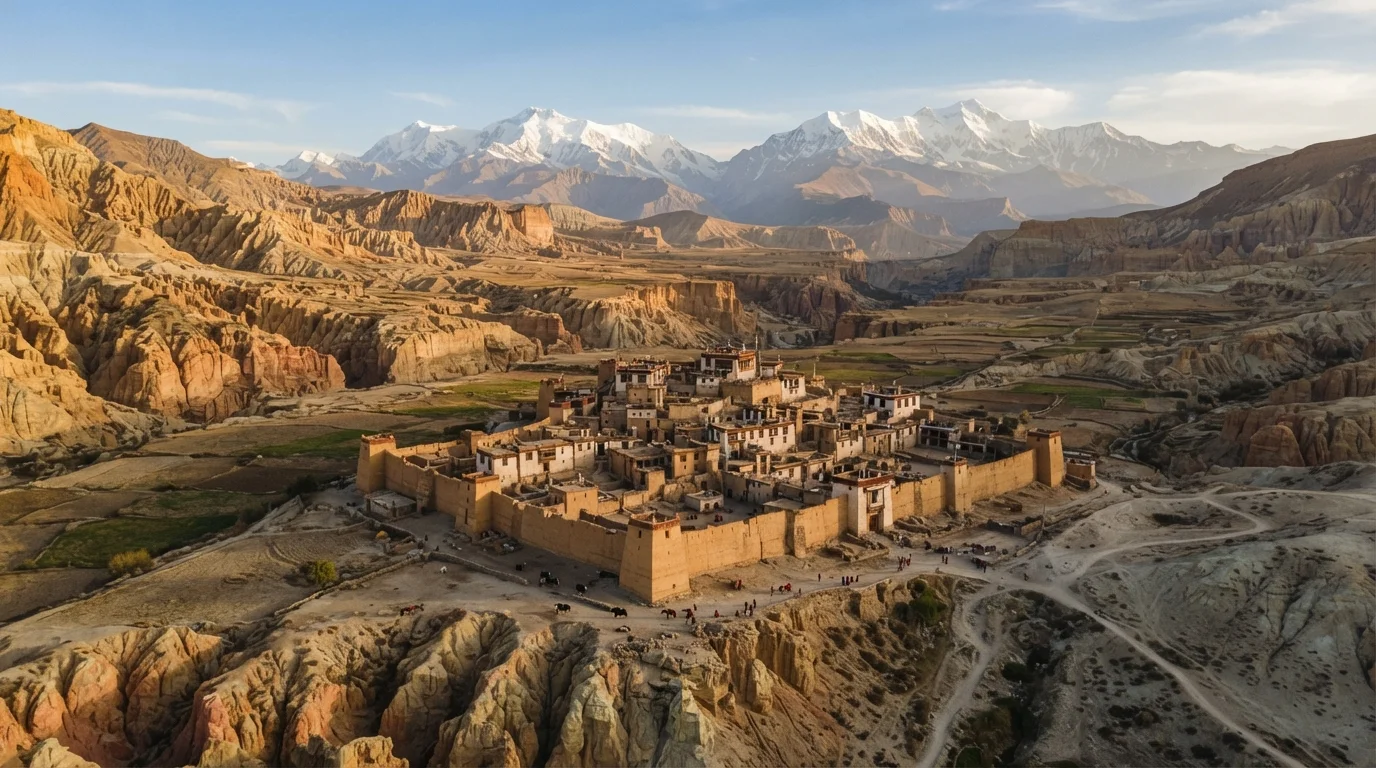
Upper Mustang sits in the rain shadow of the Annapurna and Dhaulagiri massifs, which means that while the monsoon drowns the rest of Nepal from June through August, Lo remains largely dry and hikeable. The landscape that results is not the lush green Nepal of popular imagination - it is Mars-like: wind-sculpted gullies in shades of rust, ochre, and deep violet, punctuated by improbably green irrigated fields wherever meltwater streams allow. Mani walls - long lines of stones carved with Buddhist prayers - border nearly every trail.
The Kali Gandaki gorge, one of the deepest in the world, forms the southern gateway. Trekkers ascend through Kagbeni and into progressively starker terrain, passing the eroded cliff dwellings of Chhoser and the whitewashed villages of Ghami and Tsarang before reaching Lo Manthang at roughly 3,840 meters. The wind here is not a weather event - it is a permanent condition, typically strengthening to near-gale force by early afternoon. Experienced trekkers plan their most exposed walking for mornings.
3,840 m
Elevation of Lo Manthang
Lo Manthang sits at approximately 3,840 meters above sea level, requiring careful acclimatization from all visitors.
~$500 USD
Restricted Area Permit cost (10 days)
Nepal's Department of Immigration charges approximately $500 USD per person for the first ten days in Upper Mustang; fees are subject to revision.
15th century
Age of Lo Manthang's founding
Historical accounts place the founding of Lo Manthang and its original palace complex in the mid-15th century under the Kingdom of Lo.
The comparison that comes to mind most often among trekkers who've also done Central Asia is the Wakhan Corridor - similarly remote, similarly windswept. Our full assessment of that terrain is in Trekking the Wakhan Corridor.
Lo Manthang: Life Inside the Walled City
The walled city of Lo Manthang is compact - perhaps 200 households - and its four-story palace, multiple gompas (monasteries), and labyrinthine alleys have changed little in external appearance since the 15th century. The Raja of Lo, though his kingdom was formally abolished in 2008 when Nepal became a republic, still maintains a presence here, and his family's palace anchors the city's northeastern corner. Locals practice a form of Tibetan Buddhism that predates many of the traditions currently upheld in Tibet itself, making Lo Manthang a living archive of a culture that was severely disrupted across the border during the 20th century.
The Thubchen and Jampa lhakhangs (temples) contain some of the finest 15th-century murals in the Himalayan world. Restoration work - carried out collaboratively by local caretakers and international conservation teams - has been ongoing for years, and much of it is still in process. Photography inside the monasteries is typically restricted or requires a donation; follow the guidance of your licensed guide and posted signs rather than assuming permission.
Arrange monastery visits through your guide rather than arriving independently - many gompas in Lo Manthang have specific opening hours and caretakers who must be present, and unannounced visits are often turned away.
Restricted access to sacred spaces is both a logistical and cultural reality; working with a guide who has existing relationships with monastery caretakers is the only reliable way to gain meaningful access.
Carry a substantial supply of Nepali rupees in small denominations before leaving Jomsom - ATMs do not exist in Upper Mustang, and many guesthouses cannot process card payments.
Financial infrastructure in Upper Mustang remains extremely limited; travelers who arrive cash-light find themselves constrained in both spending and tipping, which directly affects local hosts.
If your itinerary includes the Tiji Festival in May, book your guide, permits, and guesthouse space at least four to five months in advance - this is the single highest-demand period in the region's calendar.
Lo Manthang's limited accommodation capacity means that festival-period availability is genuinely finite; late bookings routinely result in significantly inferior lodging or logistical complications.
The Tiji Festival, held annually in Lo Manthang over three days in May, is among the most visually and ritually complete Buddhist festivals in Nepal. Unlike many regional festivals that have adapted for outside audiences, Tiji remains primarily a community event with deep ritual stakes for local participants. Attendance as an observer is welcome but demands a corresponding level of respect.
The Road Question: What Infrastructure Is Changing
The most consequential shift underway in Upper Mustang is not cultural drift - it's gravel and asphalt. A road now connects Jomsom, the district hub accessible by daily flights from Pokhara, to Lo Manthang. For most of the route it remains rough, seasonal, and subject to landslides, but vehicles do reach the walled city. Local residents - many of whom spent generations carrying goods by mule - are largely in favor: the road has reduced the cost of basic supplies, improved medical access, and kept young people from leaving as quickly.
For travelers, the implications are more ambiguous. The classic 10-to-14-day circuit trek that once represented the only way in is now supplemented by jeep-based itineraries that compress the journey to three or four days. These shorter visits may suit some travelers, but they miss the gradual acclimation to altitude, the incremental encounter with changing terrain, and the kind of unhurried conversation with local tea-house hosts that slow travel enables. The parallels to what road access has done to other remote Himalayan destinations are hard to ignore - and they echo the pressures documented in communities along the Mekong's smaller river routes.
Jeep Access Doesn't Eliminate Altitude Risk
Travelers arriving in Lo Manthang by vehicle rather than on foot skip the gradual acclimatization that trekking provides. Acute mountain sickness (AMS) and, in serious cases, high-altitude pulmonary or cerebral edema can affect anyone, regardless of fitness. If you are considering a vehicle-based itinerary, discuss a dedicated acclimatization schedule with your guide and a physician before departure. Evacuation from Lo Manthang, while possible by helicopter in good weather, is not guaranteed.
Practical Logistics: Permits, Guides, and Getting There
The standard entry route begins with a flight from Kathmandu to Pokhara, followed by a second domestic flight to Jomsom (Mustang Airport). The Jomsom flight is notoriously weather-dependent - morning departures have the best chance of operating before afternoon winds close the runway. Overland access via Beni and Ghasa exists but adds several days through terrain that is itself demanding.
Permit requirements as of the time of writing include: a Restricted Area Permit (processed through a registered trekking agency, not independently), a standard Annapurna Conservation Area Permit (ACAP), and a TIMS card (Trekkers' Information Management System). Because regulations and fees do change, verify all current requirements directly with Nepal's Department of Immigration or through a licensed Nepali trekking agency before finalizing plans.
Book Your Jomsom Flight With Buffer Days
Afternoon winds at Jomsom Airport regularly ground flights, and travelers frequently find themselves stranded in Pokhara for an extra day or two. Build at least two buffer days into the start of your itinerary rather than planning to fly to Jomsom on the same day you need to begin trekking. This is especially important if you have a fixed return flight from Kathmandu.
Altitude acclimatization is not optional. Lo Manthang sits above 3,800 meters, and the approach passes through Kagbeni at roughly 2,800 meters before ascending steadily. Most guides recommend at least one acclimatization day in Kagbeni or Chele. Anyone with a history of altitude sickness should consult a physician familiar with high-altitude medicine before planning this trip - not after arriving in Nepal.
For travelers interested in comparing restricted-access permit destinations, the documented experience of navigating state permits in Myanmar's Kayah and Chin States offers a useful comparative frame, though the logistical details differ significantly.
Where to Stay and How to Travel Responsibly
Accommodation in Upper Mustang is largely limited to family-run guesthouses and small lodges in villages along the trekking route - Kagbeni, Chele, Ghami, Tsarang, and Lo Manthang itself. Standards vary considerably; expect simple rooms, squat toilets in many smaller stops, and solar-heated water where available. Lo Manthang has a small number of lodges that cater specifically to trekking groups, some with better insulation and kitchen facilities than those en route.
Spending at locally owned establishments - rather than pre-purchasing all-inclusive packages that route money outside the region - is one of the most direct ways travelers can support the communities they're visiting. Carry out all non-biodegradable waste; waste management infrastructure in Upper Mustang is minimal, and the volume of packaging and plastic brought in by trekking groups has become a documented environmental concern.
Culturally, Mustang rewards travelers who arrive with some background knowledge of Tibetan Buddhism and local customs. Clockwise circumambulation of mani walls and chortens (stupas) is standard practice; entering a monastery without permission or photographing religious ceremonies without consent is not. The region's communities have navigated centuries of change on their own terms, and the traveler's role here is observer, not protagonist.
For those drawn to the broader world of restricted, high-context cultural destinations in Asia, the highland communities of Nagaland's rarely visited villages offer an entirely different but comparably rare encounter with a living indigenous culture.
Nepal Department of Immigration - Restricted Area Permits
The official source for current permit fees, required documentation, and processing procedures for Upper Mustang and other restricted regions of Nepal.
Annapurna Conservation Area Project (ACAP)
Managed by the National Trust for Nature Conservation, ACAP administers the conservation area permit and provides guidance on environmental responsibilities for trekkers entering the region.
Nepal Tourism Board Trekking Agency Directory
A searchable directory of licensed Nepali trekking agencies authorized to arrange Restricted Area Permits for Upper Mustang, useful for verifying guide credentials before committing.