

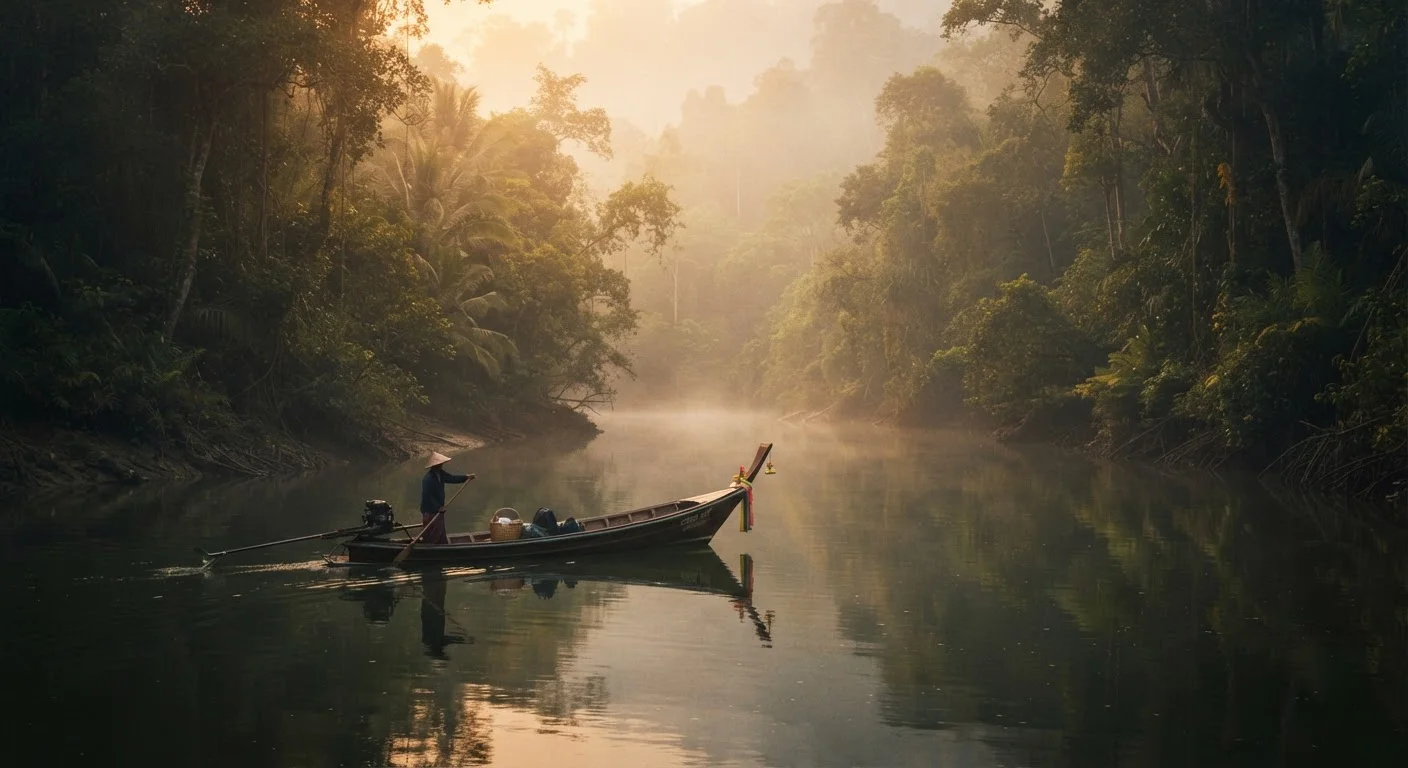
Why the Tributaries, Not the Main River
The Mekong proper has been discovered. The slow boat between Huay Xai and Luang Prabang is a well-worn traveler's rite - scenic, yes, but increasingly crowded with backpackers in transit rather than people genuinely stopping. The tributaries are different. They carry less traffic, fewer expectations, and communities that haven't yet calibrated themselves to tourist logic.
In Laos, rivers like the Nam Ou, Nam Tha, and Nam Ngum cut through forested highlands and Tai minority villages that feel structurally removed from the guesthouse-bar economy of Vang Vieng. In Cambodia, the Stung Sen and Stung Chinit wind through Kampong Thom province's lowland forests past pre-Angkorian ruins that receive a fraction of Siem Reap's visitor numbers. This is what slow, culturally immersive travel actually looks like in practice - not a manifesto, but a boat landing and a family with a spare room.
The tributary approach suits travelers who have already done the circuit - Luang Prabang, Phnom Penh, the temples - and are looking for what lies in the spaces between. If that describes where you are as a traveler, this guide is built for you.
What you will need
Getting Ready: What You Need Before the River
Tributary travel in Laos and Cambodia is not technically difficult, but it rewards preparation in specific ways. The region sits within malaria- and dengue-risk zones; consult a travel medicine specialist several weeks before departure, as some preventive medications require lead time. For the most current health guidance, reference your national government's travel health advisory - in the United States, the CDC's destination pages are a standard starting point.
Visa logistics matter more here than on a straightforward beach holiday. Both Laos and Cambodia offer e-visa options for many nationalities, but entry rules change - verify directly with each country's official immigration or embassy resources, not third-party sites. The philosophy of deliberate slow travel also means resisting the urge to over-schedule: your most useful planning asset is flexibility, not a packed itinerary.
Offline mapping app (e.g., Maps.me or OsmAnd)
Navigate river villages and jungle paths where mobile data coverage is unreliable or absent.
Dry bag or waterproof pack liner
Protect electronics, documents, and clothing during open-boat river travel.
Water purification tablets or portable filter
Ensure access to safe drinking water in remote villages with limited bottled water supply.
Small USD cash reserve
ATMs are absent along most tributaries; cash is the only payment method in rural areas.
Lightweight mosquito net
Guesthouses in remote villages rarely provide nets, and malaria-risk zones exist in parts of this region.
Pack light enough that everything fits in a single bag you can carry onto a longtail boat without assistance. Porters do not exist on remote river tributaries.
The Route in Practice: Following the Steps
Choose your entry tributary and anchor town
Not all tributaries are equal in terms of accessibility. In Laos, the Nam Ou - which flows south through Phongsali and Luang Prabang provinces - remains one of the most rewarding starting points. The market town of Nong Khiaw serves as a practical anchor: it has basic guesthouses, a boat landing, and connections to the thinner arteries beyond. In Cambodia, the Stung Sen river threading through Kampong Thom province offers a quieter corridor into pre-Angkorian temple country, with the town of Kampong Thom itself providing onward logistics.
Decide which country aligns with your timing and visa situation before narrowing down a tributary.
Research seasonal water levels before booking
Tributary travel in this region is season-dependent in ways that standard guidebooks understate. During the wet season (roughly June through October), some smaller rivers become impassable due to flooding and strong currents; others open up to flat-bottomed boats that can't run in the dry months. Dry season - November through February - is generally the most consistent window for tributary navigation, though water can run too shallow on certain stretches by March and April.
Contact local guesthouses or small tour operators in your anchor town directly to ask about current conditions. Their on-the-ground knowledge outpaces any online resource.
Arrange local boat transport - and understand what that means
There are two main options on most tributaries: scheduled public ferries (infrequent, inexpensive, and deeply local) and privately chartered longtail boats (flexible but costlier). On the Nam Ou between Nong Khiaw and Muang Ngoi Neua, a short public ferry still runs most mornings during the dry season. Beyond that, chartered boats become necessary. In Cambodia's interior rivers, motorized wooden canoes are often the only option.
Chartered boats are typically arranged through guesthouse owners, who act as informal fixers and will negotiate on your behalf with boatmen. Agree on the route, stops, and return logistics before departing - and confirm what happens if weather forces a schedule change.
Move through villages on foot and at local pace
The tributaries are corridors, not destinations in themselves. The real texture of this travel comes from stepping off the boat in places like Muang Khua or Hat Sa in Laos, or the riverside Khmer villages near Sambor in Cambodia, and walking without agenda. Morning markets along the riverbanks are active by 5:30 a.m. and largely wrapped up by 7:00 a.m. - attending one gives you a more honest window into local food systems than any curated experience.
Engage with village life respectfully: ask before photographing, follow local dress norms (particularly around temples and community spaces), and buy from local sellers rather than seeking out imported goods.
Stay in family guesthouses rather than established lodges
In tributary villages, the accommodation spectrum is narrow by design. Simple family-run guesthouses - often a handful of rooms above a family's living space - are the norm. They range from a mattress under a mosquito net to surprisingly comfortable fan rooms with cold-water showers. What they offer that no lodge can replicate is proximity: shared meals, family conversations conducted through translation apps, and a morning view from the veranda that belongs entirely to the river.
Book nothing in advance beyond your anchor town. In remote villages, showing up and asking for a room is the standard approach and rarely fails during non-peak periods.
Plan your exit route with the same care as your entry
Getting back out of a tributary corridor requires the same logistical attention as getting in, sometimes more. Public transport frequency drops on return legs, and missing a scheduled boat may mean waiting a full day for the next. Build at least one buffer day before any onward flight or international connection. In northern Laos, buses from Phongsali or Muang Khua connect back toward Luang Prabang but run on irregular schedules that vary by season.
The slower you travel in, the more gracefully you need to plan your way out.
The Best Conversations Happen at the Boat Landing
Arrive at any river landing early - an hour before scheduled departure if one exists. The informal exchange of information between boatmen, traders, and local travelers waiting there will tell you more about current conditions, village access, and what's worth stopping for than any guidebook. A translation app and patience are your best tools.
Travelers who've explored other off-grid corners of Asia - such as Nepal's restricted Upper Mustang region - will recognize a familiar rhythm here: the deeper you go, the more the infrastructure strips back and the more the experience expands. The tributaries operate on the same principle. For travelers more drawn to maritime and port-based exploration, Southeast Asian cruise itineraries that move beyond the gateway cities offer an instructive contrast in what this region looks like from the water at a different pace entirely.
Travel conditions, visa requirements, health advisories, and local regulations along the Mekong tributaries change frequently. Always verify entry requirements and safety conditions with your government's official travel advisory service and consult a qualified travel medicine provider before departing. This article provides general orientation only and does not guarantee the accuracy of conditions at the time of your travel.