
Why the Gateway Cities Are Just the Beginning
Singapore and Bangkok are natural embarkation points - logistically efficient, internationally connected, and well-served by major cruise lines. But treating them as the destination misses the point of cruising Southeast Asia entirely. The region's cultural weight sits further along the itinerary, in smaller ports where infrastructure is less polished and encounters are considerably more genuine.
Southeast Asian cruise routes now span an impressive geographic arc - from the Gulf of Thailand and Vietnam's central coast to the islands of Indonesia and the deep inlets of Myanmar's Mergui Archipelago. For the well-traveled cruiser, the question isn't whether to go, but how to read the route before booking. Exploring off-grid Asia by sea is one of the most efficient ways to reach communities that would take weeks of overland travel to access independently.
Below are six ports that consistently reward closer attention - and the specific reasons each one earns a place on a serious Southeast Asian itinerary.
Mawlamyine, Myanmar - Kipling's City on the Salween
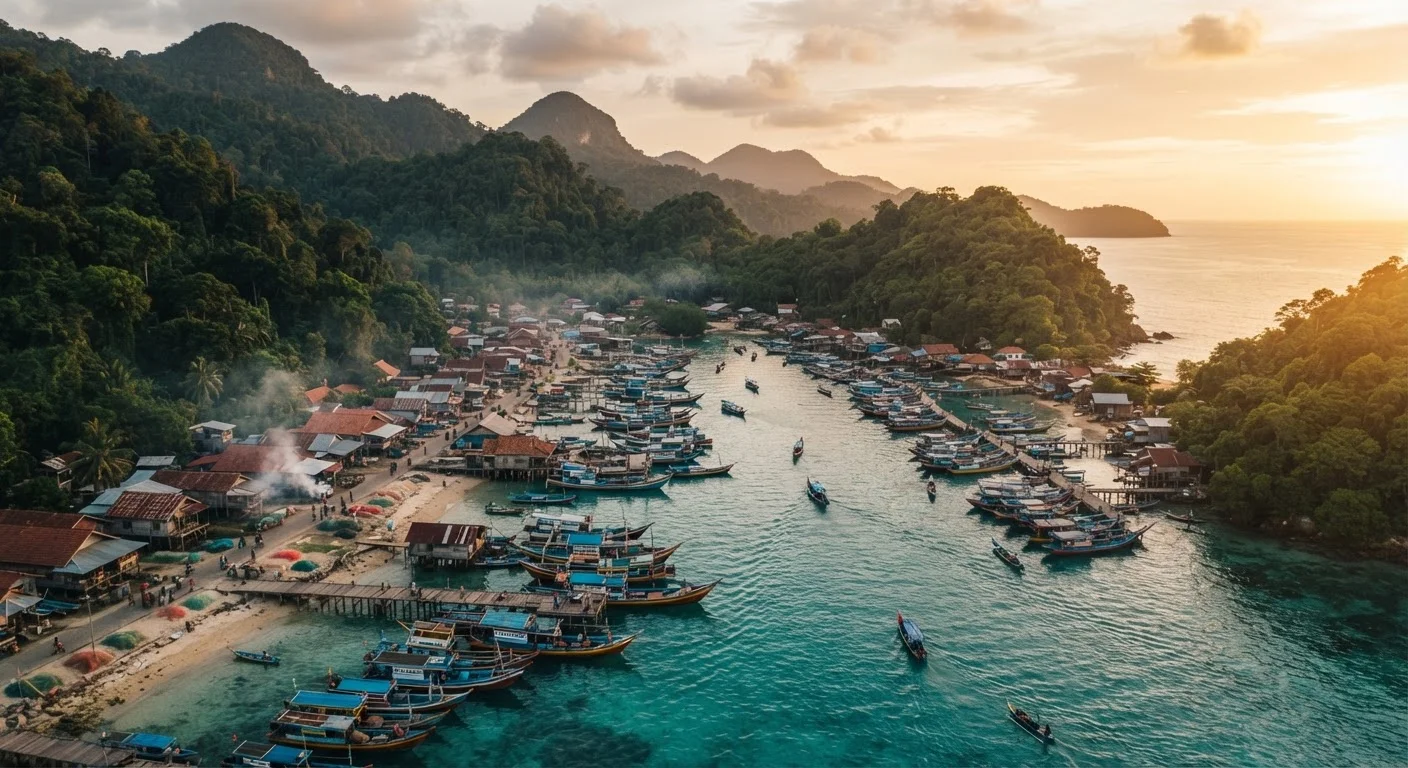
Once romanticized by colonial-era writers, Mawlamyine sits at the mouth of the Salween River and remains one of mainland Southeast Asia's most atmospheric port towns. Its riverside pagoda ridge, Mon cultural heritage, and almost complete absence of mass tourism infrastructure make it a genuinely unusual port call - but one that demands careful due diligence given Myanmar's current political situation. Travelers should consult official government advisories thoroughly before any visit.
Those who do arrive encounter lacquerware workshops, crumbling colonial architecture, and floating market rhythms that have changed little in decades.
Mawlamyine's Mon cultural heritage and riverine setting remain virtually untouched by mass tourism.
Sihanoukville / Koh Rong Archipelago, Cambodia - Reef, Ruin, and River Delta
Cambodia's coastline is too often bypassed in favor of a single bus ride to Angkor Wat. Cruises that anchor off the Koh Rong Archipelago - particularly Koh Rong Samloem - give passengers access to some of the Gulf of Thailand's clearest water and least-developed beaches. Sihanoukville itself has changed substantially in recent years, but tender trips to the outer islands still deliver the isolation and marine biodiversity the area is known for.
The delta region around the port also offers access to floating villages and rice paddies that contextualize rural Cambodian life in ways Phnom Penh cannot.
The Koh Rong Archipelago offers clear water and marine biodiversity that most Cambodia itineraries overlook.
Chan May / Lang Co, Vietnam - The Forgotten Central Corridor
Most Vietnam itineraries concentrate on Ha Long Bay in the north and Ho Chi Minh City in the south. Chan May port, which serves the imperial city of Hue and the ancient trading town of Hoi An, occupies the less-visited middle - and arguably the most historically dense stretch of the Vietnamese coast. The nearby Hai Van Pass separates the climate zones of northern and southern Vietnam and marks a genuine cultural and linguistic boundary.
Hue's royal citadel and elaborate imperial tombs along the Perfume River make this one of the most rewarding shore excursion corridors on any Vietnam itinerary.
Chan May unlocks Hue and Hoi An - Vietnam's most historically layered stretch of coastline.
Benoa, Bali / Celukan Bawang, Indonesia - Into the Indonesian Archipelago
Bali's Benoa port serves as a regional hub, but itineraries that continue east - toward Lombok, Komodo, or the Banda Sea - reveal an Indonesia that most international visitors never reach. Celukan Bawang in northern Bali is a less-developed alternative port that offers quicker access to Bali Barat National Park and the island's quieter Hindu temple circuits.
For travelers whose interests extend to truly remote Indonesian destinations, Indonesia's lesser-known island provinces provide the broader context for what lies beyond the island most itineraries stop at.
Itineraries continuing east from Bali reach Indonesian ecosystems and cultures that mass tourism has barely touched.
Kota Kinabalu, Malaysian Borneo - Rainforest at the Water's Edge
Sabah's capital is one of the few ports in Southeast Asia where a passenger can step off a ship in the morning and be inside one of the world's oldest rainforests - Kinabalu Park - by midday. The Coral Triangle waters immediately offshore are among the most biodiverse marine environments on earth, making KK a dual draw for cultural travelers and naturalists alike.
The city's Filipino-influenced night markets, mixed Chinese-Malay-Kadazan heritage, and proximity to the Kinabatangan River wildlife corridor give it a depth that far exceeds its size on most cruise maps.
Kota Kinabalu offers rare access to both ancient rainforest and Coral Triangle marine environments from a single port.
Phu My / Vung Tau, Vietnam - The Southern Gateway Done Differently
Phu My is the standard gateway to Ho Chi Minh City on most southern Vietnam itineraries. Vung Tau, the alternative tender destination nearby, is a former French colonial resort town with a dramatically different character - hill-top chapels, wide seafront promenades, and a fishing harbor that still defines the local economy. Rather than heading straight to HCMC's urban intensity, a half-day in Vung Tau provides a counterpoint that reframes the region's colonial and maritime history.
The contrast between this quieter coastal town and the sprawling metropolis two hours north is itself one of the more instructive experiences a southern Vietnam port day can offer.
Vung Tau reframes southern Vietnam's colonial and maritime history outside Ho Chi Minh City's urban intensity.
Planning Your Route with Intention
The ports listed above aren't equally accessible on every itinerary, and not all cruise lines call at the smaller or more politically complex destinations. Myanmar's Mawlamyine, for instance, has appeared on niche expedition and cultural sailings but requires additional awareness of current travel advisories - always check your government's official guidance before sailing to destinations with evolving political situations.
Match Your Itinerary to the Monsoon Calendar
Southeast Asia has multiple distinct monsoon seasons that affect different coastlines at different times. Western-facing ports along the Andaman Sea experience heavy weather from May through October, while the South China Sea coast - including Vietnam and the Gulf of Thailand - has its own seasonal patterns. Ask your cruise line specifically which weather windows shape the itinerary dates they offer, and research port conditions independently before committing to a season.
Seasonality also matters considerably in this region. The southwest monsoon affects western-facing ports (including parts of Myanmar and the Andaman coast) between May and October, while the Gulf of Thailand and Vietnamese coast experience their own weather cycles. Responsible itinerary planning accounts for this. For those drawn to slower, inland waterways rather than open-sea itineraries, Mekong river travel offers a fundamentally different pace and cultural lens. And for travelers whose interests extend to Indonesia's outer islands, Indonesia's remote island provinces round out what a multi-leg Southeast Asian journey can look like. By contrast, South American cruise routes illustrate how differently a regional itinerary can be structured when the geography and cultural corridors shift entirely.
Entry requirements, visa rules, health precautions, and port access across Southeast Asia change frequently. Always verify current conditions with your government's official travel advisory service and your cruise line before departure.