
The Indonesia That Awaits Beyond the Postcard
Most travelers who tick Indonesia off their list have visited Bali's rice terraces, Lombok's Rinjani slopes, or perhaps the Komodo National Park. These are magnificent places — but they are, by now, places that know they are being visited. The beaches have signs. The cafés have Instagram corners. The magic, though real, is increasingly curated.
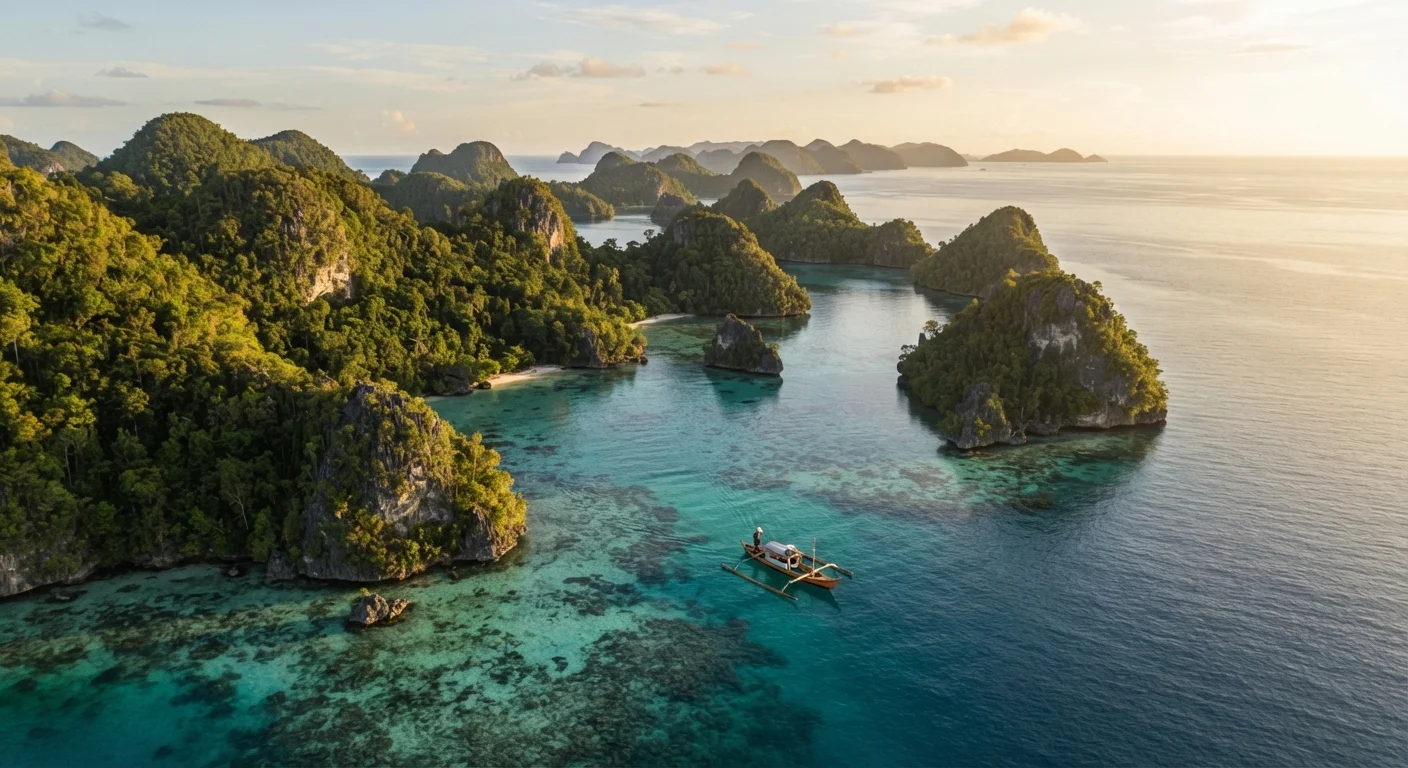
Push further — to the Banda Sea, to the Bird's Head Peninsula, to the wild coasts of Halmahera — and the experience shifts entirely. You encounter people for whom your arrival is not a rehearsed transaction but a genuine curiosity. You find reefs that haven't been touched by anchor drag, forests where the dawn chorus is the only alarm clock, and spice-trade history that sits in stone forts and old Dutch warehouses rather than in museum glass cases. These are Indonesia's outer island provinces: logistically demanding, culturally irreplaceable, and quietly waiting.
Permits and Restricted Areas Vary Widely
Some areas of West Papua and parts of North Maluku require special permits (Surat Izin Masuk Daerah Terbatas) for foreign visitors. Requirements change and are enforced at the discretion of local authorities. Before finalizing any itinerary in these provinces, verify current permit requirements through Indonesia's official immigration and tourism authorities, and cross-check with your home country's foreign affairs travel advisory. This is not a bureaucratic formality — it can determine whether you can legally enter certain districts at all.
Six Island Provinces Worth the Journey
Maluku: The Original Spice Islands
The Banda Islands sit at the center of an arc of small volcanic outcrops in the Banda Sea, and for centuries they were the only source of nutmeg on Earth. That fact shaped empires, wars, and trade routes. Today, Banda Neira's colonial Dutch forts, nutmeg orchards, and labyrinthine reef walls draw a trickle of divers and history travelers. The diving here is genuinely world-class — sheer walls dropping hundreds of meters, schooling fish in numbers that feel prehistoric — and almost entirely uncrowded. Beyond Banda, Ambon hosts some of the most biodiverse muck-diving in the region, known for endemic species found nowhere else. Lesser-known diving destinations share this character: remarkable biodiversity, minimal traffic.
Banda Neira's reef walls and nutmeg history coexist in a place that mass tourism hasn't yet found.
North Sulawesi: Volcanoes, Reefs, and a City with Swagger
Manado is North Sulawesi's capital and a functional gateway — an airport city with genuine character, known for its bold cuisine (the local food is not mild) and proximity to Bunaken Marine National Park. The park's wall diving is legendary among those who know it: vertical coral faces alive with turtles, Napoleon wrasse, and, during the right season, whale sharks. Inland, the Minahasa Highlands offer volcanic crater lakes, traditional Minahasan villages, and a culture shaped by centuries of distinct heritage. Lembeh Strait, a narrow channel north of Bitung, has become quietly famous in diving circles for critter diving — the slow, patient search for tiny, improbably camouflaged creatures on black-sand slopes. North Sulawesi is more accessible than many outer provinces, which makes it a logical first step beyond the obvious.
Lembeh Strait's black-sand critter diving and Bunaken's walls offer two completely different underwater worlds within hours of each other.
West Papua: Raja Ampat's Less-Visited Neighbors
Raja Ampat receives growing attention — deservedly so — but West Papua's coastline extends far beyond its most photographed karst islands. Cenderawasih Bay Marine National Park, reached by liveaboard from Manokwari, is one of the few places on Earth where whale sharks reliably congregate around traditional fishing platforms year-round. The interaction is passive and observer-led, but consistently extraordinary. Farther inland, the Bird's Head Peninsula holds some of the world's least-documented primary forest. Access requires planning, permits for certain restricted areas, and a tolerance for infrastructure that is minimal by any measure — but for travelers who have exhausted easier options, West Papua represents a genuine frontier. Always consult Indonesian government permit requirements and your home country's travel advisory well in advance.
Cenderawasih Bay offers reliable, passive whale shark encounters at traditional fishing platforms with almost no crowd competition.
North Maluku: Halmahera and the Sultan's Legacy
Ternate and Tidore — two small volcanic islands in the North Moluccas — were the pivot point of the entire 16th-century spice trade, contested by Portuguese, Spanish, and Dutch fleets. The physical evidence remains: Ternate's Gamalama volcano looms over Portuguese and Dutch fortifications that are largely intact and rarely visited. Halmahera, the largest island in the group, has both diving on unexplored reef systems and birdwatching terrain where endemic species including the standardwing bird-of-paradise can be sought with local guides. The provincial capital Ternate has regular flights from Manado and Makassar, making North Maluku more reachable than its obscurity suggests. Logistically, it rewards the traveler willing to do modest research before arrival.
Ternate's intact colonial fortifications and endemic bird-of-paradise species coexist in an island few outside diving circles have heard of.
East Nusa Tenggara: The Arc Beyond Flores
Flores gets attention now, mainly as the gateway to Komodo. But East Nusa Tenggara (NTT) stretches east through Sumba, Savu, Rote, and Timor — each island a distinct cultural world. Sumba is known among textile researchers and anthropologists for its ikat weaving tradition, a painstaking process where hand-dyed threads are woven into patterns encoding clan identity and cosmology. Rote, Indonesia's southernmost island, has a surf culture built around a wave called Nemberala that draws a small, dedicated crowd. Savu, reachable by ferry or small aircraft, remains almost entirely off the tourist circuit and offers one of the most intact traditional Austronesian cultures in the region. Accommodation is simple throughout; expectations should be calibrated accordingly.
Sumba's hand-woven ikat textiles encode centuries of cultural memory — and the island's tourism infrastructure remains genuinely small-scale.
South Sulawesi's Outer Reaches: Selayar and the Takabonerate Atoll
Most travelers who reach South Sulawesi go to Makassar and then north to Tana Toraja. Few continue south to Selayar Island or the Takabonerate National Park beyond it. Takabonerate is one of the largest atoll systems in Southeast Asia — a chain of coral islands and submerged reef enclosing lagoons of extraordinary clarity. Access involves a ferry from Benteng on Selayar and then local boat arrangements, and the park's infrastructure is minimal. What you find on the other side of that effort is a marine environment that sees perhaps a few hundred visitors annually. For context and comparison on how remote Indonesian waters fit into broader regional sailing routes, see our overview of Southeast Asian cruise routes and lesser-known ports.
Takabonerate is one of Southeast Asia's largest atoll systems, visited by so few people that its reefs still feel genuinely wild.
Build Time Buffers Into Every Connection
In Indonesia's outer provinces, transport links — regional flights, inter-island ferries, and local speedboats — operate on schedules that weather, tides, and passenger numbers all influence. A missed connection in Ambon or Sorong can mean an unplanned overnight. Treat buffer days not as wasted time but as built-in opportunities to explore the layover town more slowly. Travelers who arrive with rigid itineraries consistently report more frustration than those who plan for flexibility.
Planning Your Route Into Indonesia's Outer Islands
The architecture of a trip to these provinces is what separates them from more casual destinations. Garuda Indonesia and its regional subsidiary Citilink, alongside carriers like Wings Air, connect many outer island capitals — but schedules can be thin and subject to change. Build flexibility into any multi-leg itinerary; a cancelled ferry in Ambon or a delayed prop plane in Sorong can reshape your week.
For travelers interested in exploring Indonesia's outer ports by sea, regional expedition vessels and small-ship sailings do operate through the Banda and Flores seas. Southeast Asian cruise routes increasingly incorporate these waters, offering a practical way to reach multiple archipelagos without reassembling logistics from scratch each time.
Accommodation ranges from family-run penginapan (guesthouses) in Banda Neira's colonial quarter to small eco-lodges on the Triton Bay fringes. Expect limited connectivity, variable electricity, and meals that depend on what the market had that morning — all of which are features, not flaws. Travel conditions, permit requirements, and regional access rules change; always consult official Indonesian government sources and your home country's foreign affairs advisory before finalizing plans.