
What Each Route Actually Covers
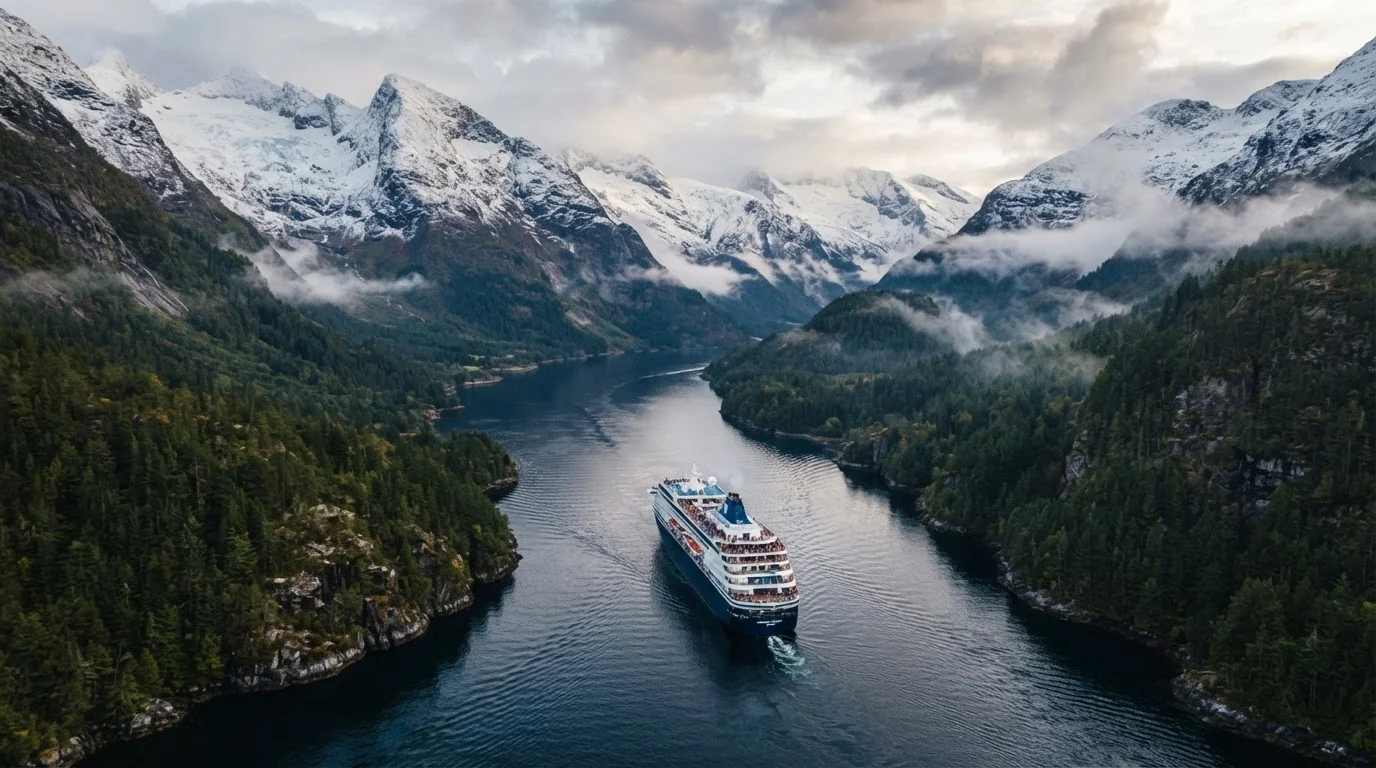
The term Inside Passage refers to a network of sheltered channels, sounds, and straits stretching roughly 1,000 miles from Puget Sound through British Columbia and into Southeast Alaska. Ships navigate between the mainland and a chain of coastal islands - the Alexander Archipelago - which acts as a natural breakwater. Ports of call typically include Ketchikan, Wrangell, Juneau, Haines, and Skagway, with scenic cruising through areas like Glacier Bay National Park, Tracy Arm, and the Misty Fjords.
Open Ocean Alaska routes - often called Gulf of Alaska itineraries - branch away from the sheltered corridor and cross the Gulf of Alaska to reach Southcentral ports such as Seward, Whittier, Valdez, or Kodiak Island. These one-way or "repositioning-style" itineraries typically depart from Vancouver or Seattle and end in Whittier (near Anchorage), or vice versa. Because they traverse open Pacific waters, the maritime experience is markedly different.
Knowing this distinction matters before you book. As we explore in our comparison of expedition versus classic cruising, the vessel type and route shape your entire onboard experience - not just the ports on your itinerary.
| Criterion | Inside Passage | Gulf of Alaska Routes |
|---|---|---|
| Sea conditions | Generally sheltered, calmer waters | Open Pacific; swells common |
| Typical ports | Ketchikan, Juneau, Skagway, Sitka | Seward, Whittier, Valdez, Kodiak |
| Glacier access | Glacier Bay, Tracy Arm, LeConte | Columbia Glacier, Hubbard Glacier |
| Itinerary structure | Round-trip or one-way | Primarily one-way |
| Interior Alaska access | Limited (via Skagway rail) | Strong (Anchorage, Denali packages) |
| Wildlife character | Bears, eagles, humpbacks, orcas | Puffins, sea lions, open-water whales |
| Scenic character | Intimate fjords, forested channels | Open horizons, rugged coastal ranges |
Scenery, Wildlife, and the Rhythm of Each Route
Inside Passage scenery is layered and close. Forested islands press in from both sides, waterfalls tumble off cliff faces, and glaciers appear with regularity. The route rewards slow observation - bald eagles perch on nearly every headland, Steller sea lions haul out on rocks near Petersburg, and humpback whales surface in Frederick Sound with reliable frequency during summer months.
Gulf of Alaska crossings trade intimacy for scale. The horizon opens up, the ocean deepens, and wildlife shifts toward pelagic species: tufted puffins, black-footed albatross, and large pods of Dall's porpoise become more common. On clear days, the snow-streaked Kenai Mountains visible from the Gulf rival anything the Inside Passage offers - but the viewing conditions are less predictable.
~3.3M
Annual Alaska cruise passengers
Alaska is consistently one of the top cruise destinations in North America, drawing millions of passengers each summer season according to industry tracking data.
1,000+ miles
Inside Passage total length
The Inside Passage corridor extends from Puget Sound in Washington State through British Columbia and into Southeast Alaska, spanning multiple marine ecosystems.
~600 miles
Open Gulf crossing distance
The open-water segment of a Gulf of Alaska crossing between Cross Sound and Seward covers approximately 600 miles of exposed Pacific Ocean.
Glacier exposure also differs. The Inside Passage grants access to Glacier Bay - one of the most protected and biodiverse glacier regions on the planet - as well as close-range tidewater glaciers in Tracy Arm Fjord. Gulf routes often include Columbia Glacier near Valdez, which is among the most actively calving glaciers in North America, though access depends heavily on ice conditions and ship size.
Practical Considerations: Sea Conditions, Ports, and Itinerary Structure
Sea conditions are the most immediate practical difference. The Inside Passage's protected waterways rarely produce the sustained ocean swells that the open Gulf can generate. For passengers with motion sensitivity, this is not a minor detail. Gulf crossings - particularly the roughly 600-mile open-water segment between Cross Sound and Seward - can involve 8-to-12-foot swells in unsettled weather, a reality that catches some cruisers off guard.
Port composition shapes what you do on land. Inside Passage ports like Skagway offer rich Gold Rush history via the White Pass & Yukon Route railway. Juneau gives access to Mendenhall Glacier by bus. Gulf-route ports like Seward and Whittier, by contrast, function primarily as embarkation points for land extensions - rail journeys through the Kenai Peninsula or overland packages to Denali and Fairbanks. If exploring Interior Alaska is part of your plan, a Gulf-route itinerary creates a natural framework for it.
Verify Current Glacier Bay Permit Conditions
Access to Glacier Bay National Park is managed under a permit system that limits the number of cruise ships entering on any given day. Not all Alaska itineraries include a Glacier Bay sailing day, and access can vary by operator and season. Confirm Glacier Bay inclusion with your cruise documentation before departure, and check the National Park Service for current vessel permit information.
One-way itineraries running between Vancouver and Whittier - or the reverse - are among the most logistically efficient ways to experience aspects of both routes. They typically transit the Inside Passage for the scenic middle segment while departing or arriving via the Gulf.
For travelers interested in how dramatic coastlines compare across different hemispheres, our look at South American cruise route corridors offers useful contrast - Patagonia's channels share some geographic logic with Southeast Alaska's fjords, even as the ecosystems diverge sharply.