
Why Nagaland Remains Genuinely Off the Map
Nagaland sits in India's far northeast, wedged between Assam, Arunachal Pradesh, and Myanmar - a region that, even by the standards of the Northeast India's Seven Sisters, receives astonishingly little visitor attention. Historically shaped by decades of insurgency and bureaucratic entry restrictions, the state has only recently opened more fully to outside travelers, and the infrastructure remains thin. That thinness is, paradoxically, what makes it extraordinary.
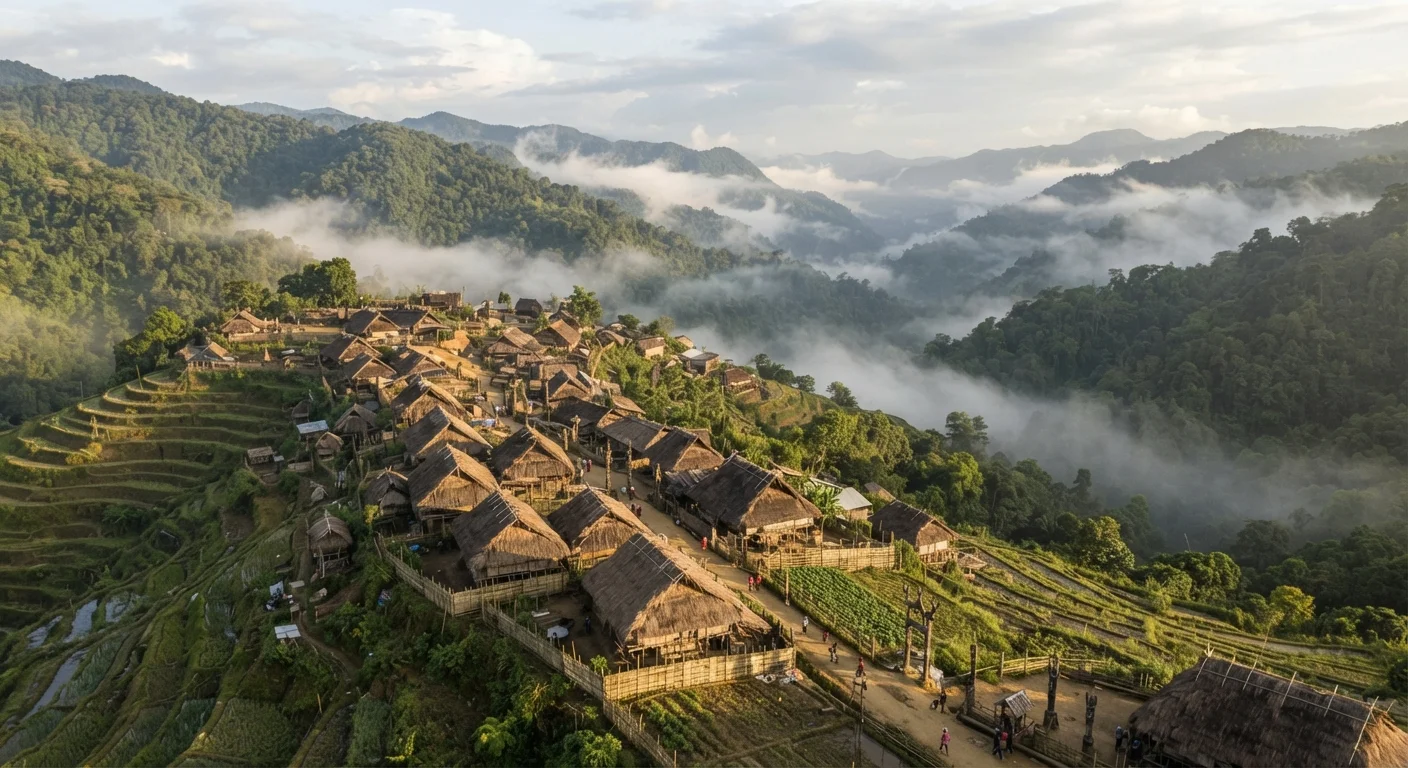
The landscape is all vertical drama - rippling ridgelines pushing past 2,000 meters, terraced fields carved into hillsides, and rivers that cut through dense subtropical forest before dropping toward the Brahmaputra plain. Sixteen major Naga tribes and dozens of sub-groups live across these hills, each with distinct languages, textile traditions, and ceremonial practices. No single experience here translates cleanly into any other corner of Asia.
16
Recognized Naga tribes in Nagaland
Each tribe maintains distinct language, textile traditions, and ceremonial practices, according to the Nagaland government's cultural records.
~12 km
Distance from Kohima to Kisama Heritage Village
The Hornbill Festival site is a short drive from the state capital, making it the most accessible entry point for first-time visitors.
2000
Year Hornbill Festival was established
The Nagaland government created the festival to promote intertribal dialogue and cultural tourism; it has grown significantly since its founding.
Understanding the Hornbill Festival
Held annually in the first week of December at the Kisama Heritage Village, roughly 12 kilometers from the state capital Kohima, the Hornbill Festival was established by the Nagaland government in 2000 to promote intertribal exchange and cultural tourism. It draws all sixteen recognized Naga tribes into a single open-air arena - a choreographed, photogenic introduction to traditions that would otherwise require weeks of backcountry travel to witness separately.
The festival is real in its content: warrior dances, fire-making demonstrations, traditional wrestling, indigenous food markets, and bamboo craft displays are not theatrical recreations but genuine practices performed by participating communities. What the festival cannot offer, however, is the quieter texture of Naga life - the morning rituals, the elder councils, the agricultural rhythms that define these communities for the other fifty-one weeks of the year.
“The Hornbill Festival gives you the grammar of Naga culture - the shapes and colors and rhythms. But the villages give you the sentence, the full meaning of how people actually live.”
— Temsula Ao, Naga writer and former professor, widely cited for her documentation of Naga oral traditions
Compared to similarly positioned cultural showcases elsewhere in the Himalayas - such as the increasingly busy festival circuit in Bhutan's eastern dzongkhags - Hornbill remains relatively crowd-free at a global scale, though numbers have grown steadily since the mid-2010s.
Beyond Kisama: Villages That Rarely See Visitors
The genuinely transformative part of a Nagaland journey begins when you leave the festival grounds and head into the hills. A handful of villages stand out for their accessibility and willingness to receive visitors in ways that respect both community autonomy and traveler curiosity.
Khonoma
About 20 kilometers west of Kohima, Khonoma is the self-declared first green village in India - the community banned hunting decades ago and has since become a model of community-based conservation. Angami tribal homesteads line stone-paved lanes, and the terraced fields below the village have been cultivated in essentially the same manner for centuries. Overnight homestays are arranged through village-level coordinators, not online booking platforms.
Tuophema
Further north toward Mokokchung, Tuophema operates a recognized tourist village experience where visitors sleep in traditional Naga morung-style huts - historically the communal longhouses of unmarried warriors - adapted sensitively for guests. It remains one of the few places where extended cultural dialogue with community members is actively facilitated.
Mon District and the Konyak Villages
Mon, in the far north bordering Myanmar, is home to the Konyak people - historically the most feared headhunters of the Naga world, now a community navigating the tension between tradition and rapid modernization. The villages of Longwa, Shangnyu, and Wakching receive only a fraction of the visitors who stop at Kisama, and the experience of sitting with an elder tattooed chief (gaonbura) in a morung still carries weight that few festival stages can replicate. Travel here requires additional permits and reliable local guidance; road conditions are unpredictable outside dry season.
If visiting Mon district, budget at least two full days - one travel day from Kohima and one full day in the villages. Attempting Mon as a day trip from Kohima is neither realistic nor respectful to the communities you're visiting.
The road journey to Mon takes six to eight hours in good conditions; a rushed visit reduces meaningful interaction and increases the risk of traveler fatigue on mountain roads.
Arrive at Hornbill a day before the official opening to observe setup and have brief conversations with tribal representatives before the crowds arrive.
The early hours before festival gates open publicly are when the most candid exchanges between tribal groups happen, and cultural journalists consistently note this as the most authentic window of the entire event.
For those drawn to similarly restricted highland territories elsewhere in the region, the dynamics of Mon district echo - in different cultural register - what travelers encounter in Upper Mustang's restricted zones: access earned through logistics, not tourist infrastructure.
Permits, Entry, and Practical Logistics
Foreign nationals require an Inner Line Permit (ILP) to enter Nagaland. This is obtained through official Indian government channels - state residency offices or designated online portals - and conditions can change. Travelers should verify current requirements directly with the Indian Ministry of Home Affairs or their nearest Indian consulate well before departure. Do not rely on third-party travel agencies as authoritative sources on permit status.
Permit Conditions Can Change Without Notice
Inner Line Permit rules for Nagaland - including which districts require additional Protected Area Permits - have been revised multiple times. Always verify your specific permit needs with the official Indian government source or your country's Indian consulate before booking transport or accommodation. Do not assume that conditions described by tour operators or travel forums reflect the current regulatory situation.
Dimapur is the state's only commercial airport, connected to Kolkata and Guwahati. From Dimapur, Kohima is roughly three hours by road - a journey that should be timed for daylight. Inter-village roads throughout the state are narrow, often unpaved, and subject to landslides during the monsoon months of June through September. A locally sourced driver who knows the routes is not optional; it is a safety requirement.
Accommodation outside Kohima and Dimapur is largely homestay-based. Book through state tourism bodies or community coordinators rather than expecting standard hotel infrastructure. Mobile connectivity drops in and out across the hills; download offline maps before leaving Kohima.
Time Your Visit for Shoulder Season
Traveling in March-April or September-October (outside monsoon) means fewer visitors at key sites, more availability at homestays, and a genuine chance to witness agricultural and community life outside the festival calendar. Village coordinators in Khonoma and Tuophema are generally more available for extended conversations during these quieter months.
How to Travel Responsibly in Naga Country
Nagaland's communities have navigated decades of political turbulence and are now, in many places, navigating a new pressure: the attention of well-meaning but occasionally careless outside visitors. A few principles matter here above all others.
Ask before photographing. This is not merely a courtesy - in many Naga communities it is a deeply felt boundary, particularly around ceremonial objects, morung interiors, and elders. The refusal of a photograph is a complete sentence and requires no negotiation.
Spend locally and deliberately. Festival souvenir markets include both authentic artisan work and mass-produced imitations. Purchasing directly from identified tribal craftspeople - weavers, blacksmiths, basket makers - rather than from general market stalls puts income where it matters most.
Understand that Naga Christianity is the dominant faith across most of the state, a fact that surprises many visitors who arrive expecting purely animist traditions. The two coexist in complex and often richly layered ways; approach both with equivalent curiosity and respect.
Finally, travel in smaller groups. The villages described in this guide are not built for tour buses. The quieter your footprint, the more openly communities tend to engage - a dynamic that holds whether you are in Mon district or, for that matter, in the high-altitude villages of Mustang.
Entry and Safety Information Changes
Travel advisories, road conditions, and permit requirements for Nagaland can shift with limited public notice. Before finalizing any itinerary, consult your government's official travel advisory portal and the Indian Ministry of Home Affairs for the most current guidance. This article reflects general, educational information and does not constitute definitive travel or safety advice.