
Why the Seven Sisters Still Fly Under the Radar
Squeezed between Bangladesh, Bhutan, Myanmar, and China, India's northeastern states - Arunachal Pradesh, Assam, Manipur, Meghalaya, Mizoram, Nagaland, and Tripura - share a nickname born of geography and solidarity. Connected to the rest of India by the slender Siliguri Corridor, they have developed in relative isolation, producing a tapestry of languages, traditions, and ecosystems found nowhere else on the subcontinent.
For the frequent traveler who has already worked through Southeast Asia's greatest hits, this corner of the world offers something increasingly rare: genuine remoteness paired with warm, sophisticated hospitality. Road infrastructure has improved steadily, domestic flight options have expanded, and a growing network of community-run guesthouses means the experience no longer demands expedition-level preparation.
That said, the region is not without complications. Several states require Inner Line Permits (ILP) for Indian nationals and Protected Area Permits (PAP) for foreign visitors. Regulations change - always verify current requirements with official Indian government sources or your country's embassy before finalizing any itinerary. It is also worth comparing the northeast's permit landscape with similarly gated destinations: our breakdown of Myanmar's Kayah and Chin states illustrates how permit systems shape the traveler experience across the broader region.
State by State: Matching Landscape and Culture to Traveler Type
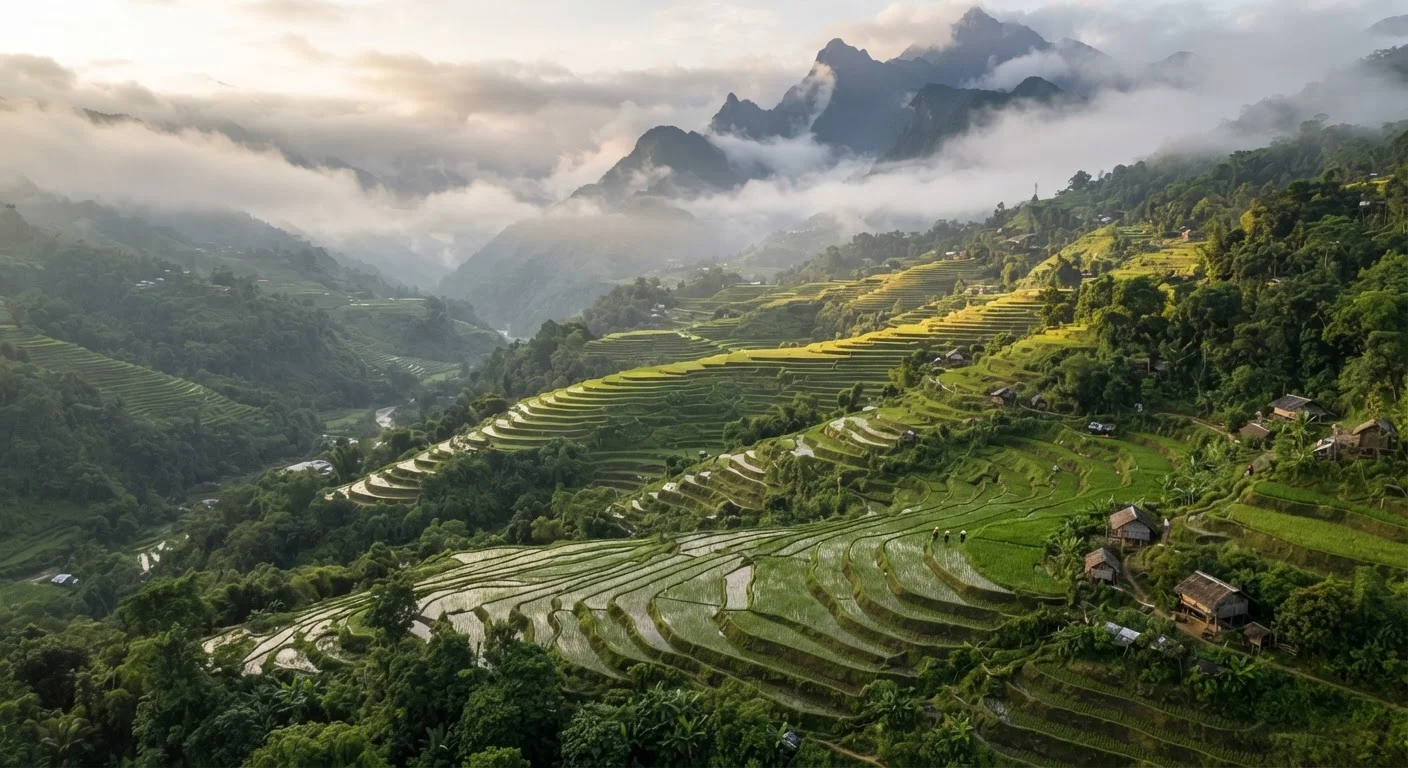
Meghalaya is the natural starting point for most visitors. The name translates as "abode of clouds," and the living root bridges of the Khasi Hills - where trees are trained over decades into functional river crossings - are among India's most quietly spectacular sights. Cherrapunji's monsoon-drenched gorges and the clean stone streets of Shillong give the state a range that suits both active trekkers and those who simply want to absorb a landscape unlike anything in mainland India.
Arunachal Pradesh is the region's crown jewel for wilderness travelers. Tawang Monastery sits above 10,000 feet in a valley that feels genuinely Himalayan rather than merely Himalayan-adjacent, and the Namdapha National Park in the east is one of India's most biodiverse protected areas. The permit requirements here are among the region's most involved - plan accordingly and allow extra lead time.
| Meghalaya | Arunachal Pradesh | Nagaland | Manipur | Mizoram | Tripura | |
|---|---|---|---|---|---|---|
| Landscape highlight | Living root bridges, limestone caves | Himalayan valleys, dense rainforest | Forested hills, tribal villages | Loktak Lake, phumdis | Bamboo hill ranges | Ancient rock carvings, palace |
| Cultural focus | Khasi & Jaintia heritage | 25+ distinct tribal groups | Naga tribal traditions | Meitei arts & history | Mizo community life | Bengali-Tripuri mix |
| Permit requirements | ILP for Indians; PAP for foreigners | PAP required; most involved process | ILP required | ILP required | ILP required | No permit required |
| Best traveler type | First-timers, trekkers, nature lovers | Serious trekkers, wildlife enthusiasts | Culture seekers, festival travelers | History & wetland enthusiasts | Relaxed explorers, photographers | History buffs, accessible adventurers |
| Accessibility from Guwahati | ~4 hours by road | Flight + road; 1-2 days | Flight to Dimapur + road | Flight to Imphal direct | Flight to Aizawl | Flight or train to Agartala |
| Peak season | Oct-Apr (monsoon spectacular) | Oct-Mar | Nov-Mar (Hornbill: Dec) | Oct-Mar | Oct-Apr | Oct-Mar |
Nagaland rewards those who time their visit around the Hornbill Festival, held annually in early December in Kisama, where sixteen Naga tribes gather for cultural performances, traditional crafts, and feasting. Outside festival season, the forested hills around Kohima - site of a pivotal Second World War battle - carry a quieter, more contemplative weight.
Manipur sits around the Loktak Lake, the largest freshwater lake in northeastern India, famous for its floating islands of vegetation called phumdis. The valley around Imphal blends Meitei cultural heritage with a lively arts scene; the state is also a gateway to deeper exploration of the region's complex contemporary history.
Mizoram offers perhaps the most approachable combination of rolling bamboo hills, Presbyterian church architecture, and remarkably hospitable towns. Tripura, though the most accessible by train from Kolkata, punches above its size with Unakoti's ancient rock carvings and the ornate Ujjayanta Palace. Assam, while not always grouped with the "sisters" proper, anchors the region with Kaziranga National Park's one-horned rhinoceroses and the tea gardens of the Brahmaputra valley.
Getting There and Getting Around
Guwahati in Assam functions as the region's main hub, with direct flights from Delhi, Kolkata, and several other Indian cities. From there, each state can be reached by a combination of domestic flights to smaller airports (Dimapur for Nagaland, Agartala for Tripura, Aizawl for Mizoram) and road journeys that are slow but scenically rewarding.
Consider a Multi-State Itinerary
Because individual states can feel compact once you're on the ground, many travelers combine two or three neighboring states in a single trip - Meghalaya and Nagaland, for instance, or Manipur and Mizoram. A local specialist tour operator familiar with permit logistics can significantly reduce the administrative burden and open doors to community experiences that aren't visible from the outside.
The road network has improved meaningfully over the past decade, but journeys that look short on a map often take far longer on the ground. Building flexibility into your itinerary - and hiring a local driver-guide rather than self-driving - is the standard approach for most visitors. Several community tourism initiatives across Meghalaya and Nagaland now offer village homestays that include guided local access, which also supports livelihoods directly.
Seasonality matters here more than in most Indian destinations. October through April is generally the most comfortable window. The monsoon (roughly June through September) can render certain roads impassable but transforms the landscape, particularly in Meghalaya, into something operatically green.