

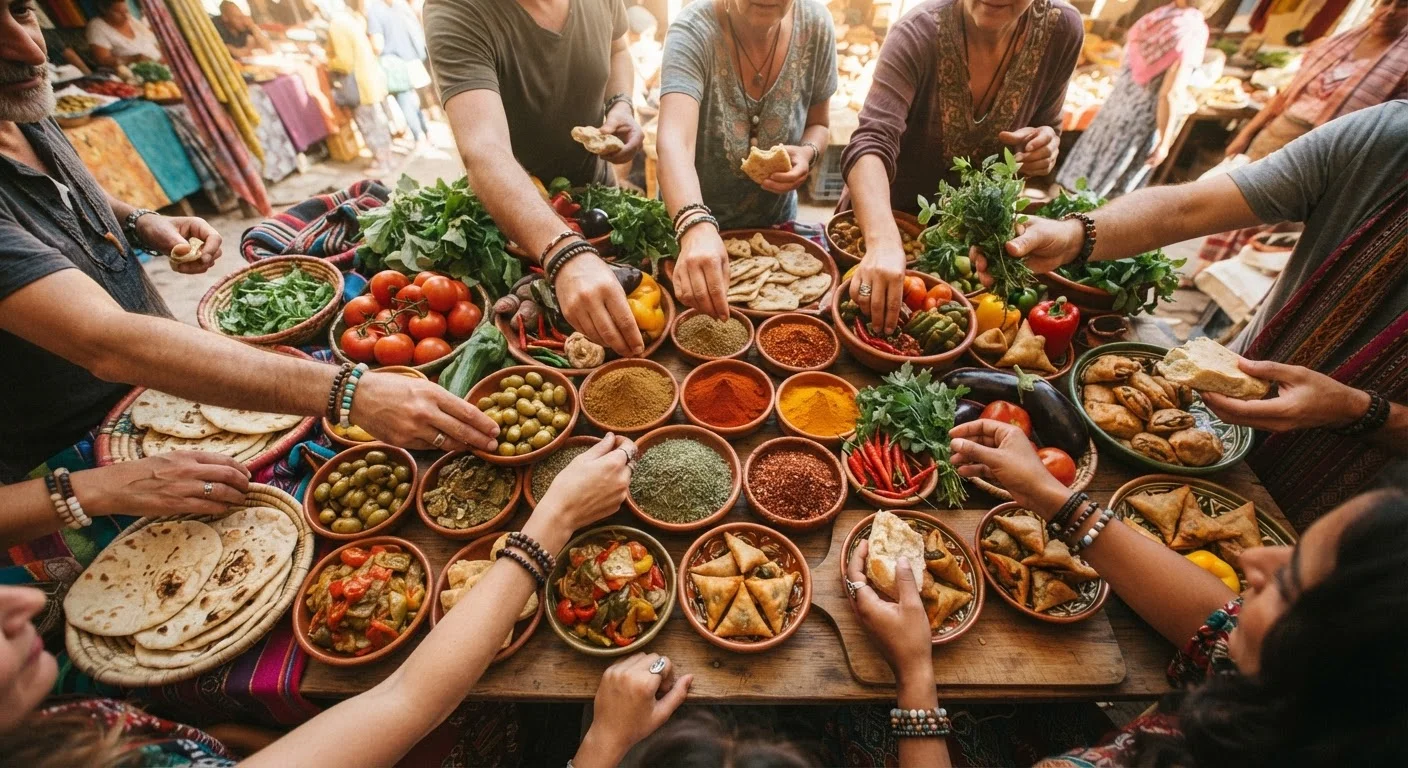
Why Food Is One of Culture's Most Honest Messengers
A country's cuisine is not decoration - it is documentation. Every spice route, colonial legacy, religious restriction, and agricultural reality leaves a trace on what ends up on the plate. When you sit down to a meal in Oaxaca, Hanoi, or Marrakech, you're reading a text written over centuries by geography, migration, faith, and survival.
This is what makes food such a powerful entry point for travelers. Unlike a museum exhibit or a guided tour, a shared meal is participatory and present-tense. It puts you in the same moment as the people around you, governed by the same rhythms - when to eat, how to eat, with whom, and why certain foods appear at certain times.
Deep cultural travel depends on exactly these kinds of embedded, quotidian experiences - and food provides them in abundance.
70%
Travelers motivated by local food experiences
A World Food Travel Association study found roughly 70% of leisure travelers participate in food-related activities as part of their trips.
1 in 3
Travel spend allocated to food and drink
The World Tourism Organization has estimated that food and beverage accounts for approximately one-third of total tourist spending globally.
Markets, Kitchens, and Street Stalls: Where the Real Education Happens
A morning in a local market can deliver more cultural context than an afternoon in a national museum. Watch what people buy, how vendors arrange their goods, which ingredients appear in abundance and which are rare. These details map a food system shaped by local ecology, trade history, and economic reality.
Home kitchens go deeper still. When a traveler is invited to cook alongside a local family - whether through a formal class or an informal hospitality exchange - they encounter technique, proportion, and the particular logic of a cuisine that no restaurant can fully replicate. The way fat is used, which herbs are considered essential, how heat is applied: these are inherited decisions, passed through generations.
Street stalls occupy a middle ground that is uniquely valuable. They are public, accessible, and immediate. They reveal what people eat on a Tuesday afternoon between work and home - not what they serve at celebrations or what they prepare for guests. That ordinariness is the point.
Go Where Locals Shop, Not Where They Perform
Seek out neighborhood markets and local canteens rather than food halls designed for tourists. Ask staff at locally-run guesthouses where they buy their produce or eat on their days off - these recommendations tend to lead to more unmediated and revealing food experiences than any curated list.
The Conversation That Starts Over a Shared Plate
Food has a social physics that few other experiences can replicate. Sharing a meal lowers guard on both sides of the table. It creates a common task - eating - that removes the pressure of needing to perform connection and simply allows it to develop.
Asking a vendor how they learned their recipe, or asking a host what a dish means to them during a holiday, opens biographical and cultural territory that would otherwise take days to reach. These are not intrusive questions when asked with genuine curiosity. They are invitations, and most people accept them readily.
This is where food-centered travel intersects with broader immersive practice. As explored in living like a local, the most meaningful moments of cultural travel tend to emerge from the unscripted spaces - and shared meals are among the most reliably generative of those spaces.
For travelers who also engage with local festivals and communal gatherings, food is often the connective tissue - understanding what's served, and why, is part of participating meaningfully rather than just observing.
Eating With Intention: Approaching Culinary Immersion Honestly
Culinary immersion, like any form of cultural engagement, carries responsibility. The goal is understanding, not consumption as performance. Travelers who approach local food traditions with humility - willing to be confused, to ask rather than assume, and to follow local norms rather than import their own - tend to have richer and more respectful experiences.
It's also worth holding complexity. A dish can be both a living tradition and a product of historical trauma. A street food that tourists celebrate may be something locals eat out of economic necessity. Authenticity in food culture is rarely simple - the most honest travelers are the ones who stay curious about those layers rather than flattening them.
Paired with slow, unhurried travel, food-centered engagement becomes one of the most reliable paths to genuine cultural understanding - not because it resolves complexity, but because it puts you inside it, one meal at a time.
“Food is everything we are. It's an extension of nationalist feeling, ethnic feeling, your personal history, your province, your region, your tribe, your grandma.”
— Anthony Bourdain, Chef, author, and documentary filmmaker