

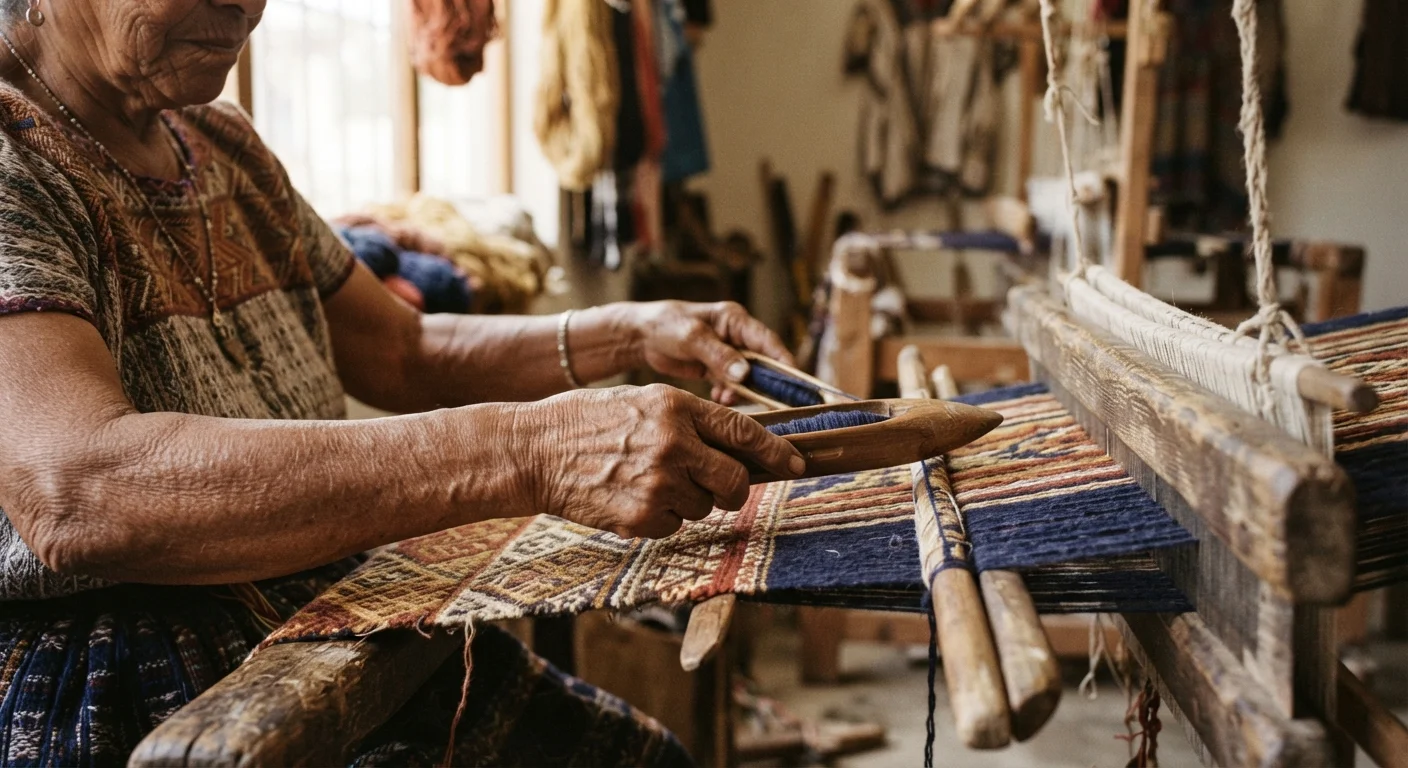
Why Craft Traditions Belong on Your Itinerary
Mainstream itineraries tend to prioritize monuments and landscapes - places you can photograph and leave. Craft traditions demand something different: attention, time, and genuine curiosity. They are living knowledge systems, where the weave of a textile or the firing of a ceramic can encode a community's cosmology, climate adaptation, and social structure simultaneously.
For frequent travelers already familiar with the well-worn circuit, these traditions offer some of the most grounded windows into how a culture actually understands itself - not through a museum placard, but through the physical intelligence of skilled hands. The Complete Guide to Culturally Immersive Travel covers how to frame an entire journey around this kind of depth. What follows is a starting point: eight traditions worth going well out of your way for.
Seek Workshops Over Market Stalls
Purchasing a finished piece at a market rarely connects you to the person who made it or the tradition behind it. Wherever possible, seek out artisan cooperatives, family workshops, or community-run studio visits. These settings allow for genuine exchange, more accurate pricing for the maker, and a far richer understanding of what you're taking home.
Eight Living Craft Traditions Worth Seeking Out
Andean Backstrap Loom Weaving - Peru and Bolivia
Weaving in the Andes is not decorative - it is documentary. Communities across Peru and Bolivia use backstrap loom techniques that predate the Inca Empire, producing textiles whose color sequences and pattern structures encode lineage, geography, and ceremonial function. The Quechua-speaking communities around Chinchero and Pisac in Peru's Sacred Valley are among the most accessible entry points, with weaving cooperatives that offer structured visits led by artisans themselves.
Bolivian highland communities, particularly around Lake Titicaca and in the Jalq'a and Tarabuco regions, produce some of the most symbolically complex textiles in the hemisphere - worth seeking out beyond the tourist-facing markets of Sucre and Potosí.
Andean textiles are living documents - each pattern encodes lineage, geography, and ceremony.
Japanese Indigo Dyeing (Aizome) - Tokushima Prefecture
Tokushima, on the island of Shikoku, has been Japan's center of indigo cultivation and dyeing for over four centuries. The process - from fermenting indigo leaf into a dye vat (sukumo) to applying resist techniques that create precise patterns - is extraordinarily labor-intensive and deeply tied to the region's agricultural calendar. Several family-run studios in Tokushima accept visitors for hands-on sessions, offering one of the more tactile, unhurried craft encounters available in Japan.
The resulting blues - ranging from pale sky to near-black - vary with vat chemistry, fiber type, and immersion time in ways that even experienced practitioners describe as unpredictable. That live uncertainty is part of what makes aizome compelling.
Even experienced aizome practitioners describe the resulting blues as beautifully unpredictable.
Moroccan Zellige Tilework - Fez
The medina of Fez contains workshops where master craftspeople (maalems) still cut and lay geometric ceramic tiles by hand using techniques refined over a millennium. Zellige - the art of hand-chiseling fired ceramic into precise geometric shapes and composing them into complex mosaic panels - is one of the most technically demanding crafts in North Africa. Each tile is shaped individually with a small hammer and chisel, then set face-down in a sand bed before being grouted.
Observing a maalem at work in the Fez el-Bali quarter requires navigating genuinely narrow streets and often arriving with no guarantee of access - which is precisely why it rewards persistence. Some workshops welcome observers briefly; others do not. Respect both outcomes equally.
Each zellige tile is hand-chiseled individually - a millennium-old practice still visible in Fez's living workshops.
Kente Cloth Weaving - Ashanti Region, Ghana
Kente is not simply fabric - it is a symbol system. Woven in narrow strips on horizontal strip looms in the Ashanti and Ewe traditions of Ghana and Togo, each pattern carries a name, a proverb, and a history of use. The Bonwire weaving village near Kumasi, widely regarded as the historical center of Ashanti kente production, offers visitors the chance to watch strip weaving in progress and to speak with weavers about the meanings embedded in specific color and pattern combinations.
Understanding that certain patterns carry ceremonial or hierarchical significance - and that commercial kente sold at markets may not carry the same integrity - is essential context before engaging with this tradition.
Every kente pattern carries a name, a proverb, and centuries of encoded social meaning.
Oaxacan Black Clay Pottery (Barro Negro) - San Bartolo Coyotepec, Mexico
Barro negro - black clay pottery from the Central Valleys of Oaxaca - achieves its distinctive metallic sheen not through glaze but through the burnishing of raw clay with a quartz stone before firing in a pit kiln without oxygen. The technique produces a reduction atmosphere that blackens the iron in the clay uniformly, creating a surface that is simultaneously matte and lustrous.
The village of San Bartolo Coyotepec, roughly 12 kilometers south of Oaxaca City, remains the center of this tradition, with several family workshops open to visitors. The craft gained wider international visibility in the mid-20th century through the work of the late Doña Rosa Real, who adapted the traditional coiling method in ways that permitted the creation of larger forms - a development that continues to shape the tradition today.
Barro negro's signature black sheen comes from clay chemistry and fire, not glaze - a technique with no close parallel.
Bidri Metalwork - Bidar, Karnataka, India
Bidri is one of India's most technically singular craft traditions: an alloy of zinc and copper is cast, then hand-engraved with intricate geometric or floral patterns, inlaid with pure silver wire, and finally treated with a paste of ammonium chloride and soil from the Bidar fort that selectively blackens the base metal while leaving the silver bright. The resulting contrast - silver on near-black - is visually striking and deeply identified with the Deccan Sultanate period from which the craft emerged.
Bidar, a small city in northern Karnataka that remains undervisited relative to its craft heritage, is where most practicing bidri artisans are concentrated. The region's specific fort soil is considered integral to the finishing process - an irreproducible local element that ties the craft to its geography.
Bidri's finishing process depends on soil from Bidar's ancient fort - the craft is literally inseparable from its place.
Tapa Cloth Making - Tonga and Fiji
Across Polynesia and Melanesia, tapa cloth - made by beating and felting the inner bark of the paper mulberry tree - has served for centuries as ceremonial currency, royal regalia, and social gift. In Tonga particularly, the production of ngatu (large decorated tapa panels) is an explicitly communal activity, typically carried out by groups of women working together in what functions as both a craft practice and a social institution.
Visitors to Tonga who time their visit around ceremonial occasions may have the rare opportunity to observe ngatu production in its full communal context - though such events are not staged for tourism, and any engagement should follow local cues carefully.
Tapa production in Tonga is as much a social institution as a craft - women work together in ways that reinforce community bonds.
Ethiopian Harari Basketry - Harar, Ethiopia
The walled city of Harar in eastern Ethiopia - itself a UNESCO World Heritage Site and one of Islam's historic holy cities - is home to a distinctive basketry tradition produced almost entirely by Harari women. Coiled baskets in bold geometric patterns serve both utilitarian and ceremonial functions, including as wedding gifts and storage vessels for grain. The dyes are derived from local plants, and the designs are passed down through female lineages.
Harar is genuinely off the main Ethiopian tourist circuit, which means visitors who make the effort encounter the craft in a context far less mediated by commercial tourism infrastructure. That also means preparation and cultural orientation matter even more before arrival.
Harari basket designs are passed through female lineages - each piece carries a specific woman's knowledge and history.
On Access and Seasonal Availability
Several traditions on this list are tied to specific communities, seasons, or ceremonial calendars. Access is not always guaranteed, and some workshops operate without fixed visiting hours. Build flexibility into your itinerary, verify current conditions locally on arrival, and always confirm that your visit is welcome before entering a working space. Entry requirements and local conditions can change; check current official government and destination advisories before traveling.
Every tradition on this list exists within a community with its own economic pressures and cultural boundaries. Read how travelers can unintentionally commodify the cultures they admire before you go, and approach each encounter as a guest rather than a consumer.
Traveling With Purpose and Responsibility
Witnessing a craft tradition is not the same as understanding it. The most meaningful encounters happen when travelers slow down, engage with practitioners directly, and resist reducing a technique to a photo opportunity. If a workshop offers a structured demonstration or a short participatory session, that is often a far more equitable and educational experience than purchasing a finished piece from a hotel gift shop.
For travel to off-grid destinations across Asia in particular, where craft communities may be navigating significant economic change, responsible travel practices are not optional courtesies - they carry real consequence. Ask who benefits from your visit, where your money goes, and whether your presence is genuinely welcome. Those questions, asked honestly, are where meaningful cultural travel begins.