
Why Your Overnight Choice Defines the Whole Trip
Where you sleep on a road trip isn't just a logistics decision - it's a statement about the kind of traveler you are. The overnight choice shapes your budget, your daily rhythm, your packing list, and how deeply you connect with the places you pass through. For anyone serious about road trip lifestyle, this question deserves honest examination rather than habit.
Camping pulls you closer to the landscape. Motels keep you mobile and rested. Both come with real trade-offs, and neither is universally superior. Understanding those trade-offs - practically and philosophically - is what separates a trip that delights from one that quietly frustrates.
Reservations Are Now Common at Campgrounds
The assumption that camping is always walk-up and spontaneous no longer holds at many US campgrounds. National park sites and popular state park campgrounds frequently require advance reservations - sometimes weeks or months ahead during peak season. Dispersed camping on Bureau of Land Management or national forest land remains largely unreserved, but always verify current rules through official agency websites before your trip.
The Case for Camping: Freedom at a Cost
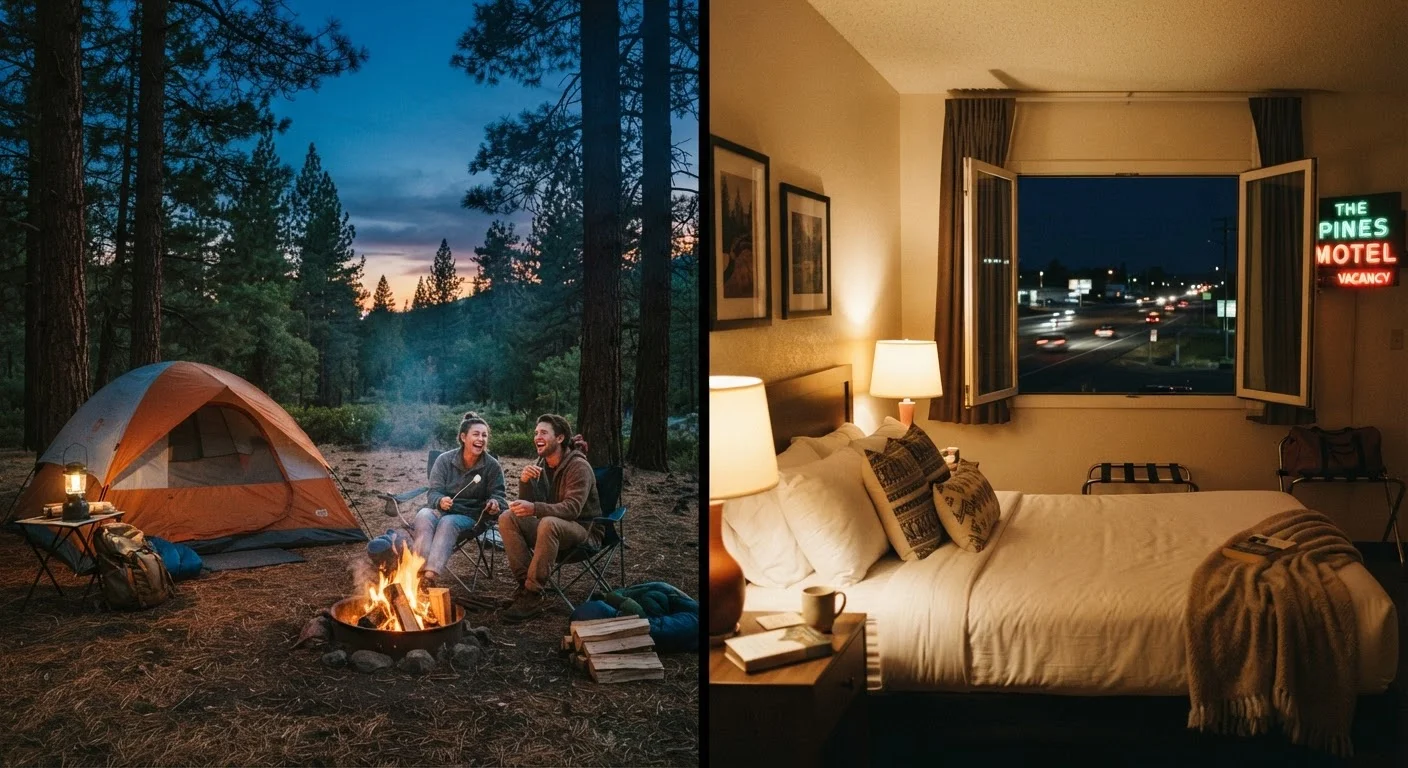
Pitching a tent at a national forest campground or a dispersed BLM site puts you somewhere a motel never could - inside the landscape itself. You fall asleep to the wind in pines and wake to actual birdsong, not an HVAC unit. For routes cutting through the American West, the Appalachians, or the upper Midwest, camping isn't just affordable; it's transformative.
Dramatically lower nightly costs on most routes
Campsite fees - particularly at dispersed or national forest sites - often run a fraction of motel rates, making camping a meaningful budget lever on longer trips.
Direct access to remote, scenic locations
Many of the most visually striking overnight spots in the country are campgrounds, not roadside motel strips - particularly in national parks and wilderness areas.
Deepens connection to the natural environment
Sleeping under open sky or in forest cover changes how you experience a place, slowing the pace and sharpening attention to landscape in ways a motel room simply cannot replicate.
Greater flexibility on timing and location
Dispersed camping on public land requires no reservation - you can stop when the light is perfect or the site looks right, without being locked into a booking.
That said, the upfront gear investment - tent, sleeping pad, cook stove, lighting - is real. So is the prep time required to research campsite availability, reservation windows, and seasonal closures. And after a long day of driving, setting up camp in the dark or rain tests even the most seasoned outdoor traveler. Campers who travel in groups often offset the gear burden more easily, as explored in our piece on solo vs. group road trip planning.
45M+
Americans who camp annually
According to the Outdoor Foundation's annual participation reports, tens of millions of Americans include camping in their recreational activities each year.
40-60%
Potential nightly savings over budget motels
Campsite fees at public land sites commonly range from free to $30, compared to budget motel averages of $70-$120 in many US regions, representing significant per-night savings.
The Case for Motels: Comfort With Trade-Offs
A motel offers something camping rarely does: a reliable baseline. A hot shower. A real bed. A place to charge every device and spread out a map without wind. For road trips built around covering significant miles - or for travelers who need genuine recovery between driving days - motels reduce friction substantially.
Nightly costs accumulate quickly on long trips
Motel rates along popular American road trip corridors can be substantial, and a two-week trip at even mid-range properties adds up to a significant portion of a total travel budget.
Reduced spontaneity due to availability and bookings
Motel stops work best with at least a loose plan - popular towns fill up fast in peak season, and last-minute searches can leave travelers settling for less convenient locations.
Keeps you separated from the natural landscape
Motel stays are efficient but insulating - you move between parking lot and room without the immersive quality that makes road trips through wild terrain memorable.
Variable quality is difficult to predict
Roadside motel quality varies widely by region and property; what reads as adequate online can feel quite different in person, particularly in rural stretches.
The cost picture, however, is less flattering. Nightly motel rates along popular corridors can run well beyond what even a reserved campsite costs, especially during peak travel seasons. And the motel experience, by design, keeps you one step removed from the landscape. You're adjacent to the road rather than embedded in the terrain. For a deeper look at how accommodation choices ripple through a travel budget, our overview of accommodation trade-offs for budget travelers lays out the full picture.
Mixing Both: The Hybrid Approach
Many experienced road trippers don't choose a side - they build a flexible itinerary that uses both. Camp for three nights in a canyon, then book a motel in the next town for a laundry run, a proper meal, and a full night's rest before a long drive. This hybrid rhythm respects both the desire for immersion and the body's need for recovery.
The gear question shifts here too. Packing light without sacrificing comfort becomes a genuine challenge when your trunk needs to hold camping gear and a clean outfit for a city night. Prioritizing modular, dual-purpose gear helps - but it requires intentional planning before you leave home.
Your route matters enormously. A coastal highway with towns every thirty miles makes motels easy and camping harder to access. A high-desert loop through sparsely populated terrain flips that equation entirely. Match your overnight strategy to your route, not the other way around. For travelers drawn to the deeper culture of life on the road, this kind of deliberate planning is part of what separates long-haul road travelers from vacationers.