
Born from a Nation on the Move
When Route 66 was certified on November 11, 1926, it threaded together a patchwork of existing roads and wagon trails into something genuinely new: a continuous, numbered highway linking the industrial Midwest to the Pacific Coast. The corridor passed through rural towns that had never before been connected to a national grid, and the economic ripple was immediate. Gas stations, motor courts, and roadside diners sprang up in its wake - an entire commercial ecosystem that owed its existence to the painted centerline.
The highway's first defining moment came not from leisure but from desperation. During the 1930s Dust Bowl, an estimated 200,000 or more migrants - many from Oklahoma and surrounding states - loaded their families into battered vehicles and headed west on Route 66, chasing the promise of California's agricultural valleys. John Steinbeck observed this exodus firsthand, and in The Grapes of Wrath he christened the highway "the Mother Road" - a name that has never left it. That descriptor still resonates because it captures something true: the road did not simply carry people; it sustained them.
2,401
Miles of the original Route 66 alignment
The highway spanned eight states from Grant Park in Chicago to the Santa Monica Pier in California, according to National Park Service documentation.
1926
Year Route 66 was officially certified
The U.S. Highway System, including Route 66, was established on November 11, 1926, coordinated by the American Association of State Highway Officials.
8
States crossed by the historic route
Illinois, Missouri, Kansas, Oklahoma, Texas, New Mexico, Arizona, and California each host segments of the historic alignment, many still marked and drivable.
1985
Year Route 66 was decommissioned
The final segment of Route 66 was officially removed from the U.S. Highway System in October 1985, after Interstate highways had supplanted the entire corridor.
The Postwar Golden Age and the Birth of Car Culture
If the Depression years defined Route 66 as a road of necessity, the postwar decades recast it as a road of possibility. Returning veterans, flush with savings and hungry for motion, discovered that a long American highway could double as both destination and freedom. The motel industry exploded along the corridor, and the now-iconic imagery of neon signs glowing against a desert night - arrows pointing toward vacancy - became shorthand for the open-road ideal.
Television crystallized the mythology. The CBS series Route 66, which aired from 1960 to 1964, followed two young men crossing the country in a Corvette, treating the highway as a moving stage for distinctly American stories. Bobby Troup's 1946 song "(Get Your Kicks on) Route 66" had already planted the name in popular music; by the early 1960s, the route had its own gravitational pull in popular culture. Travelers didn't just pass through - they made the road itself the point.
“66 is the path of a people in flight, refugees from dust and shrinking land, from the thunder of tractors and shrinking ownership... They streamed over the mountains, hungry and restless - restless as ants, scurrying to find work to do - to lift, to push, to pull, to pick, to cut - anything, any burden to bear, for food.”
— John Steinbeck, Author of The Grapes of Wrath (1939)
This era also seeded what we now call road trip culture: the idea that the journey, not the destination, holds the meaning. You can trace that philosophy directly from Route 66's mid-century heyday into the van life movement of today.
Bypassed but Never Forgotten
The Federal Aid Highway Act of 1956 authorized the Interstate Highway System, and with it came Route 66's slow erasure. Interstate 40, 44, and 55 progressively claimed the traffic that had sustained roadside communities for decades. Towns that had thrived on the through-traveler economy - Tucumcari, New Mexico; Seligman, Arizona; Galena, Kansas - watched storefronts go dark. By 1985, the last stretch of Route 66 was removed from official U.S. highway designation.
Yet the decommissioning paradoxically amplified the route's cultural magnetism. Advocates, historians, and travelers rallied around preservation. In 1999, Congress established the Route 66 Corridor Preservation Program, and multiple states have since designated the historic alignment with their own signage and funding. What couldn't be saved in asphalt has been preserved in collective memory - in museums, murals, and the determined optimism of towns that chose revival over surrender.
Research Each State's Historic Alignment
Route 66 doesn't follow a single road - the alignment shifted over the decades, and different states have preserved different segments. Before you go, download or purchase a state-by-state alignment map from a Route 66 preservation organization. These maps distinguish the original 1926 path from later realignments and will save you from accidentally bypassing the most character-rich stretches.
The mythology Route 66 carries isn't always accurate - romanticized versions of the road often obscure complicated histories of race, displacement, and uneven prosperity. Our companion piece on Route 66 myths that persist digs into the gap between legend and record.
What the Road Actually Looks Like Now
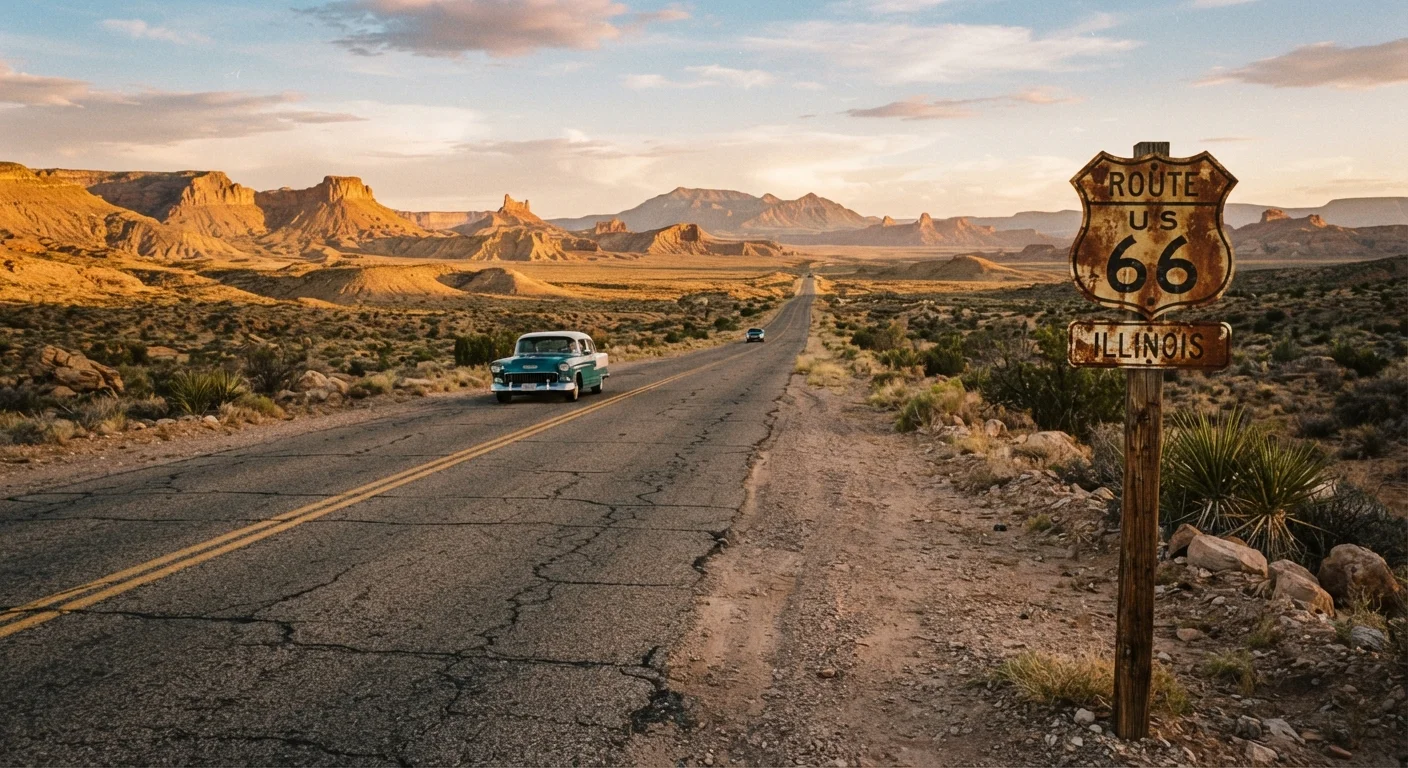
Driving Route 66 today is an act of archaeology as much as adventure. The experience shifts radically across its eight-state span: Chicago's urban grid gives way to Missouri's forested hills, then flattens into Oklahoma's rolling plains before the terrain transforms into the rust-red canyon country of New Mexico and Arizona. Each state contributes a distinct register of landscape and local character.
Preserved landmarks reward patient explorers: the Art Deco facade of the Pueblo Deco Tulsa landmark buildings, Wigwam Motel's concrete tepees in Arizona, the kitschy-brilliant Cadillac Ranch outside Amarillo. Many original diners still operate, and a growing number of towns have leaned into heritage tourism as a deliberate economic strategy.
The road connects, too, with something broader - the small rituals that give road trips their texture: the diner coffee ordered at a worn Formica counter, the photo beside a sun-bleached milepost, the hours-long conversation with a stranger who drove in from the opposite direction. These are the moments Route 66 was always best at producing, and they haven't changed.
For those planning their own drive, the Road Trip Planning hub offers practical guidance on logistics, and it's worth knowing that conditions vary significantly by season - especially in the desert Southwest and at higher elevations in New Mexico and Arizona. Always verify current road conditions and any entry or access requirements with local and state transportation authorities before you go.