
The Legend Versus the Actual Road
Few American highways carry as much symbolic weight as Route 66. Pop songs, novels, and television series have turned it into a shorthand for freedom, westward possibility, and the open road itself. That mythology is genuinely powerful - and genuinely misleading. The real Route 66 has a messier, more fascinating history than the postcard version allows, and understanding the difference makes for a far richer drive.
For travelers already comfortable with the mainstream story, the myths below are worth unpacking before you pull out of Chicago or Albuquerque. See also how common road trip freedom myths can shape unrealistic expectations before any long-distance journey begins.
Myth
Route 66 is a single, intact highway you can drive from Chicago to Los Angeles without interruption.
Fact
Large sections have been replaced by Interstate highways or simply paved over, requiring navigation around gaps and detours.
The romanticized image of an unbroken ribbon of asphalt is appealing but inaccurate. When the Interstate Highway System expanded through the 1960s and 1970s, it bypassed and eventually absorbed much of Route 66. By the time the highway was officially decommissioned in 1985, continuous through-travel on the original alignment was no longer possible. Drivers today navigate a patchwork of surviving segments - some well-marked, some not - that require dedicated route maps or GPS overlays specifically designed for the historic alignment.
Myth
Route 66 was always called 'The Mother Road' - a name as old as the highway itself.
Fact
The nickname comes from John Steinbeck's 1939 novel 'The Grapes of Wrath' and gained wide use only decades after the road opened.
Route 66 was commissioned in 1926, but 'The Mother Road' wasn't part of its identity at launch. Steinbeck applied the phrase in his Depression-era novel to describe how the highway carried desperate families westward. The nickname gained popular traction much later, largely through the nostalgia revival of the 1980s and 1990s as preservation groups sought to market the decommissioned highway to tourists. It's a beautiful phrase - but it's a literary invention retroactively attached to the road's origin story.
Myth
The Dust Bowl migration was primarily a Route 66 story - hundreds of thousands of 'Okies' drove the highway to California.
Fact
While Route 66 was an important corridor, migration patterns were more dispersed, and Steinbeck's portrayal was a dramatization, not a demographic study.
Historians including James Gregory, whose research examined actual Census and migration data, have shown that the Dust Bowl diaspora was geographically wider than the Route 66 narrative implies. Many migrants traveled other roads, arrived from states beyond Oklahoma, and settled in locations Steinbeck's story doesn't address. The Joad family's journey was a powerful literary archetype, not a representative sample. Route 66 was genuinely significant to this migration, but it has absorbed disproportionate cultural credit for a movement far larger than any single highway.
Myth
The quirky roadside attractions along Route 66 are authentic remnants of mid-century American culture.
Fact
Many were purpose-built for the tourist trade during the nostalgia revival of the 1980s-2000s, not preserved from the highway's operational peak.
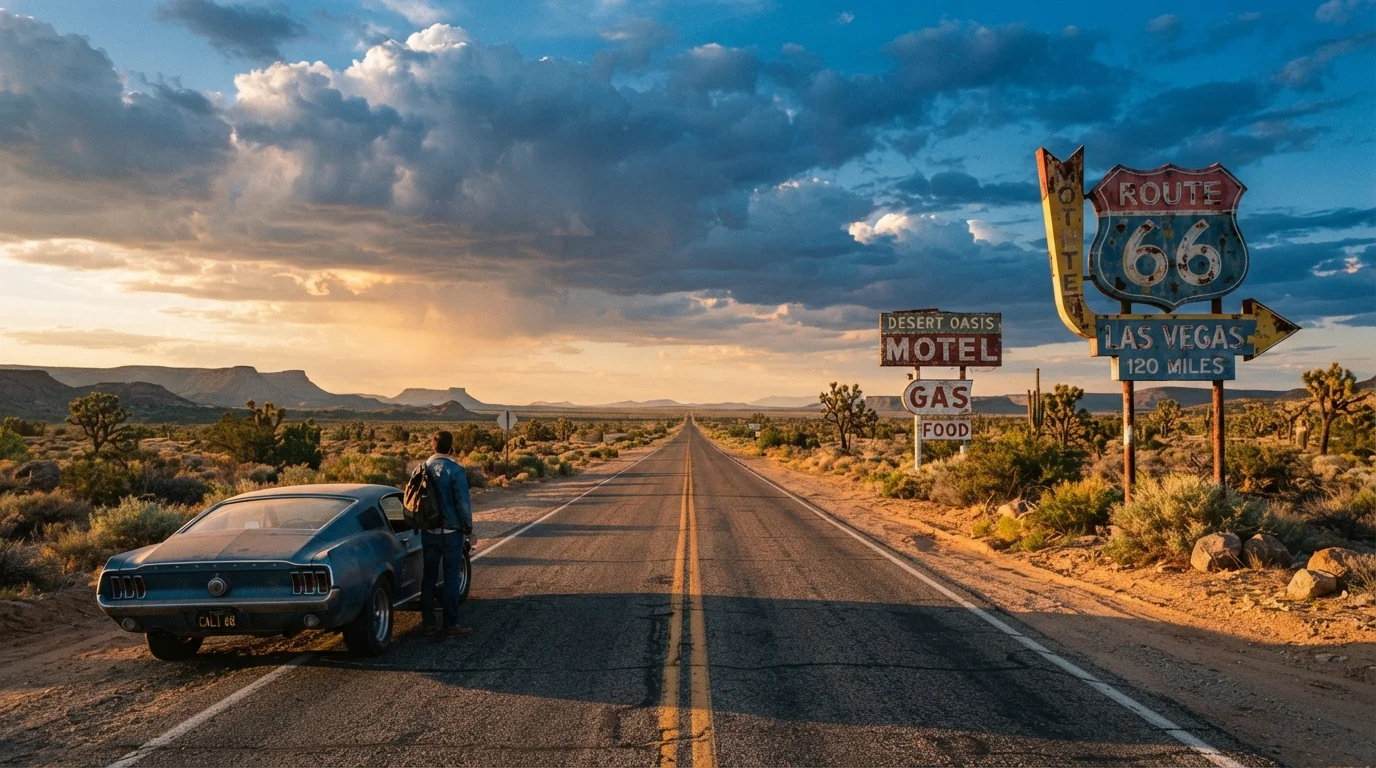
Genuinely historic structures do exist along the alignment - certain motor courts, diners, and service stations date to the 1930s-1960s and have been carefully preserved. But a notable share of what feels 'vintage' was constructed or heavily restored after decommissioning, explicitly to attract travelers seeking a retro experience. This isn't necessarily a problem; tourism-driven preservation keeps communities alive. But visitors who assume every rusted sign and neon motel facade is an untouched artifact are often looking at a curated performance of history rather than the thing itself.
Myth
Driving Route 66 is a spontaneous, freewheeling adventure that requires minimal planning.
Fact
Successful navigation of the historic alignment requires detailed route maps, awareness of seasonal closures, and advance lodging research in remote stretches.
The open-road mythology encourages the idea that you can simply 'follow Route 66' without preparation. In practice, the route is fragmented, signage is inconsistent across states, and some of the most compelling segments pass through genuinely remote territory with limited services. Certain sections of New Mexico and Arizona see extreme heat in summer, and some historic roadbeds become impassable after storms. Preservation organizations publish updated driving guides that are worth consulting before departure - spontaneity works best when the logistical groundwork is already in place.
What the Evidence Actually Shows
Historians, highway preservationists, and geographers have documented Route 66's story in considerable detail. The National Historic Route 66 Federation and state-level preservation groups maintain records that contradict many of the highway's most durable legends. What emerges is a road shaped by commerce, politics, and regional inequality - not simply the romantic symbol of personal liberation it became in popular culture.
2,448 mi
Original certified length of Route 66
The highway's total length varied over its lifetime due to realignments; the figure most commonly cited reflects the route as it stood near its 1926 commission.
1985
Year Route 66 was officially decommissioned
The American Association of State Highway and Transportation Officials removed Route 66 from the U.S. Highway System on June 27, 1985, after Interstate highways had rendered it redundant.
8 states
States the historic alignment crosses
Illinois, Missouri, Kansas, Oklahoma, Texas, New Mexico, Arizona, and California each contain surviving segments of varying length and condition.
Planning a trip along the surviving corridor requires treating it the way you would any historically layered route: with curiosity about what's real and skepticism toward what's been staged for cameras. The small rituals that define road culture - the diner stops, the roadside pull-outs, the unhurried pace - are genuine. The glossy mythology around them often isn't.
If you want the fuller arc of how Route 66 shaped and was reshaped by American travel culture, the evolution from Route 66 to van life traces how each generation has reinterpreted the open road for its own moment. And before you finalize your itinerary, it's worth checking whether your planning assumptions hold up - itinerary myths that lead travelers astray covers the most common mistakes.
Verify Conditions Before You Drive
Road conditions, segment accessibility, and business hours along the historic alignment change frequently. Some rural stretches lack reliable cell service, fuel, and emergency assistance. Consult current preservation organization guides and check state DOT advisories before setting out - especially for the more remote sections in New Mexico and Arizona.