

Why Your Sleep Position Determines Pillow Performance
Most airports and airline gift shops stock one design: the foam U-shaped neck pillow. It sells well because it's familiar, not necessarily because it works best. In practice, how you naturally fall asleep - and whether you have a wall to lean against - dictates which pillow geometry actually stabilizes your head and reduces neck strain.
Frequent flyers who've experimented know the frustration: a pillow that felt supportive in the store becomes useless the moment your head droops to one side at cruising altitude. Understanding the mechanics behind each design helps you avoid that mismatch. Your seat choice also plays a significant role, since window seats provide a structural lean point that aisle seats do not.
Comparing the Main Travel Pillow Designs
Each pillow type targets a different sleeping posture. Understanding the trade-offs before you buy prevents the common mistake of choosing purely by price or brand recognition.
| U-Shaped (Memory Foam) | Wrap-Around / J-Shape | Chin-Support / Forward-Lean | Inflatable | |
|---|---|---|---|---|
| Best sleep position | Upright, head centered | Side leaner, window seat | Forward head drooper | Any (budget-dependent) |
| Lateral head support | Low | High | Moderate | Low to moderate |
| Forward slump prevention | None | Low | High | None |
| Packed size | Medium to large | Medium | Medium | Very small |
| Aisle seat suitability | Fair | Good | Good | Fair |
| Window seat suitability | Good | Excellent | Good | Fair |
| Headphone compatibility | Moderate | Moderate | High | High |
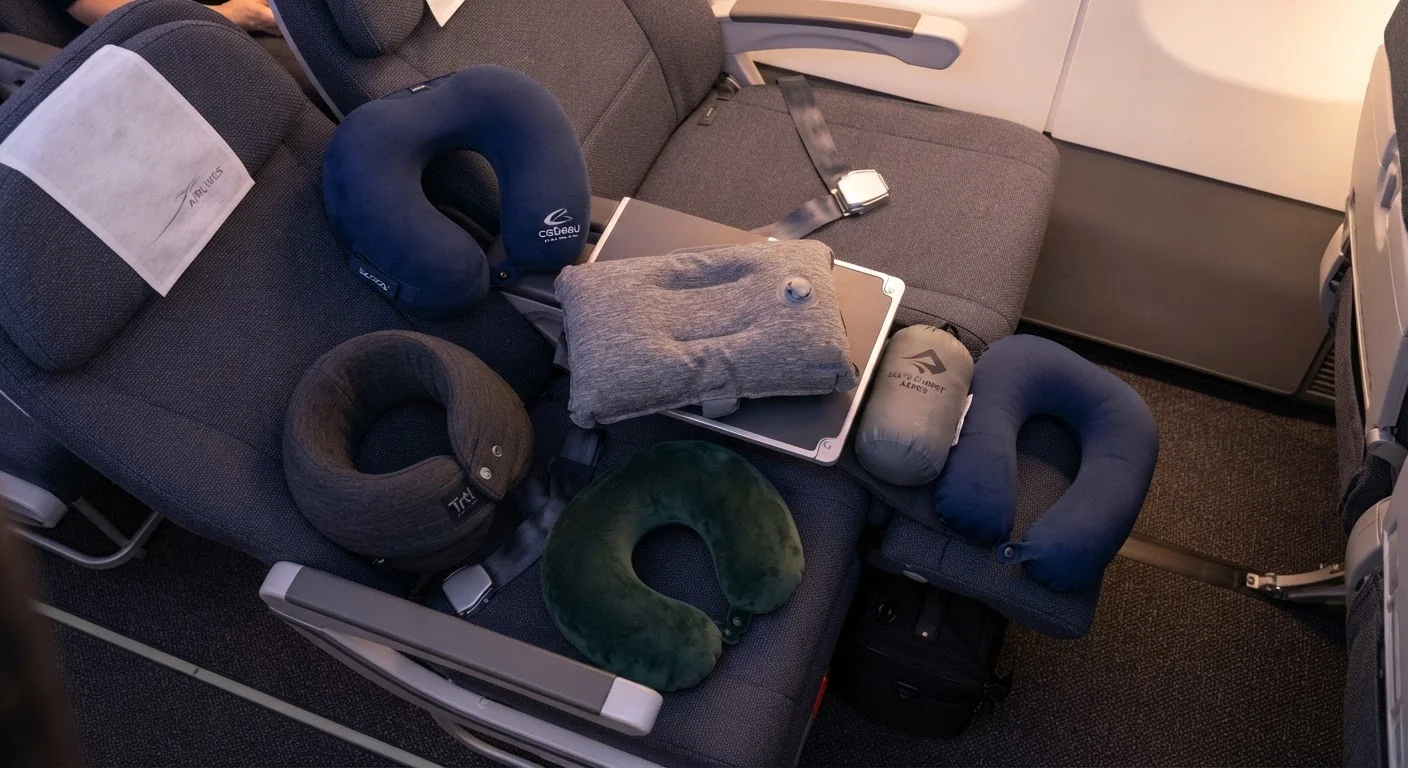
Memory foam U-shaped pillows deliver firm, consistent support for travelers who stay relatively upright throughout a flight. Their limitation is that they do little to stop the head from tilting sideways when sleep deepens. Wrap-around and J-shaped pillows address this by extending support up one side of the neck and jaw, making them far more effective for those who naturally lean left or right. Chin-support pillows - sometimes called forward-lean designs - use a front-mounted pad to cradle the chin and prevent the head from dropping forward, which is the most structurally damaging sleep posture for the cervical spine during extended sitting. Inflatable pillows sacrifice some cushioning quality for a major size advantage: they compress to near nothing and are worth considering for travelers who can't afford the carry-on bulk of foam options.
Test Your Posture Before You Buy
Sit in a firm upright chair and let yourself relax as if dozing - notice whether your head tilts sideways, drops forward, or stays centered. That natural direction is your primary support need. If possible, try a pillow in-store by sitting upright in a chair rather than testing it while standing; the experience is completely different at rest.
Matching Pillow Type to Seat Position and Sleep Habit
Window seat travelers have the most flexibility. Leaning against the cabin wall or bulkhead means almost any supportive pillow - including a standard U-shape or a simple rolled-up blanket - can work adequately. A wrap-around design used with the longer arm toward the window offers particularly stable lateral support in this position. See our full guide to sleeping in non-lie-flat seats for additional positioning strategies.
Aisle travelers face a different challenge. Without a surface to lean against, your pillow must provide self-contained support in all directions. Chin-support and wrap-around styles with symmetric coverage perform better here than traditional U-shapes, which leave lateral movement unchecked. Middle seat passengers are in the most constrained position and generally benefit most from pillows that hold the head as centrally upright as possible.
For anyone building a broader in-flight comfort kit, a well-chosen pillow is one piece of the picture. Our carry-on comfort checklist covers what seasoned travelers actually pack alongside their pillow of choice.
Fill Material, Packability, and Practical Considerations
Fill material affects how a pillow feels under sustained pressure and how small it packs. Memory foam conforms to your neck's shape but typically doesn't compress beyond about half its original volume. Microfiber and down-alternative fills are softer, often more compressible, and machine washable - a genuine hygiene advantage for frequent travelers. Inflatable designs pack the smallest but require inflation time and can feel firmer and less adaptive than foam.
Weight matters too, particularly for carry-on travelers managing tight overhead bin space. Consider whether the pillow clips to a bag exterior - many designs now include attachment loops specifically for this - to avoid sacrificing internal bag space. If you're also managing headphone or earplug choices for sleep, think about how a pillow interacts with over-ear headphone cushions before committing to a thicker foam design.
This article provides general informational guidance on travel comfort products and is not a substitute for medical advice. If you experience chronic neck pain or sleep disorders, consult a qualified healthcare professional before relying on any pillow or sleep accessory as a remedy.