
The Signal a Single Greeting Sends
There is a moment familiar to experienced travelers - the instant a local's expression shifts when you attempt even a halting buenos días or sabah el-kheir. What changes isn't the conversation. What changes is the relationship.
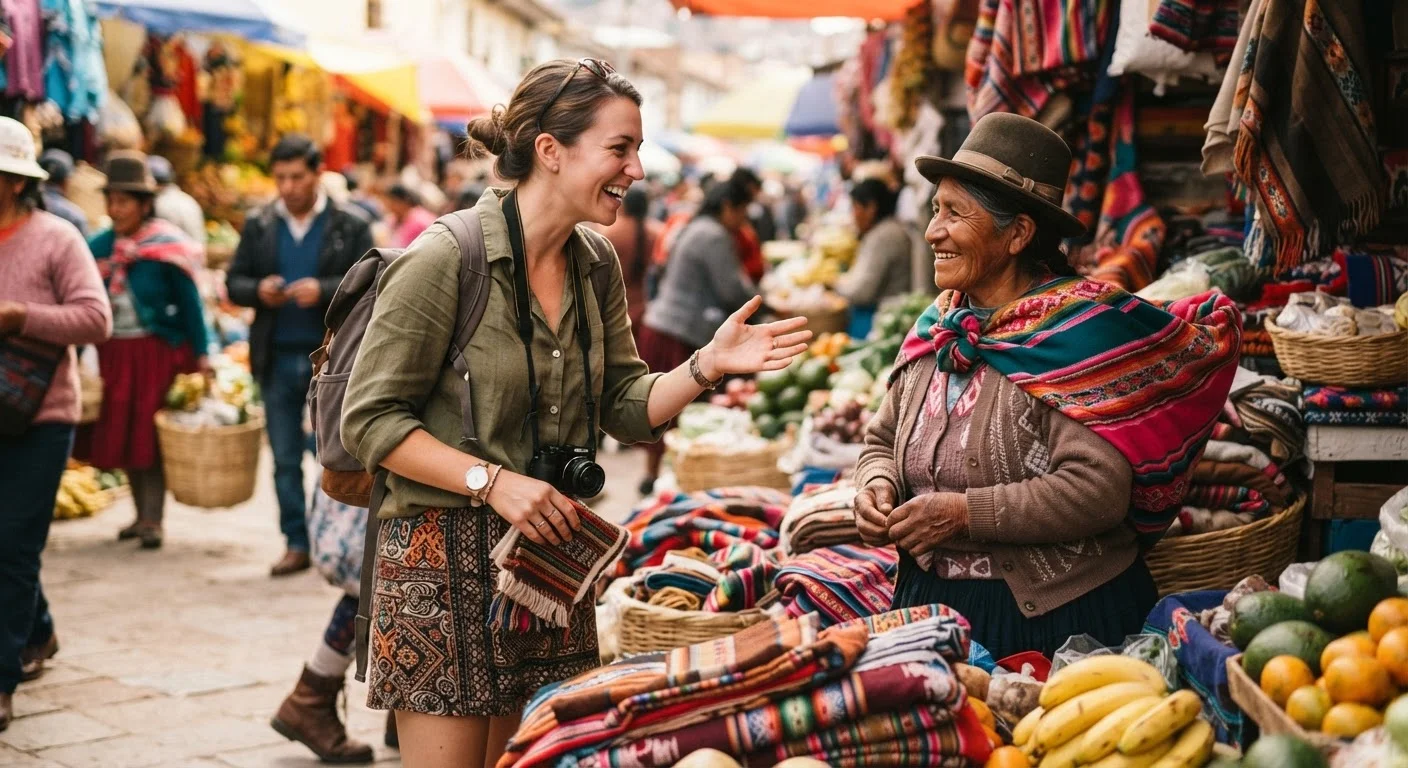
Speaking a few words in someone's native language signals something that no amount of polite English can fully convey: I came prepared to meet you on your terms. That signal cuts through the transactional rhythm of tourist-and-destination and establishes something more reciprocal. Locals who might otherwise offer a courteous but guarded interaction often open up - pointing out a dish worth trying, offering an unrequested piece of history, or simply smiling in a way that feels earned rather than performed.
This is especially true in destinations that see heavy tourist traffic, where locals have grown accustomed to visitors who expect service without engagement. As explored in myths about cultural experiences abroad, the encounters travelers often label "authentic" depend less on finding the right place and more on how they show up in it.
Not All Languages Have Equal Visibility
In destinations where indigenous or minority languages coexist with a national language, learning a few words of the local or regional tongue - rather than just the dominant national language - can carry even greater cultural significance. It signals awareness that language is tied to identity, not just geography. Research the linguistic landscape of your destination before departure.
Why Effort Outweighs Accuracy
A persistent misconception holds that stumbling through a foreign phrase risks embarrassment or offense. In practice, the opposite is nearly always true. Intercultural communication research consistently finds that perceived effort and respectful intent carry more social weight than grammatical precision.
The traveler who greets a guesthouse host in Vietnamese - mispronounced, slightly wrong tone - and the traveler who opens with "Do you speak English?" are not having the same experience, even if both get their question answered. One has offered something. The other has made a request.
Start With the Greeting, Not the Ask
Before requesting directions, ordering food, or asking a question, lead with a local greeting. Even a simple "hello" in the native language establishes a different conversational footing than jumping straight to your need. It takes two seconds and changes the entire tone of the interaction.
This dynamic scales. At a local festival, a market, or a rural homestay, a handful of phrases becomes a kind of social currency. It isn't fluency - it's a gesture. And gestures, in every culture, carry meaning. For travelers focused on participating meaningfully in local celebrations, language is one of the most practical tools available.
What to Learn and How to Learn It
The goal isn't a vocabulary list - it's a short repertoire of high-impact phrases that cover the moments most likely to matter. Greetings and farewells, expressions of gratitude, a polite way to ask if someone speaks English, and simple courtesy markers (please, excuse me, I'm sorry) form the practical core.
Beyond those basics, context-specific phrases add significant value: ordering food by pointing and saying the dish name correctly, asking permission before photographing someone, or acknowledging a local holiday with even a brief, appropriate phrase.
72%
Travelers who feel language barriers limit their experience
A survey by the British Council found that a significant majority of international travelers report feeling that language gaps reduce the depth of their cultural experiences abroad.
10-20
Phrases sufficient to shift cultural dynamics
Language educators and intercultural communication specialists broadly agree that a core vocabulary of 10 to 20 targeted phrases is enough to meaningfully improve traveler-local interactions.
15 min/day
Daily practice needed for travel-ready phrases
Consistent short practice sessions over two to four weeks before departure is widely cited by language learning researchers as more effective than intensive last-minute study.
Preparation matters more than most travelers expect. Short daily sessions - 10 to 15 minutes - in the weeks before departure outperform last-minute cramming. Audio-based learning tends to produce better pronunciation for spoken use than text-focused study. Whatever the method, the priority is usability on arrival, not test-readiness.
Travelers committed to deeper cultural engagement, including those visiting undervisited destinations where communities are less accustomed to tourism, will find that language preparation is among the most respectful forms of pre-trip research possible.
Language as a Door, Not a Destination
Fluency is not the point. The point is the doorway. A few well-chosen words don't just improve a single interaction - they alter the texture of an entire trip. Meals become conversations. Transactions become exchanges. The experience of a place shifts from something observed to something participated in.
That shift is precisely what separates immersive travel from tourism, and it requires far less than most people assume. The path to meaningful cultural travel isn't built on itineraries alone. It's built on moments of genuine contact - and language, even in its simplest form, is how many of those moments begin.
Carry a phrasebook or use an app, but put the screen away when the moment comes. Look up, make the attempt, and let the imperfection be part of it. That's where the travel actually happens.