

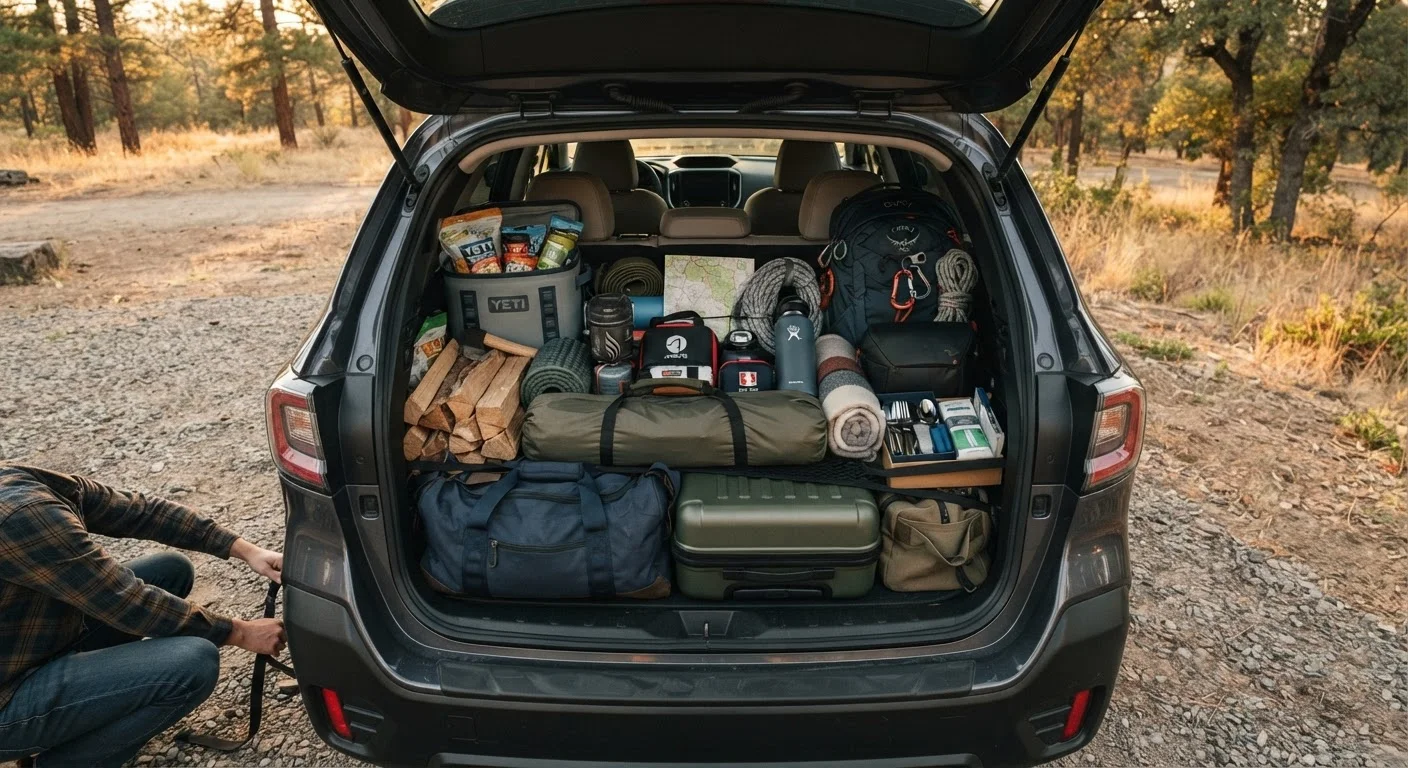
Why Car Packing Deserves Its Own Strategy
Car packing sits in a category of its own. Unlike air travel - where luggage restrictions and overhead-bin geometry force discipline - road tripping can lull you into thinking that more space means more stuff. It doesn't. It means more opportunity to pack poorly and pay for it in back-aches, lost time, and a cabin that feels like a storage unit by day two.
The principles here differ sharply from what you'd apply to a cruise, where luggage tags, cabin storage, and formal-night requirements set the agenda. For a deep-dive into that contrast, see how cruise packing differs. Road trip packing is governed by physics - weight distribution, volume, and access - not dress codes.
A well-packed car is also just one layer of trip preparation. If you haven't yet worked through route selection, overnight logistics, and timing, the anatomy of a well-planned road trip covers those foundations in full.
Packing cubes or compression bags
Compress clothing and create uniform, stackable shapes that fill trunk space efficiently.
Cargo net or trunk organizer
Secures loose items and prevents gear from shifting during driving.
Soft-sided duffel bags
Conform to irregular trunk shapes and fill gaps that rigid suitcases leave.
Rooftop cargo carrier
Adds overflow storage for bulky, lightweight items like bedding or sports equipment.
Cooler with lid strap
Keeps perishables fresh and, when strapped shut, doubles as a stable surface for flat items.
Backseat organizer
Keeps passenger-zone essentials - snacks, maps, chargers - accessible without digging.
What You'll Need Before You Start Loading
What you will need
Good packing begins before anything leaves the house. If your vehicle hasn't been inspected ahead of a long haul, run through a pre-departure vehicle checklist first - suspension, tyre pressure, and cargo capacity are all relevant to how safely you can load up.
Step-by-Step: Loading the Car Right
Weight Distribution Affects Safety
Overloading a vehicle's rear or piling gear above window height can impair handling, reduce braking effectiveness, and create dangerous blind spots. Check your vehicle's payload capacity in the owner's manual before loading up. Never exceed the manufacturer's rated maximum.
Audit everything before it touches the car
Lay every item out on the floor or a large surface. Sort into three groups: must-have (documents, medications, chargers), situational (rain gear, hiking boots), and nice-to-have (extra comfort items). Cut the third group aggressively. Road trips reward experienced packers who've learned that the car doesn't grow - the list has to shrink.
Choose the right bags for the space
Swap hard-shell suitcases for soft-sided duffels wherever possible. Soft bags compress, conform to trunk contours, and stack without leaving wasted air pockets. Use packing cubes inside each bag to keep categories discrete - one cube per person per clothing day works well for trips under a week.
Load the trunk in weight-and-access order
Place your heaviest items lowest - that usually means a cooler, tool kit, or dense luggage goes in first, centered over the rear axle. Stack medium-weight bags on top. Items you'll only need at your destination (formal wear, specialty gear) go deepest. Anything needed at a day-stop - a day pack, rain jacket, or snack bag - should sit on top or toward the trunk opening.
Build a dedicated in-cabin zone
The footwell behind the passenger seat and the backseat pocket are prime real estate. Designate this zone for items that must remain reachable while rolling: phone chargers, a navigation device, a small first-aid kit, sunglasses, and snacks. A backseat organizer keeps this tidy. The goal is zero trunk stops for anything you'll use during driving hours.
Secure everything with straps or a cargo net
Once loaded, run a cargo net over the trunk contents and attach it to the anchor hooks (most vehicles have them recessed into the floor or sides of the cargo area). For roof carriers, use the manufacturer's recommended tie-down straps and do a tug-test before pulling out of the driveway. Revisit tie-downs at each fuel stop on day one - loads settle.
Do a final walk-around and close-and-open test
Before departure, close every door, hatch, and carrier lid - then open them again. This catches anything jammed in the seal line or protruding from a side pocket. Check that the trunk closes fully without forcing and that your rear view and side mirrors are unobstructed. Then pull forward 10 feet and listen for shifting or rattling before you hit the highway.
The Tetris Principle Works
Think of your trunk as a three-dimensional puzzle. Fill gaps between bags with rolled clothes, shoes, or soft accessories. Compression packing cubes are especially useful for squeezing out dead air and creating uniform block shapes that stack cleanly.
The Perennial Tension: Stuff vs. Space
Every road tripper eventually confronts the same negotiation between comfort and minimalism. Those who travel frequently learn to read their own patterns - what they reached for on the last trip, what stayed vacuum-sealed in the bag the whole time. If you're working through that calculus, packing light without sacrificing comfort walks through how seasoned travelers handle the trade-offs.
The short answer: systems beat willpower. A good set of packing cubes, a reliable cargo net, and a packing protocol you follow every time will outperform a brilliant one-off effort every single trip. Build the habit once; the car loads itself from muscle memory thereafter.
Unsecured Cargo Is a Real Hazard
Loose items in the cabin or cargo area can become dangerous projectiles during sudden braking. Use cargo nets, straps, or organizers to anchor everything. This applies equally to lightweight items like water bottles and snack bags.