
Two Traditions, One Shared Instinct
At first glance, a ryokan in Kyoto's Higashiyama district and a boutique hotel in Lisbon's Mouraria neighborhood appear to have little in common. One is rooted in centuries of Japanese hospitality philosophy; the other is a 21st-century reimagining of independent lodging. Yet both reject the anonymous efficiency of large-scale hotel chains in favor of something more considered: a stay that reflects a specific place, a specific sensibility, and a specific relationship between host and guest.
Understanding what separates them - not just aesthetically, but philosophically - helps travelers choose with clarity rather than confusion. For a deeper look at what defines the boutique category on its own terms, see what actually separates a boutique hotel from a standard property.
| Criterion | Ryokan | Boutique Hotel |
|---|---|---|
| Cultural rootedness | Deeply embedded in Japanese tradition | Locally inspired, varies by property |
| Guest schedule | Structured (meals, bathing at set times) | Flexible, guest-directed |
| Meals | Typically included (kaiseki dinner, breakfast) | Often optional or à la carte |
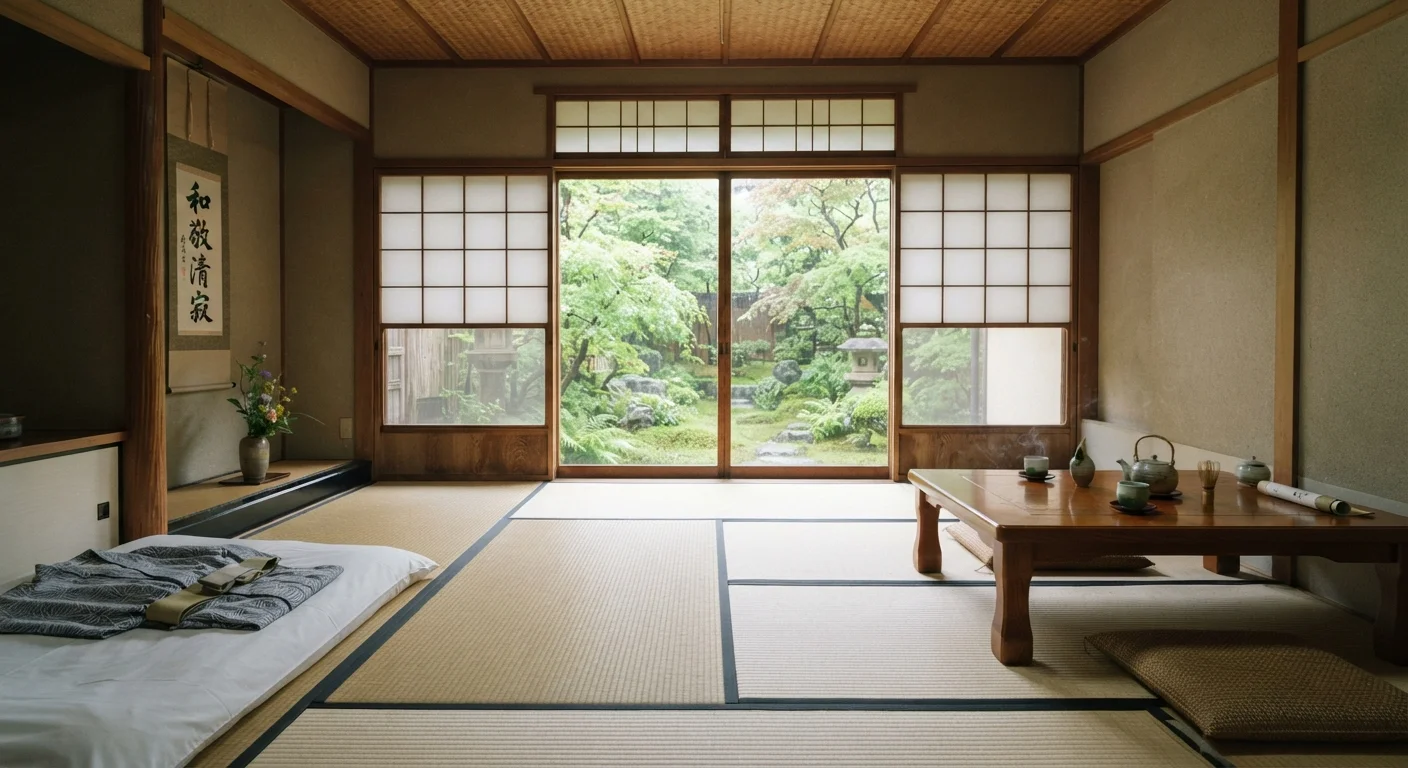
| Room style | Tatami, futon, minimalist Japanese aesthetic | Varies widely; usually Western beds |
| Bathing | Communal onsen or private rotenburo | Standard en-suite or spa facilities |
| Geographic range | Primarily Japan | Global |
| Suitable for first-time visitors | Requires cultural preparation | Generally accessible to all |
| Pace of stay | Slow, restorative, inward | Adaptable to any travel tempo |
The Ryokan: Hospitality as Cultural Practice
A traditional ryokan is less a place to sleep than a framework for living, temporarily, as a Japanese guest. The format traces back to the Edo period, when hatago - roadside inns - served travelers on long journeys between cities. Over centuries, those practical way-stations evolved into something far more refined: a highly codified hospitality system in which every element, from the folding of a futon to the sequencing of a kaiseki meal, carries meaning.
Arrival at a ryokan typically involves changing into a yukata (cotton robe) shortly after check-in - a physical act that signals a shift out of traveler mode. Dinner is served in-room or in a private dining space at a fixed time, progressing through multiple small courses that reflect seasonal produce and regional culinary tradition. Communal onsen (hot spring baths) follow specific etiquette: wash thoroughly before entering, no swimwear, no phones. These aren't arbitrary rules - they're the architecture of an experience designed to slow the guest down entirely.
~3,000+
Registered ryokans operating in Japan
Japan's Ministry of Land, Infrastructure, Transport and Tourism tracks registered traditional inn formats; numbers have declined from a postwar peak as newer accommodation options expand.
12-15
Average courses in a kaiseki dinner
A full kaiseki progression - the multi-course meal central to the ryokan experience - typically spans 12 to 15 small courses reflecting seasonal and regional ingredients.
The ryokan's constraint is also its power. Unlike a hotel stay, where the guest is largely autonomous, the ryokan shapes your time deliberately. That structure suits some travelers deeply and unnerves others. It also means that ryokans rarely work well as a base for packed sightseeing itineraries - they're a destination in themselves.
The Boutique Hotel: Character Without Choreography
The boutique hotel emerged as a conscious reaction to the homogenization of global chain hospitality - properties that could be anywhere, designed for anyone. Where chains optimized for consistency, boutique properties optimized for distinctiveness. Fewer than 100 rooms (often far fewer), locally inspired design, staff who know returning guests by name, and a lobby that tells you immediately where in the world you are: these became the category's hallmarks.
Crucially, the boutique hotel leaves the guest's schedule almost entirely open. Breakfast might be included; it might not. Dinner may be available on-site, or the hotel's value might be entirely in its location - walking distance from a city's most interesting restaurants. The experience is curated but not choreographed. Guests bring their own rhythm; the property amplifies it rather than overrides it.
This flexibility makes boutique hotels versatile across travel styles - city breaks, long weekends, business trips with leisure extensions - in ways that ryokans, by design, are not. The trade-off is that the depth of immersion a well-run ryokan delivers is rarely matched. For travelers weighing how boutique properties stack up against the consistency of international chains, this comparison of boutique versus chain stay experiences offers useful grounding.
It's also worth noting that not every property that markets itself as boutique delivers genuine local character - a point worth examining critically. Separating authentic character from aesthetic performance is a useful exercise before booking.
Where They Converge - and Where They Don't
Both formats share a commitment to scale: intimacy is harder to manufacture in a 400-room tower. Both invest in design as a form of communication, using space and objects to express a point of view. And both attract travelers who are, broadly, looking for meaning in a stay rather than simply a bed.
The divergence is in what they ask of the guest. A ryokan requires cultural fluency - or at least cultural humility - and a willingness to surrender personal schedule to a host's structure. A boutique hotel asks far less of you, which makes it more universally accessible but also, in some cases, less transformative.
Ryokans are also geographically anchored in a way boutique hotels are not. The ryokan format exists outside Japan - hybrid properties in Taiwan, South Korea, and even parts of Europe borrow its vocabulary - but its fullest expression is inseparable from Japanese culture, landscape, and the presence of natural onsen. Boutique hotels, by contrast, are a global phenomenon, appearing with equal conviction in Marrakech medinas and Reykjavik harbor districts. For a broader survey of how regional accommodation traditions compare across cultures, distinctive stay formats around the world maps the full landscape.
Accommodation formats, customs, and entry requirements can change. Always verify current conditions with official sources and property websites before travel.