
Understanding the Terrain: Gobi Fringes vs. the Tourist Circuit
Most travelers who venture south from Ulaanbaatar encounter the Gobi through its polished edge: organized ger camps near Dalanzadgad, jeep day-trips to the Khongoryn Els dunes, camel rides choreographed for Instagram. None of that is dishonest - it is genuinely spectacular - but it is not the Gobi as it actually exists across most of its area.
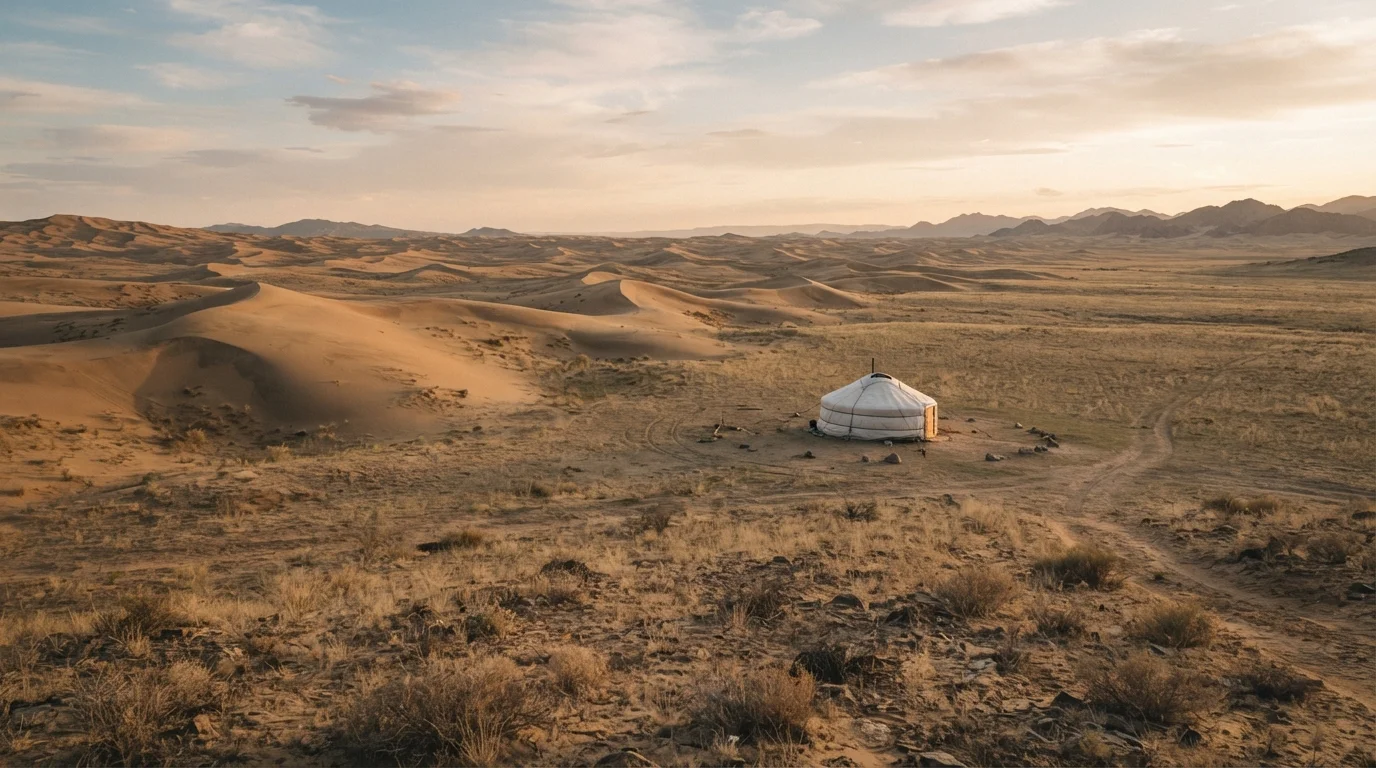
The fringes begin where the camp bookings run out. Administratively, this territory falls across the Ömnögovi, Dornogovi, and Dundgovi provinces, a combined expanse larger than many European countries. Landscapes shift from rocky desert pavements to salt flats, saxaul forest fragments, and the occasional freshwater spring that sustains a cluster of herding families. Wildlife - Bactrian camels, Gobi bears in their critically small population, snow leopards at altitude - exists here in fact rather than as a selling point.
Ger
A circular, portable dwelling used by Mongolian nomadic herders - essentially a latticed felt tent built for rapid assembly and insulation against extreme temperatures.
Aimag
A province-level administrative division of Mongolia. The Gobi fringes span several aimags, each with its own regional capital and administrative offices.
Strictly protected zone
A category of Mongolian conservation area with tighter access rules than a standard national park - entry typically requires advance permits and may be restricted to research or guided travel.
UAZ Furgon
A robust Russian-made four-wheel-drive van widely used across the Mongolian steppe for off-road transport due to its high clearance and mechanical simplicity that allows field repairs.
Tögrög
The official currency of Mongolia. Outside major urban centers, cash in tögrög is the only accepted payment method - card readers and digital payments are not available in rural areas.
Saxaul forest
A sparse, drought-adapted woodland of saxaul trees found in parts of the Gobi - a critical but fragile habitat that stabilizes desert soils and supports limited wildlife.
If you already know Bali and have done the Silk Road cities, the Gobi fringes offer something genuinely different: space, silence, and a form of hospitality that has nothing to do with the tourism industry. Getting there honestly requires confronting what that actually demands of a traveler.
Permits, Paperwork, and Entry Realities
Mongolia does not require a complex permit framework for most of its territory, but protected areas are the critical exception. Gobi Gurvansaikhan National Park - which contains the dunes, the Yol Valley, and significant wildlife habitat - requires an entry permit. Strictly protected zones within and adjacent to the park impose stricter limits and may require additional documentation.
Permits for national parks are generally arranged through Mongolia's Ministry of Environment and Tourism or its aimag-level offices. The process, fees, and lead times are subject to revision, so confirm current requirements through official government channels well before your travel dates. Do not assume permits can be purchased at park entrances - in remote fringe areas, there may be no staffed gate at all, but rangers do patrol and fines apply.
For the broader Gobi steppe outside protected zones, independent travel is generally unrestricted, though certain border-adjacent areas may require separate border zone passes - another item to verify with Mongolian authorities and your own government's travel advisory before departing. The planning errors that turn remote Asia trips into genuine ordeals are often administrative rather than logistical; our piece on underestimating logistics in off-grid Asia covers these gaps in detail.
Getting There: Transport Options Beyond Ulaanbaatar
Ulaanbaatar connects to Dalanzadgad via domestic flights on a schedule that can be irregular - delays and cancellations occur more often than on international routes, so build buffer days. A shared minibus (known locally as a mikr) runs between the capital and Dalanzadgad via a long and rutted road; it is cheap and authentic, but expect eight to twelve hours depending on conditions.
Once in Dalanzadgad, paved roads functionally end. All travel deeper into the fringes happens on unmarked dirt tracks across open desert. A capable 4WD vehicle - usually a Russian-made UAZ Furgon or a Toyota Land Cruiser - with a driver who knows how to read the terrain is the standard arrangement. Fuel is carried in additional jerrycans; there are no roadside stations once you leave the aimag center.
Build Driver Relationships Before You Need Them
The best fringe-route drivers are known by reputation in Dalanzadgad, not listed on booking sites. Arriving a day early and spending time at the local market or fuel station asking for referrals often yields better options than any online search. A driver with existing relationships along your intended route is worth more than a cheaper unknown - their contacts with herding families determine where you sleep and how safely you navigate.
Hiring a local driver through Dalanzadgad rather than contracting a Ulaanbaatar-based tour operator often means better terrain knowledge and more flexible routing, though it requires more on-the-ground negotiation. If you've never coordinated this style of overland travel before, our primer on vehicle travel as a first-timer sets useful expectations about the realities of road-based logistics in remote regions.
Where to Sleep When Ger Camps Run Out
Beyond the national park's organized camps, the primary accommodation reality is nomadic family homestays. Mongolian hospitality culture - zochid buudal at its most informal - means that approaching a herder's ger respectfully almost always results in an invitation to share tea, food, and floor space. This is not a commercial transaction in most cases, though bringing small gifts (sugar, tea bricks, sweets for children) and contributing meaningfully to any shared meal is the culturally appropriate response.
Camping independently is also widely practiced across open steppe and desert, though fires should be kept small or avoided given the fragility of the ecosystem. Carry a proper four-season tent rated for temperature swings, since even summer nights in the Gobi can drop sharply.
Homestays Are Not a Commercial Product
Nomadic family hospitality in the Gobi fringes operates outside the tourism economy. There are no booking platforms, no listed prices, and no formal cancellation policies. Arrangements are made in person through your driver's existing community relationships. Approach every family interaction as a guest, not a customer - bring appropriate gifts, respect household rhythms, and understand that your host's willingness is a form of generosity rather than a service transaction.
There are no booking platforms for Gobi fringe homestays. Arrangements happen in person, facilitated by your driver's existing relationships with herding families along a given route. This is precisely why a locally rooted driver-guide matters so much in this region.
Infrastructure, Connectivity, and What Not to Assume
Electricity exists at organized ger camps via generator or solar panel; beyond those, assume none. Charge all devices in Dalanzadgad before departure. Water sources in the fringe are wells, springs, and rivers - all of which require treatment before drinking. Carry a quality filter or purification tablets, and carry substantially more water than you think you'll need.
Mobile data drops away within an hour of leaving Dalanzadgad on most Mongolian networks. Download offline maps before you lose signal - applications like Maps.me or OsmAnd with Mongolia tiles loaded are considered standard kit. A satellite communicator (personal locator beacon or two-way satellite messenger) is strongly advisable for any multi-day fringe route; it is your only emergency communication option in much of this territory.
ATMs exist in Ulaanbaatar and Dalanzadgad. Beyond those two points, carry tögrög cash sufficient for your entire rural portion of the trip, including driver fees and contingency funds.
Practical Preparation Before You Go
The Gobi fringes are not a destination that rewards spontaneity. A realistic planning timeline begins at least three months before departure: time enough to resolve permits, arrange vaccinations (consult a travel medicine specialist about what is recommended for Mongolia), source appropriate gear, and build the local contacts that smooth logistics on the ground.
Health preparation deserves specific attention. Medical facilities in Ömnögovi province are basic; Ulaanbaatar's better hospitals are half a day's drive from Dalanzadgad at minimum. Travel insurance that explicitly covers medical evacuation is not optional in this context - verify the coverage terms carefully rather than assuming standard policies apply. For guidance on what your broader pre-departure checklist should cover, see our pre-departure checklist for remote Asia travel.
If this would be your first time in genuinely remote terrain, consider whether a supported first trip - with an operator who handles logistics - might be a more honest starting point than full independence. Our introduction to adventure travel for first-timers helps calibrate that decision without pressure.
Entry requirements, permit conditions, and travel advisories for Mongolia can change. Always verify current information through official government sources and your own country's foreign travel advisory service before making travel decisions.