
The Scenic Bypass Problem
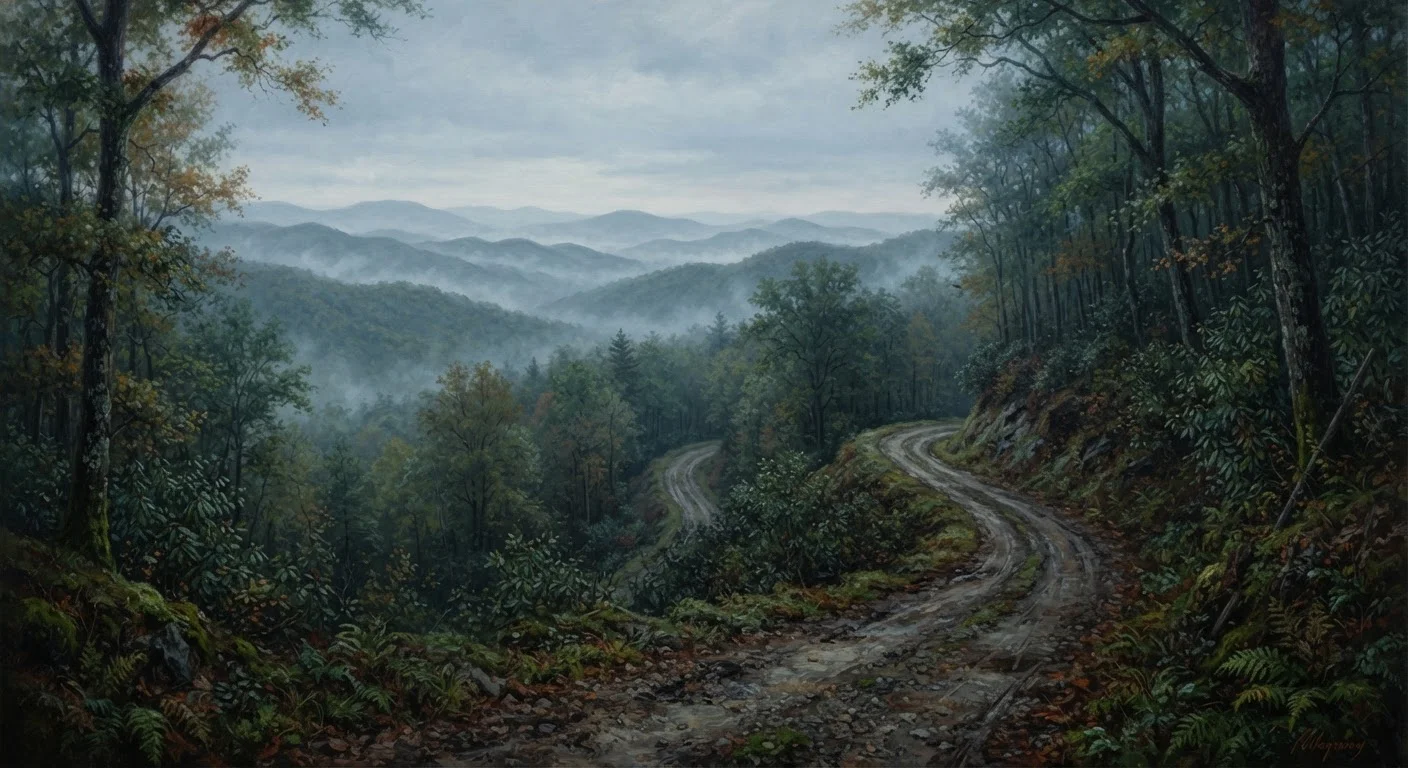
Most travelers encounter Appalachia from a moving car window - the Blue Ridge Parkway, Skyline Drive, or a themed fall-foliage loop. These routes are genuinely beautiful. But they are also, by design, corridors built to pass through the region rather than to deposit visitors inside it. If the parkway is your only lens, you will leave having seen mountains without having encountered Appalachia. Both classic routes offer distinct drives, but neither was designed to introduce you to the social fabric of the communities that exist a few miles off the ridge.
The traveler who exits at a designated overlook, photographs the haze over layered ridgelines, and continues north is not doing anything wrong. But they are missing the experience that makes this region genuinely extraordinary - and genuinely misunderstood.
423
Counties in the ARC's official Appalachian region
The Appalachian Regional Commission, a federal-state partnership, defines the region across 423 counties in 13 states - a geographic scope larger than many countries.
13
States that include Appalachian counties
According to the Appalachian Regional Commission, the region spans from southern New York to northeastern Mississippi, crossing dramatically different climatic, economic, and cultural zones.
~25M
People living within the Appalachian region
The ARC estimates the region's population at roughly 25 million - making it one of the most densely populated rural zones in the United States.
What "Appalachian" Actually Means
Appalachia is not a state, not a single culture, and not a synonym for poverty. It is a geographic and cultural zone the size of Western Europe in terms of internal diversity. The Appalachian Regional Commission counts 423 counties across 13 states in its official boundary, but cultural geographers argue that the lived experience of Appalachian identity doesn't map cleanly onto those administrative edges.
The region's character emerged from overlapping histories: the sovereign nations - Cherokee, Shawnee, Lenape, and others - whose territories predate European maps entirely; the waves of Scots-Irish and German settlers who moved into the backcountry in the 18th century; the African American communities whose presence, both free and enslaved, has been systematically underrepresented in popular Appalachian narratives; and the coalfield labor history of central Appalachia, which shaped entire county economies for over a century. Any traveler trying to understand one version of Appalachia as the Appalachia is misreading the map.
“Appalachia is not a problem to be solved. It is a place to be understood - and understanding it requires sitting with its complexity rather than resolving it into a simpler story.”
— Ronald D. Eller, Historian and author of 'Uneven Ground: Appalachia Since 1945'
Three Appalachias Travelers Rarely Distinguish
Northern Appalachia - parts of Pennsylvania's Ridge and Valley region, the Catskills fringe, the Allegheny Plateau - carries a distinctly industrial and immigrant labor heritage. Towns like Johnstown or Scranton are not scenic destinations in the conventional sense, but their architecture, museums, and community histories tell a story about American manufacturing and migration that has few equivalents.
Central Appalachia - the coalfields of eastern Kentucky, southern West Virginia, and southwest Virginia - is the zone most frequently flattened into stereotype. The economic disruptions following coal's decline are real and ongoing, but so is an extraordinary tradition of community resilience, visual art, and music that has produced some of the most distinctive creative voices in American culture. Places like Hindman, Kentucky or Grundy, Virginia offer the attentive traveler something no resort corridor can replicate.
Southern Appalachia - centered on western North Carolina and east Tennessee - has the region's most developed visitor infrastructure, including a robust craft economy anchored by institutions like the Penland School of Craft and the folk school tradition in Brasstown, NC. The Eastern Band of Cherokee Indians maintains a sovereign nation at the Qualla Boundary near Cherokee, NC, with its own museum, cultural programming, and community-set protocols for visitors. Approaching any of these communities with genuine curiosity rather than a checklist changes the quality of every interaction.
Research Before You Visit Indigenous Sites
Sovereign tribal nations set their own visitor protocols, photography policies, and cultural event guidelines. Before visiting the Qualla Boundary or any other Indigenous-administered site in Appalachia, check directly with the relevant tribal authority for current guidance. Respecting these boundaries is not just courteous - it's legally and ethically required.
How to Travel Appalachia's Interior Differently
The single most effective reorientation a traveler can make is to plan around towns rather than routes. Instead of plotting a parkway drive and noting what towns appear along it, identify a specific community - say, Elkins, West Virginia, or Marshall, North Carolina - and build a two- or three-day itinerary that treats it as a destination in its own right. Farmers markets, regional music festivals, county historical societies, and locally run restaurants reveal social texture invisible from a scenic overlook.
This approach mirrors what seasoned travelers discover when they leave the highway corridors in other mountain regions. The same misreading happens in the Carpathians, where the mountains are treated as scenery rather than as home to living communities with their own complex identities.
Accommodation choices matter here too. Regional bed-and-breakfasts, community-run lodges, and small-town inns circulate money directly through local economies in ways that highway-exit chains do not. This isn't a moral argument so much as a practical one: the people who run these places are usually the most informed and generous guides to their own communities.
Finally, questioning what you mean by "authentic" before you arrive is worth doing. Appalachia has spent generations being romanticized, pitied, and mythologized by outside observers. Travelers who arrive expecting either a theme park of folk tradition or a portrait of deprivation will find what they came looking for - and miss everything else.
Road and weather conditions in mountain Appalachia can change quickly, especially at elevation. Always verify current road status, seasonal closures, and any relevant travel advisories through official state and federal sources before departing. Entry conditions and site accessibility should be confirmed directly with relevant authorities or land managers.