
Built for Different Waters: Engineering and Scale
The single most defining difference between ocean ships and river vessels is straightforward: they are engineered for entirely different bodies of water, and that engineering shapes everything about your experience.
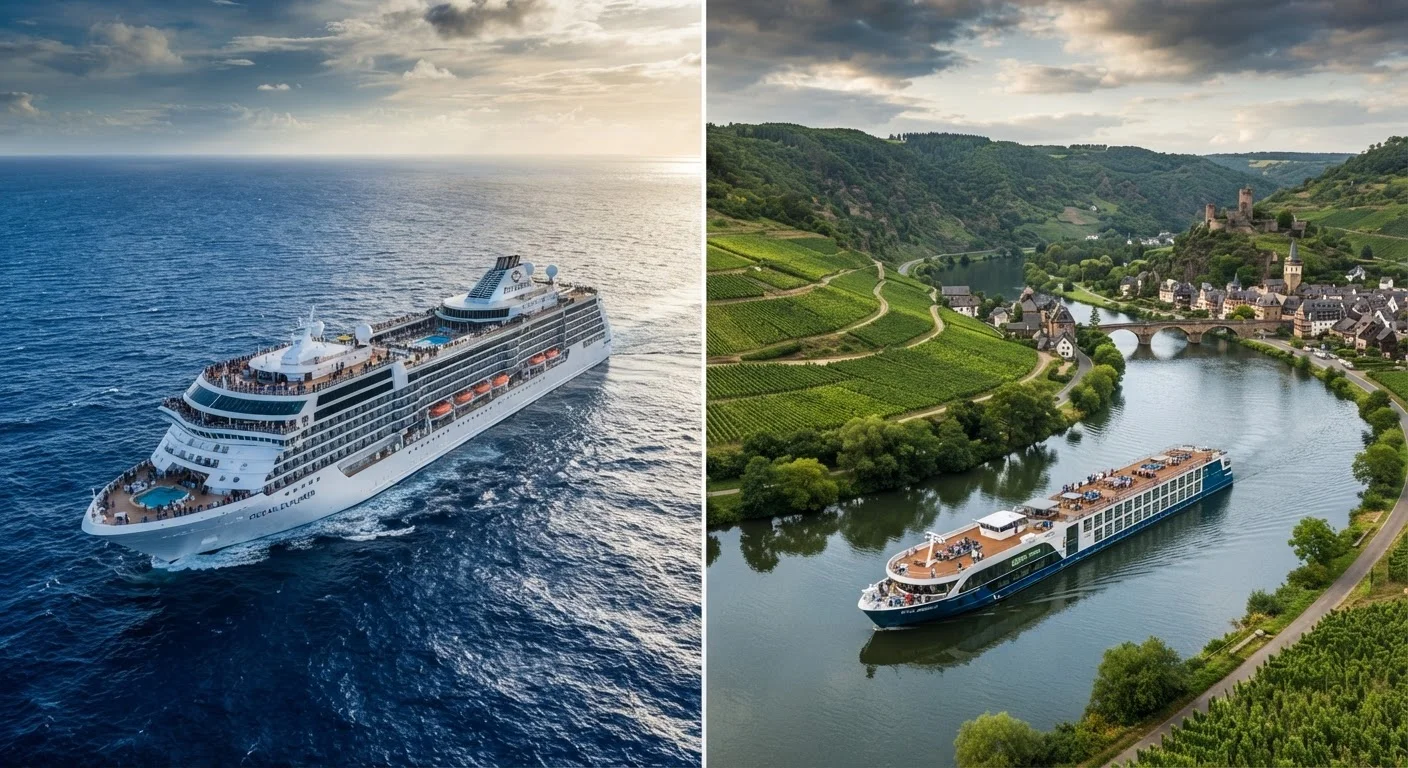
Ocean cruise ships - including mega-ships operated by mainstream lines and the more modestly scaled vessels favored by premium and luxury operators - are built to withstand open-sea conditions. They range from roughly 30,000 gross tons for smaller expedition and luxury ships to more than 230,000 gross tons for the largest class of resort-style liners. Passenger capacity follows suit, from a few hundred to over 6,000 guests aboard the most expansive vessels. Hull depth, stabilizer systems, and redundant propulsion are all engineered for oceanic demands.
River vessels exist in an entirely different engineering category. To navigate the Rhine, Danube, Mekong, or Amazon - waterways with fixed bridge clearances, shallow seasonal depths, and narrow locks - these ships must be dramatically constrained in height, width, and draft. Europe's most common river cruise ships typically measure around 135 meters in length and 11 meters in beam, dictated by the dimensions of the Rhine-Main-Danube canal lock system. Passenger counts usually fall between 100 and 200 guests. That's not a luxury affectation - it's a physical necessity.
This constraint has a direct cascading effect on the onboard experience, from cabin dimensions to the number and type of public spaces available. Understanding how ship class shapes onboard experience is equally relevant here: within river cruising, newer vessels built in the last decade often feature more light-filled, open-plan designs than their predecessors, even within the same size envelope.
Onboard Life: Amenities, Dining, and Social Scale
Step aboard a large ocean ship and the scope is immediately apparent. Multiple pools, a spa complex, multiple dining rooms and specialty restaurants, live entertainment venues, casinos, retail, and activity programming fill a vessel that functions more like a floating resort district than a single ship. Navigating onboard dining options is itself a subject worth exploring, given how meaningfully the choices differ from venue to venue.
River vessels operate on an entirely different hospitality philosophy. Public spaces are purposefully limited: a main lounge, a dining room (usually a single seating serving all guests), a small sundeck, and sometimes a modest fitness area. What river ships lack in breadth, thoughtful operators compensate for with quality - curated local menus, regional wines included in fare, and excursion programming designed by destination experts rather than generalist entertainment directors.
| Criterion | Ocean Cruise Ships | River Cruise Vessels |
|---|---|---|
| Passenger Capacity | 500-6,000+ guests | Typically 100-200 guests |
| Vessel Size | 30,000-230,000+ gross tons | Constrained by waterway dimensions |
| Onboard Amenities | Pools, spa, casino, theaters, specialty dining | Lounge, dining room, sundeck, limited spa |
| Port Access | Major ports, sometimes via tender | City-center docking, walk-off access |
| Motion & Stability | Open-sea swells; stabilizers fitted | Calm river water; highly stable |
| Itinerary Pace | Mix of sea days and port days | Daily port stops typical |
| Social Atmosphere | Large, anonymous crowd | Intimate, familiar group dynamic |
| Destination Focus | Balanced between onboard and ashore | Heavily destination-focused |
The social dynamic also diverges sharply. On a 3,000-passenger ocean ship, you may never cross paths with the same travelers twice. On a river vessel, you'll share meals, excursions, and lounges with the same 130 people for the full duration - an intimacy that suits some travelers enormously and others not at all.
Itinerary Logic: How Each Format Approaches Destinations
Ocean itineraries typically balance time at sea with port days, and the ratio varies significantly by route. Transatlantic crossings and longer Pacific voyages may include several consecutive sea days; Caribbean loops often alternate between sea and port. Ports themselves - Nassau, Cozumel, Juneau - are usually visited for six to ten hours before the ship repositions overnight.
River itineraries are structurally different. Because the vessel is always near land and the waterway itself is the highway between stops, most river cruises include a port visit every day. Docking is almost always directly in town - meaning your walk from gangway to the town square might be two minutes rather than a tender ride and bus transfer. This proximity enables a genuinely different kind of port experience: early-morning walks before the crowds, evening meals ashore, and the ability to linger independently rather than return by ship's curfew.
For travelers drawn to Europe's historic interior - castles along the Moselle, medieval walled towns of the Douro Valley, Budapest's riverfront grandeur - this kind of access is difficult to replicate any other way. How Europe's major river routes each tell a different story is worth reading if you're weighing which waterway fits your interests.
Expedition Ships: A Third Category Worth Knowing
Neither ocean mega-ship nor river vessel, expedition cruise ships occupy a distinct middle ground - small enough to reach remote polar and island destinations, purpose-built for zodiacs and shore landings in untouched environments. If neither mainstream ocean cruising nor river itineraries quite match your ambitions, expedition cruising versus classic cruising is a useful comparison to explore. These vessels serve an entirely different traveler profile from either format discussed here.
For context on how river and ocean experiences compare at the broader voyage level, our overview of ocean versus river cruising covers the full experiential picture beyond ship design alone.