
Three Rivers, Three Very Different Journeys
Europe's river cruise market is dominated by three iconic waterways - the Rhine, the Danube, and the Douro - yet travelers often treat them as interchangeable options when they are anything but. Each river has a distinct character shaped by its geography, the cultures it passes through, and the type of ports it connects. Understanding those differences before booking matters as much as choosing the right ship class. For context on why vessel design shapes the experience, see how ocean ships and river vessels differ.
The Rhine, Danube, and Douro share the river cruise format - long, narrow ships, close-to-shore views, and port-intensive itineraries - but diverge sharply from there. What follows is a structured comparison of landscape, cultural depth, pace, and traveler fit across all three.
| Rhine | Danube | Douro | |
|---|---|---|---|
| Typical itinerary length | 7-8 days | 10-15 days | 7-8 days |
| Landscape character | Castle-studded gorges, vineyards | Plains, mountains, capital cities | Terraced wine estates, schist hills |
| Cultural sweep | Western European depth | West-to-East European breadth | Focused Portuguese wine culture |
| Port size and crowd level | Moderate to busy | Varies widely | Small, quiet, low crowds |
| Pace | Fast-moving, port-intensive | Balanced mix of active and scenic | Slow, immersive, reflective |
| Best suited for | First-timers, sight-density seekers | History enthusiasts, longer voyagers | Wine lovers, slow-travel advocates |
| Ship size | Standard river vessels | Standard river vessels | Smaller, purpose-built ships |
The Rhine: Medieval Density and Dramatic Scenery
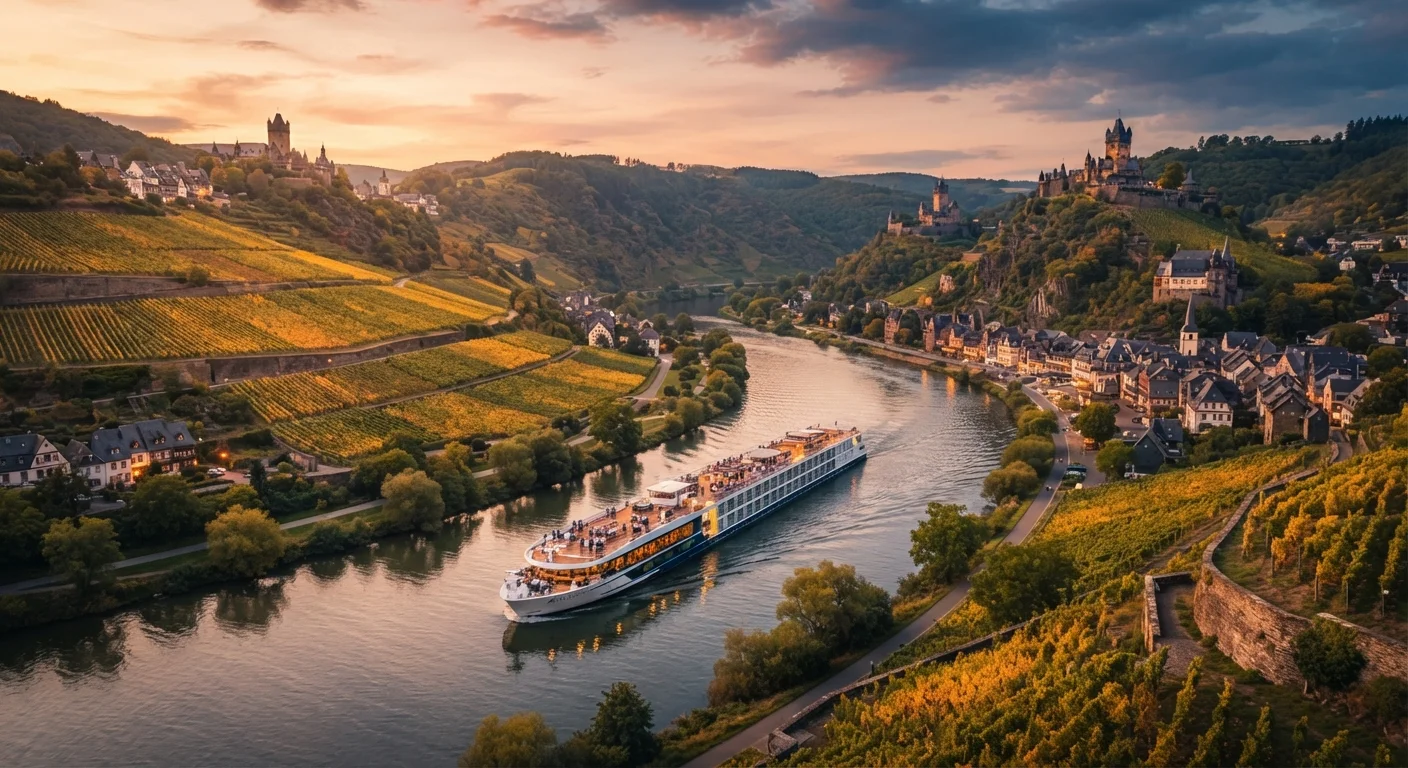
The Rhine is the river cruise world's most storied corridor, and it earns that reputation through sheer concentration of landmarks. The classic Basel-to-Amsterdam route packs castle ruins, Gothic cathedrals, vineyard-clad gorges, and UNESCO-listed stretches into just seven to eight sailing days. The Middle Rhine Gorge - between Koblenz and Bingen - delivers the most visually arresting river scenery in Western Europe, with Lorelei rock, Marksburg Castle, and dozens of hilltop fortifications visible from the ship's sun deck.
Ports such as Rüdesheim, Breisach, and Strasbourg offer immediate walkability: passengers are steps from wine cellars, Christmas market squares, and half-timbered old towns. The Rhine moves at a faster pace than its counterparts - itineraries tend to port-hop daily, which suits travelers who want to cover ground efficiently. The trade-off is less time to linger.
Timing Your Rhine Sailing Matters
The Rhine Gorge is spectacular year-round, but spring (April-May) and autumn (September-October) offer cooler temperatures, fewer crowds, and vivid seasonal color. Winter sailings around the Christmas markets are popular but book up well in advance. Avoiding peak summer can meaningfully change the experience at smaller ports like Rüdesheim.
The Rhine also has the most mature cruise infrastructure of the three rivers, meaning a wider range of ship classes and onboard concepts. That variety can work for or against you - see why ships within the same cruise line can feel completely different before committing to a particular vessel.
The Danube: Cultural Breadth Across Two Worlds
The Danube is Europe's longest river cruise route and its most culturally layered. Standard itineraries run between Passau or Regensburg and Budapest - sometimes extending to Bucharest or the Black Sea on longer sailings - threading through Austria, Slovakia, Hungary, Serbia, and Romania. No other European river cruise route transitions so visibly from the prosperous, cathedral-dense cities of Western Europe into the Ottoman-influenced towns and agrarian plains of the East.
Vienna and Budapest are the twin anchors: both cities merit overnight stays, and the best itineraries build them in. Beyond those capitals, stops like Bratislava, Novi Sad, and the Wachau Valley (another UNESCO Cultural Landscape) add layers that reward curiosity. Travelers interested in discovering lesser-visited corners of Europe will find the Danube's eastern stretches particularly rich - smaller ports like Melk, Dürnstein, and Vukovar carry histories that most visitors simply never encounter.
The Danube suits travelers who want their river cruise to function as a cultural education as much as a scenic experience. Itineraries are typically longer - 10 to 15 days - and the pace balances active port days with slower stretches of pastoral countryside.
2,860 km
Total navigable length of the Danube
The Danube passes through or borders 10 countries, making it Europe's most internationally connected river cruise corridor.
~200 km
Navigable Douro cruise length
The relatively short navigable stretch of the Douro concentrates the itinerary into an intimate, landscape-focused experience.
The Douro: Intimacy, Wine, and the Road Less Sailed
The Douro in northern Portugal is the outlier - shorter, less traveled, and deliberately slow. Itineraries typically sail between Porto and the Spanish border town of Barca d'Alva, covering roughly 200 kilometers through the UNESCO-listed Douro Valley wine region. The landscape is the defining feature: terraced quintas (wine estates) climb sheer schist hillsides above the river, and the light at dusk turns the valley into something closer to a painting than a cruise backdrop.
What the Douro lacks in city stops it compensates for in vineyard culture. Port wine tastings at working quintas, olive oil estates, and small-village walking tours replace the museum-heavy itineraries of the Rhine and Danube. Stops are quiet - Régua, Pinhão, Peso da Régua - and the absence of large tourist crowds is precisely the draw. Travelers who have already done the major European capitals and are searching for something more grounded will find the Douro unexpectedly rewarding. For a sense of the broader appeal of off-the-beaten-path European travel, Europe's overlooked villages offer a comparable sense of discovery.
One practical note: the Douro's lock system and five navigable dams mean itineraries are tightly managed by river conditions. Ships here are also smaller than Rhine or Danube vessels, adding to the intimate character. For travelers comparing river cruising against ocean itineraries, Mediterranean cruise itineraries offer a useful point of contrast in terms of port density and pace.