
The Brand Assumption That Catches Cruisers Off Guard
When experienced travelers research a new destination, they investigate neighborhoods, not just cities. The same logic applies to cruise ships - yet most cruisers book by brand first and investigate the actual vessel only as an afterthought, if at all.
A cruise line is a corporate umbrella. Under that umbrella you may find ships launched across multiple decades, built to entirely different design briefs, operating under distinct onboard concepts, and carrying passenger loads that range from intimate to stadium-scale. The brand guarantees certain baseline standards - loyalty program continuity, broadly consistent service philosophy - but it does not guarantee that your 12-night sailing will feel like the one your friends took on a different ship last year.
This is the single most common misconception among repeat cruisers: that a positive experience on one ship transfers automatically to another ship flying the same flag. Matching your travel style to the right cruise line is a useful starting point, but it's only the first layer of research. The ship itself is the second - and arguably more consequential - layer.
Assuming all ships in a fleet deliver the same onboard experience because they share a brand name.
Why it happens: Cruise line marketing emphasizes brand identity - signature dining concepts, loyalty programs, and service standards - which implies consistency across the entire fleet.
Ignoring a ship's build year and whether it has been meaningfully refurbished.
Why it happens: Booking interfaces typically lead with destination and price, making it easy to overlook that a 20-year-old vessel may carry the same logo as a ship launched last year.
Underestimating how dramatically passenger capacity changes the onboard atmosphere.
Why it happens: Two ships from the same line might carry 2,000 and 5,000 passengers respectively, but this rarely registers as significant during the booking process.
Overlooking how dining concepts vary by ship class rather than by cruise line alone.
Why it happens: A line's signature restaurant concept may only exist on certain ships or in a limited form on older vessels, but this is rarely front-and-center during the sales process.
Assuming solo traveler or family-specific amenities are consistent across the fleet.
Why it happens: Lines that market themselves as family-friendly or solo-welcoming often have newer ships built with those demographics in mind, while older ships were designed under different assumptions.
What Actually Differs Between Ships on the Same Line
Once you start looking at ships individually, the variation becomes striking. Here are the dimensions that matter most:
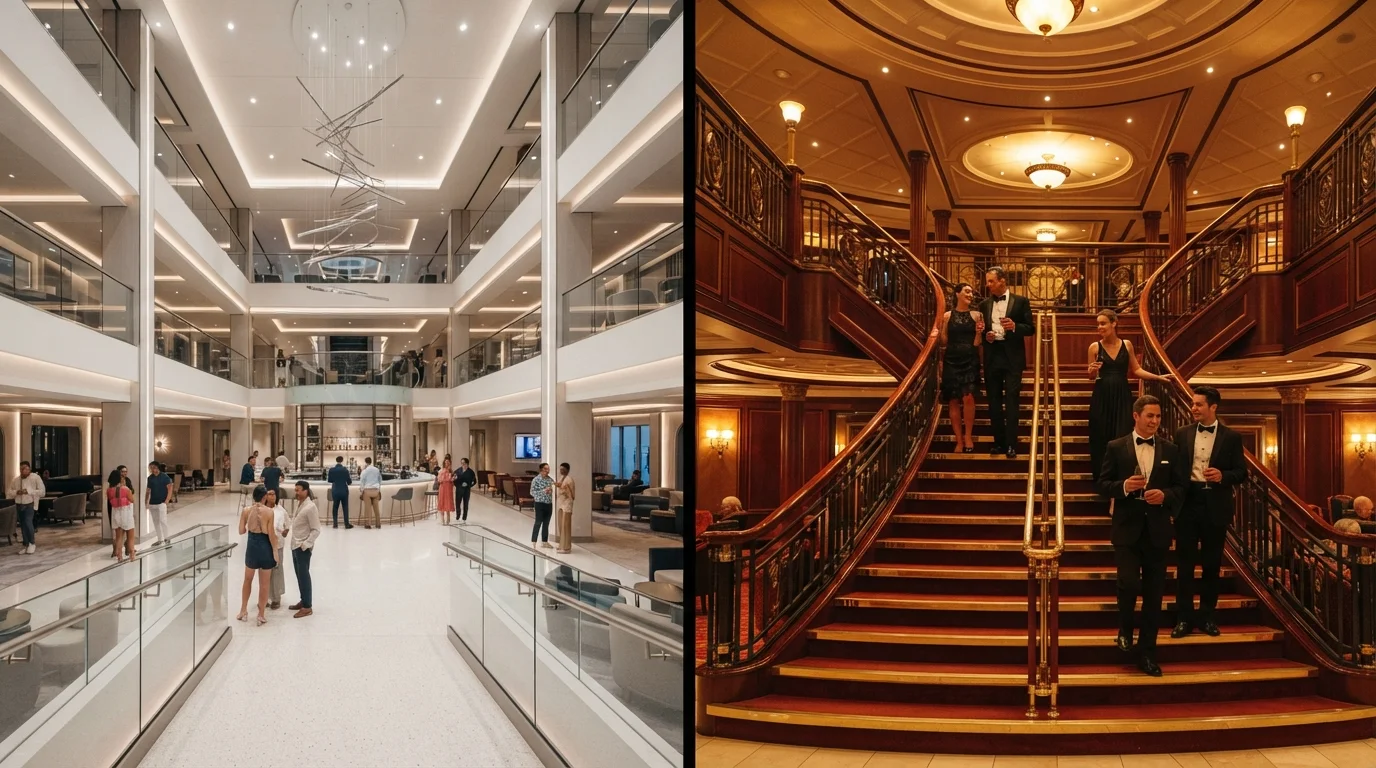
- Ship class and design era: Newer ship classes are typically built around a central entertainment and dining concept that older classes simply weren't designed to support. Retrofitting a 15-year-old vessel with a newer dining philosophy is expensive and structurally limited, so the experience often remains tied to the era in which the ship was built.
- Passenger-to-space ratio: This metric - total gross tonnage divided by passenger capacity - tells you more about onboard comfort than any marketing copy. Two ships from the same line can have meaningfully different ratios depending on when they were built and what the design priorities were at the time.
- Entertainment and programming: Broadway-style productions, immersive theme nights, and technology-forward activities tend to exist on newer vessels. Older ships may offer a more traditional entertainment format, which suits some travelers perfectly and disappoints others.
- Connectivity and cabin infrastructure: Stateroom size standards, storage design, bathroom configurations, and in-cabin entertainment systems all reflect the year a ship was built. A balcony cabin on a ship launched a decade apart can feel like a different product category entirely.
For cruisers who prioritize dining, the variation is especially pronounced. Each dining venue onboard serves a different experience, and the number and quality of those venues depends heavily on which ship you're on - not which line you've chosen.
Brand Loyalty Without Ship Research Is a Gamble
Returning to a cruise line you've enjoyed before does not guarantee a comparable experience if you're sailing on a different ship class. A line's flagship vessel and its older mid-tier ship can differ in dining options, entertainment format, cabin quality, and passenger-to-crew ratio. Always verify the specific ship before booking, not just the brand.
Seasoned cruisers evaluate a specific set of ship details beyond itinerary and price. Adopting that habit - even partially - can prevent a significant mismatch between expectation and reality.
20+
Ship classes some major lines operate simultaneously
Large cruise corporations can operate fleets spanning more than two decades of vessel generations, each built to a different design brief and passenger experience standard.
2-3x
Passenger capacity difference within a single brand's fleet
It is common for a cruise line's smallest and largest active ships to differ by a factor of two to three in passenger capacity, creating fundamentally different crowd dynamics.
5-10 years
Typical interval between major ship refurbishments
Industry practice generally sees significant dry-dock refurbishments scheduled every five to ten years, leaving noticeable gaps in onboard product quality between older and newer ships.
Refurbishment Timelines Are Not Always Publicized
Older ships in a fleet may be scheduled for dry-dock refurbishment, but these timelines are not always prominently disclosed during booking. If the condition of onboard spaces matters to you, check the ship's last refurbishment date independently. Cruise forums and enthusiast communities can surface this information before it appears in official marketing materials.