
What Makes Overnight Flights Biologically Different
Flying overnight isn't simply flying at an inconvenient hour - it actively conflicts with one of the most deeply embedded systems in your body. Your circadian rhythm doesn't care that you have a flight to catch. Between roughly 10 p.m. and 6 a.m., your core body temperature drops, melatonin rises, alertness falls, and your digestive system slows. Boarding a plane during this window means subjecting your body to stimulation, stress, and environmental change at the precise moment it's primed for stillness.
Daytime flights land during waking hours when your system is already operating. Overnight flights land after a night of disrupted, fragmented sleep - or no sleep at all - and then expect you to function. That asymmetry explains why two travelers on the same route feel dramatically different depending on when their flight departs.
As the distinction between jet lag and travel fatigue makes clear, these aren't the same condition - and overnight flights can trigger both simultaneously, compounding recovery time.
The Cabin Environment Actively Works Against Sleep
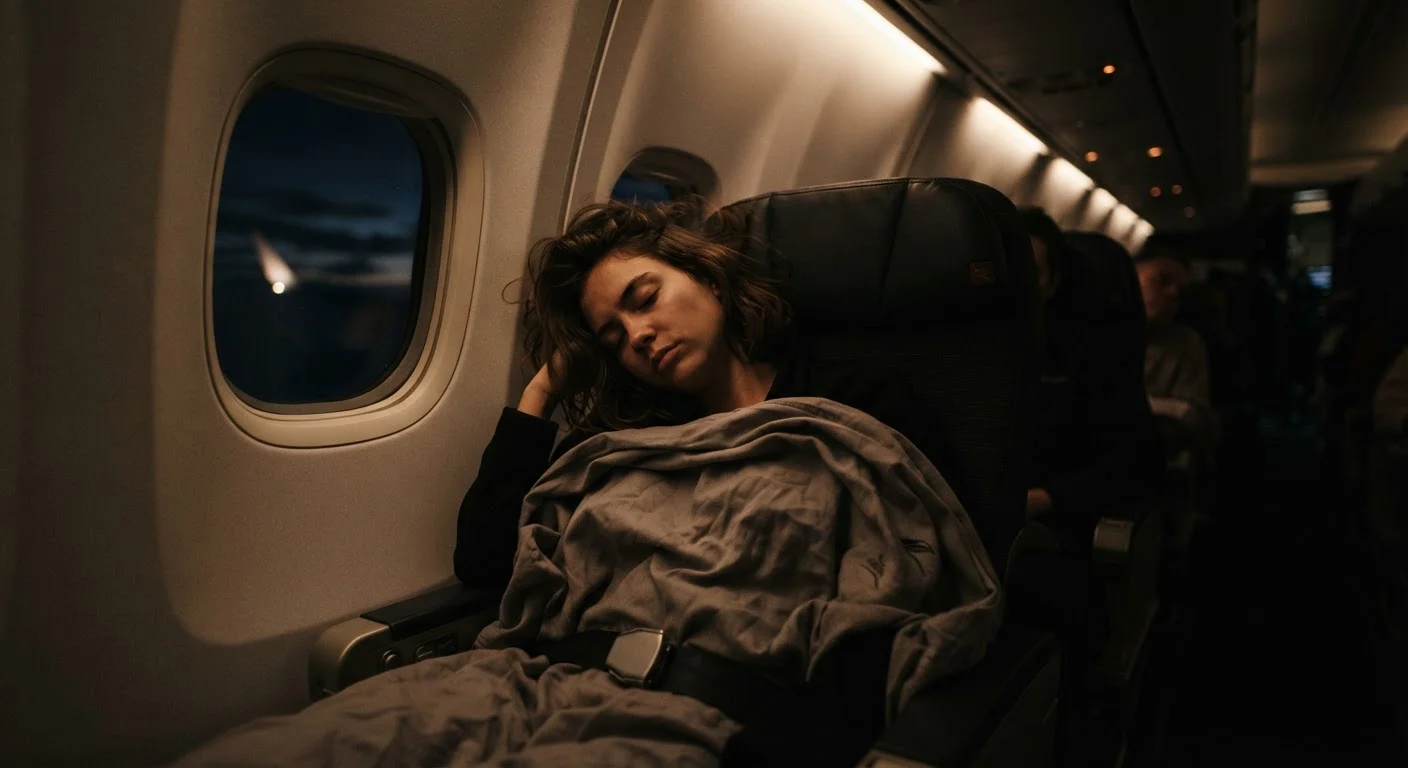
Even passengers who manage to close their eyes on overnight flights rarely get restorative sleep. Aircraft cabins operate at cabin altitude equivalents typically between 6,000 and 8,000 feet, reducing blood oxygen saturation slightly compared to sea level. Lower humidity - often dropping below 20% in-flight - contributes to dehydration, which in turn affects cognitive function and energy levels. These aren't discomforts you adapt to quickly; they accumulate across a flight.
Artificial lighting is particularly disruptive. Even low-level overhead cabin lighting, screen use, and the glow of other passengers' devices can suppress melatonin production, making it harder to initiate sleep. Some airlines dim cabins on night flights, but the light environment is rarely dark enough to fully support sleep onset.
Block Light Before You Try to Sleep Onboard
Put on your eye mask and cease screen use at least 30 minutes before you intend to sleep on a night flight. This gives your melatonin levels time to rise despite the disruptive cabin environment. A quality eye mask that fully blocks light - including from below - makes a measurable difference in how quickly you can initiate sleep at altitude.
Seat geometry matters too. Economy seats that restrict recline force passengers into positions that compress the diaphragm and reduce oxygen intake - further degrading sleep quality. Lie-flat seats help, but they don't resolve the underlying circadian and environmental challenges.
Avoidable in-flight mistakes - like skipping hydration or relying on alcohol as a sleep aid - make these conditions significantly worse. Alcohol may accelerate sleep onset but measurably reduces REM sleep, leaving travelers feeling worse on arrival despite having technically slept.
How Experienced Travelers Approach Recovery
Seasoned frequent flyers treat post-overnight-flight recovery as a structural planning issue, not a willpower question. Returning exhausted is often a planning failure, not a personal failing - and the same principle applies to overnight flight recovery.
6,000-8,000 ft
Typical aircraft cabin pressure altitude
The FAA requires cabin pressure equivalent to no higher than 8,000 feet, which mildly reduces blood oxygen and can contribute to fatigue during long flights.
<20%
Typical in-flight cabin humidity
Aircraft cabin humidity commonly drops well below 20% during long flights, compared to typical indoor comfort levels of 30-50%, accelerating dehydration.
1-1.5 days
Per time zone crossed for adjustment
A widely cited general estimate is that the body adjusts at roughly one to one-and-a-half days per time zone crossed, though individual variation is significant.
Practical strategies that experienced travelers rely on:
- Light anchoring: Seeking bright natural light immediately upon arrival (or avoiding it, depending on the direction of travel) is one of the most evidence-supported methods for resetting circadian timing.
- Strategic napping: Limiting post-flight naps to under 30 minutes prevents full sleep cycle entry, which would otherwise make nighttime sleep harder and prolong adjustment.
- Scheduling margin: Blocking the first partial day after an overnight arrival for low-demand activity rather than meetings or intensive sightseeing. Flight timing decisions extend well beyond cost - arrival time shapes your entire first day.
- Pre-flight sleep shifting: Adjusting bedtime by 30-60 minutes in the days before an eastward overnight flight can soften the landing-day deficit, though individual responses vary.
None of these strategies eliminate the disruption entirely - but they meaningfully shorten recovery and reduce the severity of impairment travelers experience in the first 24-48 hours after arrival.