
What Fare Classes Actually Are
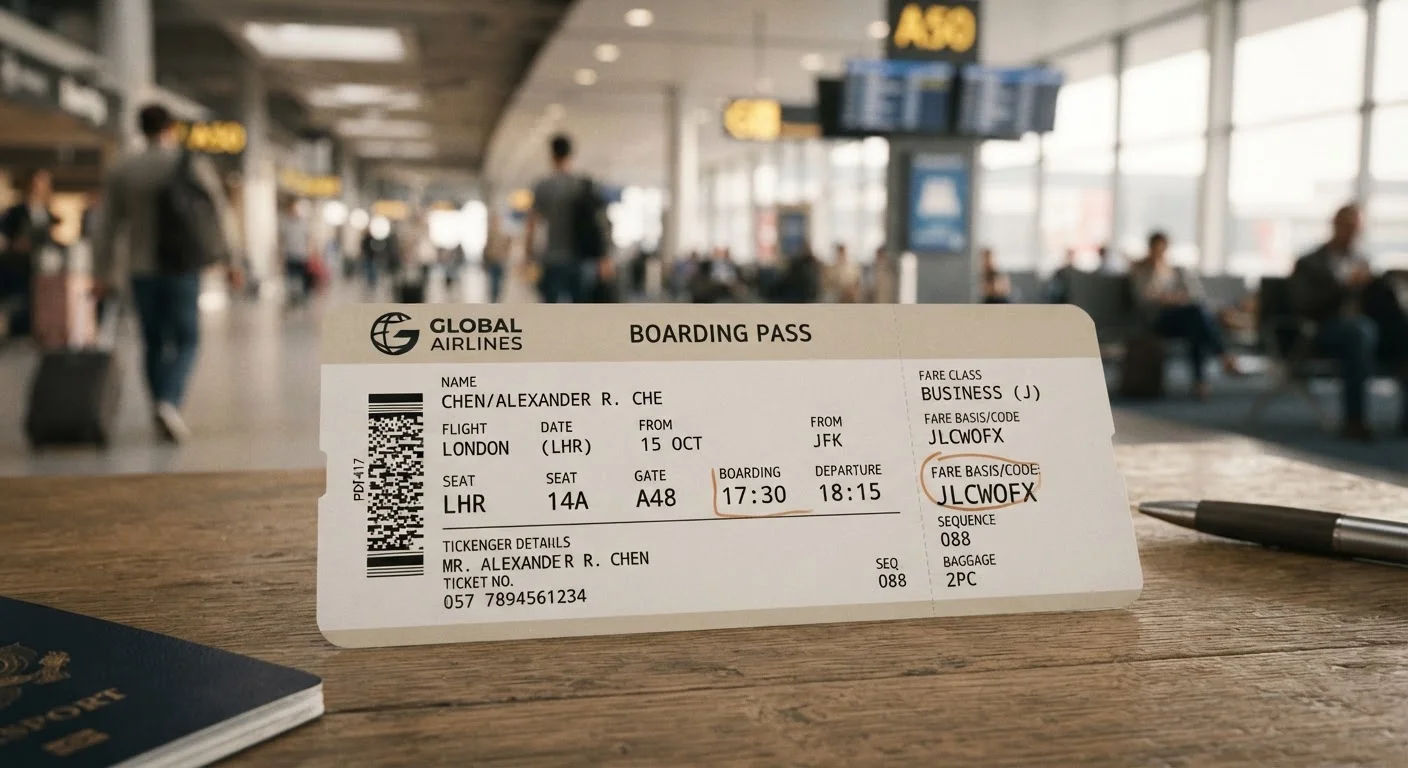
When you purchase a flight, you're not just buying a seat - you're buying into a specific inventory bucket governed by a single letter code. That letter is your fare class, and it sits embedded in your ticket's booking record, invisible to most travelers but absolutely central to how your trip will unfold.
Airlines divide each cabin into multiple fare classes to maximize revenue across different buyer segments. An economy cabin on a domestic route might contain eight or more distinct fare classes - from a deeply discounted G or Q class all the way up to Y, the full-fare economy code. Each bucket opens and closes as demand fluctuates, which is why the same seat can carry a very different price depending on when you search. For a deeper look at how that pricing mechanism works, see how dynamic pricing and fare classes interact.
8-12
Fare class buckets per cabin on major routes
Revenue management experts note that large network carriers commonly operate eight or more distinct fare classes within a single economy cabin on competitive routes.
25-150%
Mileage accrual range by fare class
Frequent flyer program earning rates across major U.S. carriers vary from as low as 25% of miles flown on the cheapest economy codes to 150% or more on premium business class fares.
72 hrs
Typical fare class repricing cycle window
Industry revenue management practitioners generally acknowledge that fare class availability can shift within hours, with significant repricing events common in the 72-hour window before departure.
Decoding the Letter Codes
While letter assignments vary by airline, certain conventions are broadly consistent across major U.S. and international carriers:
- F / A - First class, typically full-fare and fully flexible
- J / C / D - Business class, ranging from full-fare to discounted business inventory
- W / S - Premium economy codes used by carriers that offer this cabin
- Y - Full-fare economy; the most flexible and highest-earning economy code
- B / M / H / K / L / Q / N / G / V - Progressively discounted economy classes with increasingly restrictive rules
The exact meaning of each code is carrier-specific. A letter that means one thing on one airline may represent a completely different fare tier on another. For a plain-language glossary of booking codes across cabin types, the fare classes and booking codes reference guide is a useful companion resource.
Always Check Fare Rules Before You Book
The fare class code is displayed in your booking details before purchase on most airline websites and major booking platforms. Look for the "fare rules" or "ticket conditions" link to review change fees, refund eligibility, and mileage accrual rates for your specific code. Spending two minutes on this step can prevent significant frustration - and unexpected costs - later.
How Fare Class Affects Your Travel Experience
Three areas of your trip hinge directly on your fare class:
Mileage Accrual
Frequent flyer programs don't reward distance flown uniformly. They reward distance flown multiplied by your fare class earning rate. A traveler in a discounted economy class may earn 25-50% of base miles, while one in full-fare economy earns 100% or more. Business class codes typically earn 125-150%. If miles matter to your travel strategy, check the earning table for your specific code before confirming your booking.
Change and Cancellation Rules
The fare rules attached to your booking code determine whether you can change your itinerary, how much it costs, and whether any refund is possible. Discount codes are often non-refundable and may prohibit same-day changes. Full-fare codes - Y in economy, J in business - carry maximum flexibility, which is why corporate travelers and those with unpredictable schedules often pay a premium for them.
Upgrade Eligibility
Elite status doesn't guarantee a complimentary upgrade from every fare class. Most major airlines restrict complimentary cabin upgrades to mid-tier or higher economy codes. Buying the cheapest available ticket - even as an elite member - can lock you out of upgrade consideration entirely. Reviewing the upgrade eligibility rules for your fare class at purchase is a straightforward way to set accurate expectations.
Making Fare Class Work for You
Fare class literacy translates directly into better decisions at booking. When flexibility is essential - business travel, uncertain itineraries, or international connections where a missed leg creates real complications - paying for a higher fare class is a deliberate trade-off, not an upsell. When the itinerary is fixed and disruption unlikely, a lower class may represent a reasonable cost reduction with minimal practical downside.
Always read the full fare rules before purchasing, not just the headline price. Most booking platforms surface fare class codes and their associated rules in the details screen before you confirm. Taking 60 seconds to review those terms is one of the simplest ways seasoned travelers avoid costly surprises.
“Airline pricing is not arbitrary - it is a precise, real-time matching of supply to demand. The fare class system is the mechanism that makes that matching possible, and travelers who understand it are better equipped to navigate it.”
— An airline revenue management expert, Industry practitioner in airline pricing and inventory optimization