

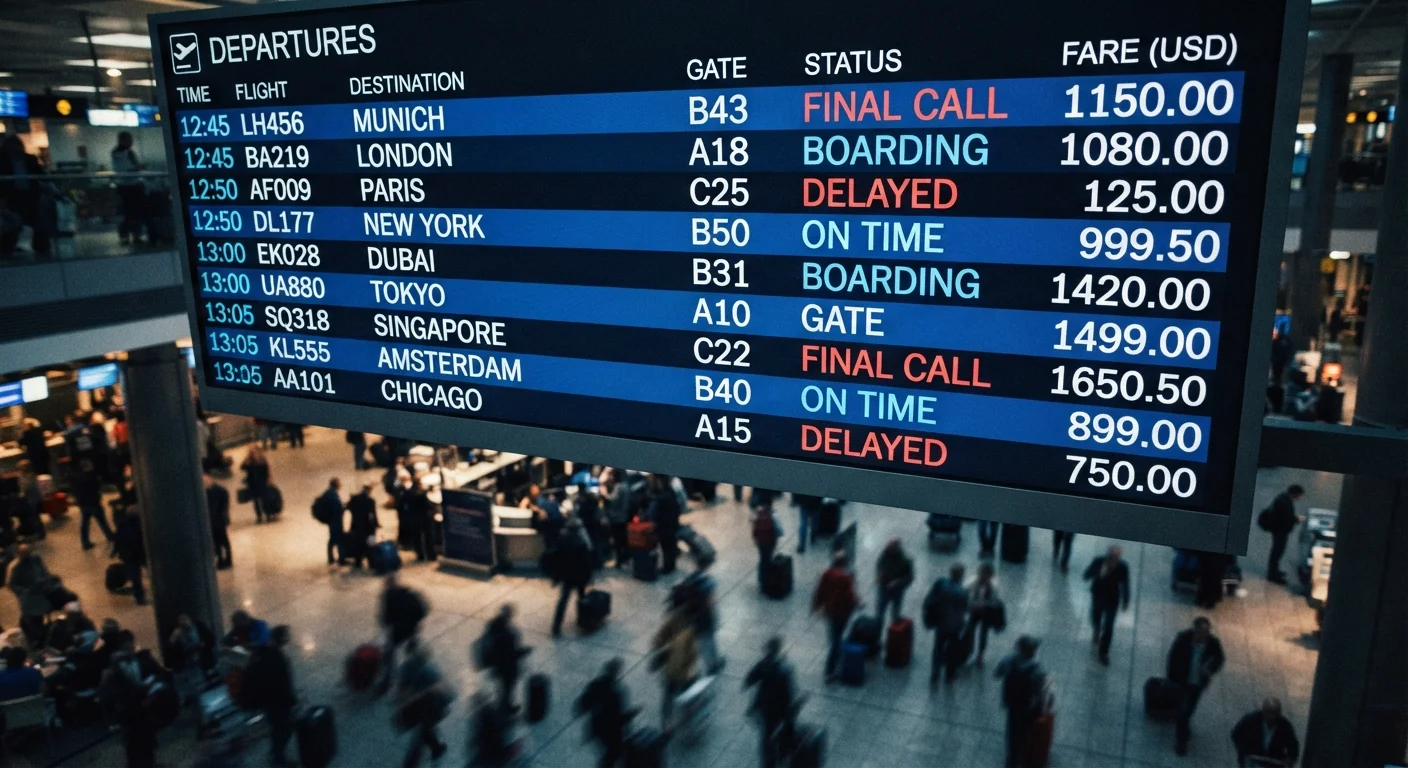
Fare Classes: The Invisible Architecture Under Every Price
When you buy an airline ticket, you're not buying a physical seat - you're purchasing access to a specific fare class (also called a booking class), identified internally by a single letter code. Economy cabins alone can contain a dozen or more fare classes, each representing a separate pricing bucket with its own price point, availability cap, and conditions around changes, refunds, and mileage accrual.
The critical mechanic: these buckets are finite. Airlines pre-allocate a limited number of seats to each fare class on any given flight. When the cheapest bucket sells out - even if just a handful of seats filled it - the system automatically closes that tier and only the next, pricier bucket remains available. This is why a fare can jump $80 overnight after a handful of purchases, not because demand surged dramatically, but because one pricing level simply closed.
For a deeper look at how these letter codes translate into real-world upgrade eligibility and flexibility, see how airline fare classes work in practice.
Check Fare Rules Before Assuming Flexibility
A low headline price often comes with the most restrictive fare class rules: no changes, no refunds, reduced mileage accrual, and last-priority seat selection. Before booking the cheapest available option, review the specific fare conditions - particularly if your trip involves any schedule uncertainty. The gap between a base-economy and a standard-economy fare can be smaller than the cost of a single change fee.
The Demand Signals Airlines Actually Watch
Airlines don't set prices based on gut feel - their yield management systems process multiple inputs simultaneously and adjust inventory in response. The key demand signals include:
- Search and booking velocity: A spike in searches or purchases on a specific route signals rising interest, prompting the system to close lower-priced inventory faster.
- Historical load data: If a route filled to 90% capacity on the same week in previous years, the algorithm anticipates similar demand and prices more aggressively early.
- Competitive pricing: Airlines monitor competitor fares on shared routes and may match, undercut, or hold firm depending on their load position and strategy.
- Departure date proximity: As the flight date approaches, the system increasingly favors higher-yield passengers - primarily business travelers booking late - and may pull cheaper inventory earlier than expected.
Route competition is among the most powerful fare moderators. On city pairs served by multiple carriers, particularly where a low-cost operator competes, base fares are demonstrably lower than on routes with limited competition.
12-14
Typical fare classes in a single economy cabin
Airlines commonly structure economy seating into a dozen or more distinct booking classes, each with different pricing and restriction profiles, per industry yield management standards.
~47%
Of US routes with limited or no competition
A U.S. Government Accountability Office analysis found that a substantial share of domestic routes are served by only one or two carriers, directly correlating with higher average fares.
Up to 7x
Fare range on the same flight
Aviation researchers have documented cases where the highest and lowest fares sold on a single domestic flight differ by a factor of seven or more, reflecting the full span of fare class tiers.
Why the Same Route Prices Differently by Travel Date
A Tuesday in February and a Friday before a holiday weekend are not remotely comparable in airline pricing terms, even on the identical route. Airlines segment their calendars precisely because demand is not uniform. Peak travel periods - major holidays, school breaks, summer vacation windows - trigger earlier inventory compression, meaning cheaper fare classes sell out faster and the price curve rises sooner.
Shoulder periods work in reverse: lower anticipated demand means airlines hold cheaper inventory open longer and may release discounted fares closer to departure to stimulate bookings. This dynamic is particularly pronounced on leisure-heavy routes where the traveler population is price-sensitive.
The day and time of the actual flight also affects pricing in ways that go beyond cost. Flight timing affects far more than just price - from load factors to operational reliability.
A parallel dynamic plays out in hotel markets, where seasonal occupancy patterns drive rate floors and ceilings. Seasonal demand shapes hotel pricing using similar logic to airline yield management, though the levers differ.
Reading Price Movements Without Overreacting
The practical takeaway from understanding this system is calibrated patience rather than panic-buying or indefinite waiting. A price jump doesn't automatically mean you've missed your window - it may simply mean one fare bucket closed and a slightly pricier tier opened, with more inventory still available at that level. Conversely, a price drop doesn't always signal a trend that will continue.
Strategies worth applying in light of this:
- Set fare alerts rather than checking obsessively. Most flight search tools offer notification options when prices on a specific route change. This gives you a factual signal instead of noise from repeated manual checks.
- Understand your route type. Business-heavy routes (major hub-to-hub corridors) tend to show more last-minute volatility. Leisure routes to resort destinations often price more predictably around holiday calendar anchors.
- Know your flexibility value. A higher fare class that allows free changes may be worth the premium on trips where plans are uncertain - the cost of a change fee or rebooking can quickly exceed the initial fare difference.
Popular planning lore contains some persistent myths about pricing - from specific booking days to browser tricks - that don't hold up. Flight planning myths worth discarding covers what the evidence actually shows.
For broader context on structuring air travel efficiently, the flight planning hub covers timing, booking structure, and itinerary decisions. If cost management is your primary concern, the trip budgeting hub addresses how airfare fits into overall travel spend.
“Yield management is essentially the practice of selling the right seat to the right customer at the right time for the right price. Airlines have been refining this for decades, and it's now far more granular than most travelers realize.”
— Robert Crandall, Former Chairman and CEO of American Airlines, widely credited with pioneering yield management in commercial aviation