

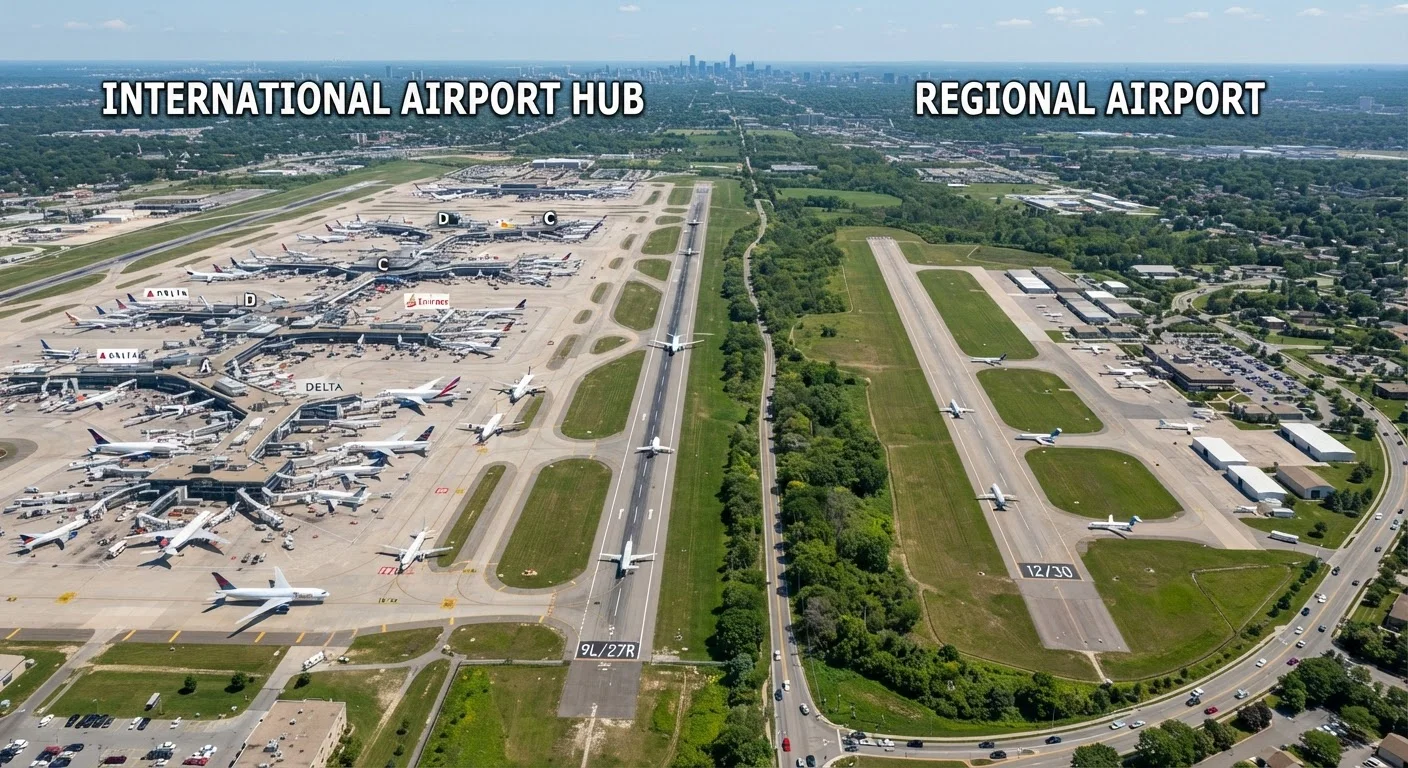
What Separates a Hub From a Spoke Airport
In airline network terms, a hub airport is a high-volume facility where a carrier concentrates flights to maximize connectivity - think Chicago O'Hare, Dallas/Fort Worth, or Atlanta Hartsfield-Jackson. A spoke airport is a smaller origin or destination point that feeds passengers into and out of those hubs, often serving regional markets with limited nonstop options.
The distinction isn't purely about airport size. It's about the density of routing options and the operational infrastructure each type supports. Hub airports typically host multiple daily frequencies on major routes, large gate complexes, and airline-operated lounges and support staff. Spoke airports tend to offer fewer daily departures, more compact terminals, and closer proximity between gates and curbs.
Understanding this structure helps explain why route selection isn't just about finding the shortest path between two cities. It's about understanding how airline networks connect and what that means for your specific journey.
The Case for Routing Through a Major Hub
When your travel day goes sideways - a mechanical delay, a weather system, a late inbound aircraft - the hub is where recovery options live. A large hub typically offers the same carrier's next departure on the same route within a few hours. That inventory of alternatives is the hub's most underappreciated asset.
Hubs also carry practical advantages for complex itineraries. International connections, codeshare arrangements, and alliance partnerships are often easier to execute at a hub where multiple carriers have significant operations. If your routing involves two or more airlines, a hub is frequently the most reliable transfer point.
| Major Hub Airport | Smaller Spoke Airport | |
|---|---|---|
| Rebooking options after disruption | High - frequent departures, more alternatives | Low - limited daily frequencies |
| Terminal navigation complexity | High - long concourses, multiple terminals | Low - compact, shorter walks |
| Connection time risk | Higher - distances can erode buffer time | Lower - gates typically close together |
| International route access | Strong - multiple carriers, alliances | Limited - mainly domestic or regional |
| Crowd and congestion levels | High - peak periods especially intense | Lower - generally less crowded |
| Suitability for complex itineraries | Strong - alliance/codeshare support | Weaker - fewer onward options |
The trade-off is real, however. Terminal distances at major hubs can be substantial. Published minimum connection times may be technically sufficient but leave little buffer for the realities of crowded jet bridges, long concourse walks, or unexpected gate changes. Our guide on minimum connection times explains what those airline-published figures often leave out.
The Case for Using a Smaller Spoke Airport
Spoke airports offer a fundamentally different ground experience. Security lines are typically shorter, terminal layouts are more compact, and gate-to-gate distances are often walkable in minutes rather than the 20-plus-minute sprints that some hub concourses demand. For travelers connecting through a regional facility, the process can be markedly calmer.
For passengers with mobility considerations, the physical scale of a spoke airport can be a meaningful advantage. Smaller facilities tend to require less physical navigation, though travelers should still confirm what assistance services are available - our overview of airport assistance for reduced mobility outlines what to look for and how to arrange it in advance.
Check Onward Frequency Before Booking
Before committing to a spoke airport connection, look up how many times per day the carrier operates your onward segment from that facility. If the answer is once or twice daily, even a minor delay on your inbound flight could strand you overnight. Building in a longer layover at a low-frequency airport is a straightforward way to reduce that risk.
The limitation of spoke routing is its narrower safety net. If your connecting flight is cancelled at a smaller airport, the next available departure may not be until the following morning. That reduced frequency is the defining vulnerability of the spoke-to-spoke or spoke-to-hub connection.
How to Decide: A Framework for Route Selection
Rather than defaulting to whichever itinerary appears first in a search, experienced travelers weigh a handful of specific variables before committing to a routing.
- Trip stakes: The higher the consequence of a missed connection - a cruise departure, a wedding, a non-refundable hotel block - the more a hub's rebooking depth matters.
- Seasonal weather patterns: If your hub connection runs through a region prone to convective weather or winter storms, factor in historical delay data for that facility.
- Layover duration: A 90-minute connection at a hub like JFK carries more risk than the same window at a smaller airport where gates are adjacent. Check common routing red flags before finalizing.
- Onward frequency: Ask how many times per day your spoke airport sees service on your next segment. Once-daily routes leave almost no margin for disruption.
- Strategic value: In some cases, a hub layover isn't a compromise at all - stopover routing strategies can turn a connection city into an additional destination worth exploring.
No routing decision is risk-free. The goal is to understand the tradeoffs clearly so you can match the right airport type to the demands of your specific journey.