

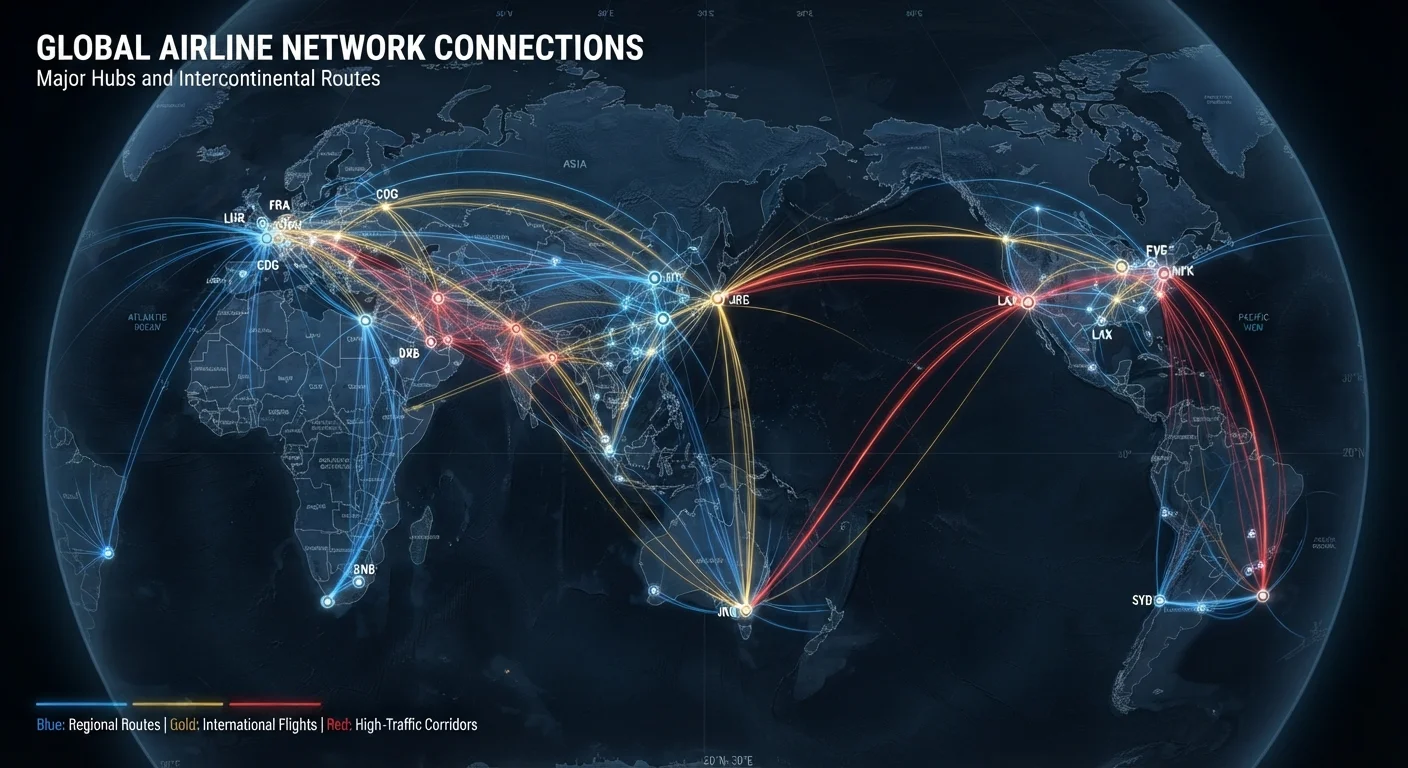
The Three Alliances and What They Control
Three alliance networks dominate commercial aviation: Star Alliance (founded 1997, the largest by member count), oneworld (1999), and SkyTeam (2000). Each groups airlines that have agreed to coordinate on scheduling, ticketing, and passenger services. While membership rosters shift occasionally, the core effect is consistent - when you fly a multi-leg itinerary across alliance partners, the journey is treated more like a single product than a patchwork of separate tickets.
Alliance membership dictates which hub cities serve as natural connectors. Star Alliance routes frequently pass through Frankfurt, Chicago O'Hare, and Tokyo Narita. oneworld itineraries often connect through London Heathrow, Dallas/Fort Worth, and Sydney. SkyTeam leans on Paris Charles de Gaulle, Amsterdam, and Atlanta. Knowing this shapes your routing instincts: if you need to reach a secondary city in Southeast Asia, the hub your alliance favors will determine whether you spend your layover in Tokyo or Paris.
3
Major global airline alliances
Star Alliance, oneworld, and SkyTeam collectively account for the overwhelming majority of scheduled international seat capacity worldwide.
40+
Airlines in the largest alliance
Star Alliance, the largest of the three by member airline count, connects carriers across Africa, the Americas, Asia-Pacific, Europe, and the Middle East.
1,000+
Airports served across all three alliances combined
The combined network of the three alliances reaches destinations across every inhabited continent, enabling complex multi-carrier itineraries on a single ticket.
How Alliances Expand (and Constrain) Your Route Map
A solo carrier can only serve the destinations it operates. An alliance multiplies that reach dramatically through two mechanisms: interline agreements, which let carriers issue tickets on each other's flights, and codeshare arrangements, where one airline's flight number appears on a partner's operated service. The practical result is that a search under one carrier's brand may surface a routing that actually involves two or three different planes and operators - all seamlessly connected on a single ticket.
This has a real impact on route selection. A traveler flying from a mid-sized U.S. city to a secondary European destination might see only limited options when searching a single airline. Expanding the search to consider the full alliance network reveals connections through additional hubs with better timing or fewer total hours in transit. Building a search strategy that surfaces these options requires knowing which alliance your preferred carrier belongs to and which partners operate relevant connecting legs.
Search by Alliance Hub, Not Just Carrier
When a direct flight doesn't exist or is prohibitively expensive, try identifying which hub airport your preferred alliance uses in the connecting region and search routes through that city explicitly. This surfaces connection options that broad searches sometimes suppress in favor of costlier direct options.
Alliance Membership and Loyalty Mile Accrual
Frequent flyer programs are structured around alliances. When you fly on a partner carrier, your home program typically credits miles - but the rate depends on fare class and the specific bilateral agreement between carriers. Flying in a deep-discount economy fare on a partner airline may earn significantly fewer miles than the same cabin on your home carrier. This matters when you're choosing between two similar itineraries: an alliance-partner routing in a higher fare class might ultimately earn more toward elite status than a cheaper mixed-alliance option.
Alliance membership also governs lounge access during connections. Lounge access pathways are partly alliance-driven - elite status on one member is often recognized at partner airline lounges, making long layovers more manageable. This is a meaningful consideration when evaluating routes with extended connections.
“Airline alliances were designed to expand the apparent network of every member carrier - the passenger benefit is real, but only for travelers who understand how to use the system intentionally.”
— Aviation Industry Analyst, Commercial aviation network strategy consultant
Using Alliance Logic in Multi-Stop Planning
For travelers building complex itineraries - open-jaw tickets, multi-destination trips, or routes with strategic layovers - alliance awareness becomes a practical planning tool. Staying within one alliance maximizes the chance that baggage transfers automatically, that status benefits apply, and that a single ticket price is achievable rather than separate bookings. Multi-destination trip planning benefits directly from understanding which alliance hubs connect naturally along your intended path.
That said, rigid alliance loyalty isn't always optimal. Some routes are served better - in terms of timing, aircraft quality, or total elapsed time - by a carrier outside your preferred network. Certain routing combinations create unnecessary risk regardless of alliance affiliation. And for travelers open to unconventional connections, stopover routing strategies can turn a layover hub into a destination in its own right - an option that often emerges from understanding which alliance hub sits naturally on your route.
Alliance Membership Changes Over Time
Airlines join, leave, or shift alliance affiliations - sometimes with significant consequences for passengers holding future bookings or expecting specific partner benefits. Before building a complex itinerary around alliance assumptions, verify current membership status directly with the carriers involved. This is especially relevant for regional carriers that may have recently changed affiliations.