
What 'Special Assistance' Actually Covers
Airlines and airports use the term special assistance - or more formally, PRM services - to describe a coordinated range of support for travelers who need help moving through the airport environment. Understanding what falls under this umbrella prevents unpleasant surprises on travel day.
| Legal framework (U.S.) | Air Carrier Access Act (ACAA) (U.S. Department of Transportation) |
| Cost to passenger | No additional charge (Required by ACAA for U.S. and foreign carriers operating in the U.S.) |
| Best time to request | At booking; confirm 48 hours before departure |
| Personal wheelchair handling | Must be accepted as checked baggage; returned at aircraft door on request (U.S. DOT disability rules) |
| Aisle chair requirement | Required on aircraft with 30+ seats (ACAA regulations) |
| Complaint escalation | U.S. DOT Aviation Consumer Protection Division |
Common services include:
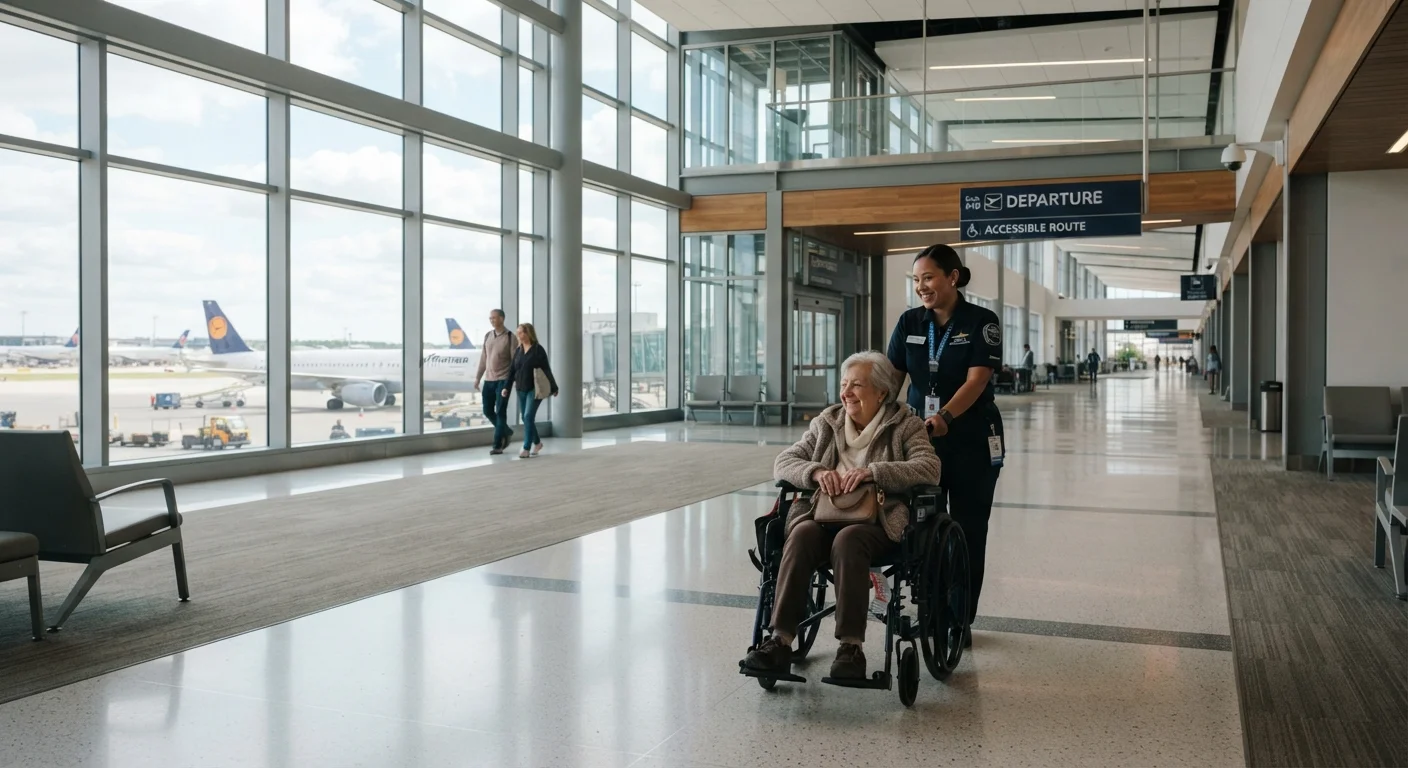
- Wheelchair or mobility escort from check-in to the gate, and from the gate to the aircraft door
- Assistance through security screening, including support with removing items from bags if needed
- Electric cart transport across long concourses or between terminals
- Ambulift or jetway boarding assistance when a standard jet bridge is unavailable
- Priority boarding before general boarding begins
- Assistance with connecting flights, including escort to the next gate
In the United States, these services are governed primarily by the Air Carrier Access Act (ACAA), which requires U.S. airlines and foreign carriers operating in the U.S. to provide mobility assistance at no additional charge. The responsibility is shared: airlines handle aircraft-side support, while airports manage landside assistance.
Understanding how terminals, concourses, and gates fit together helps you anticipate where escort handoffs typically occur and how far assistance must carry you.
How to Request Assistance - and When
The single most effective step any traveler with reduced mobility can take is notifying the airline as early as possible - ideally at the time of booking. Assistance is not automatically triggered by a disability; it must be requested and confirmed.
PRM (Passenger with Reduced Mobility)
The formal designation used by airlines, airports, and aviation regulators for any passenger whose mobility is limited in ways that require assistance. This includes temporary injuries, chronic conditions, and age-related limitations - not only permanent disabilities.
Ambulift
A hydraulic vehicle that raises passengers in a wheelchair or seated position directly to the aircraft door when jet bridges are unavailable - common at remote stands or smaller airports.
Air Carrier Access Act (ACAA)
U.S. federal legislation that prohibits discrimination against passengers with disabilities by airlines operating in the United States and mandates the provision of specific accessibility services at no additional cost.
Aisle Chair
A narrow, purpose-built wheelchair used to move passengers through the aircraft cabin to their seat. Airlines are required to have these available on aircraft with 30 or more seats.
Priority Boarding
The right for passengers with disabilities or reduced mobility to board the aircraft before other passengers, allowing extra time to stow belongings and settle without the pressure of boarding crowds.
Step-by-Step Request Process
- At booking: Select your assistance need through the airline's website, app, or by calling reservations. U.S. carriers are required to accept these requests.
- 48 hours before departure: Confirm your request directly with the airline. This is especially important for complex itineraries with connections.
- At check-in: Alert the check-in agent that you have a PRM request on file. This triggers airport ground staff notification.
- At the gate: Identify yourself to gate agents on arrival, particularly if you require early boarding or a specific boarding device.
If you use a personal wheelchair or mobility device, airlines must accept it as checked baggage. You will typically be asked for dimensions, battery type (for power chairs), and weight at check-in. Regulations require airlines to return your device at the aircraft door upon arrival, not only at baggage claim, though you can request baggage claim delivery if preferred.
Connections at large hub airports introduce additional coordination needs. Inter-terminal transfers involve more logistics than most travelers realize - request gate-to-gate escort explicitly if your connection requires a terminal change, and build in sufficient connection time. When deciding between routing options, it's worth comparing hub connections with smaller spoke airports, as PRM escort times at major hubs can be longer.
If Assistance Falls Short at the Airport
If requested assistance does not arrive within a reasonable timeframe, alert the nearest airline or airport service desk immediately rather than waiting. Under ACAA provisions, U.S. carriers are required to provide the agreed assistance, and complaints can be filed with the U.S. Department of Transportation's Aviation Consumer Protection Division. Document the date, time, airline, airport, and nature of the gap in service.