

The Gap Between Expectation and Reality
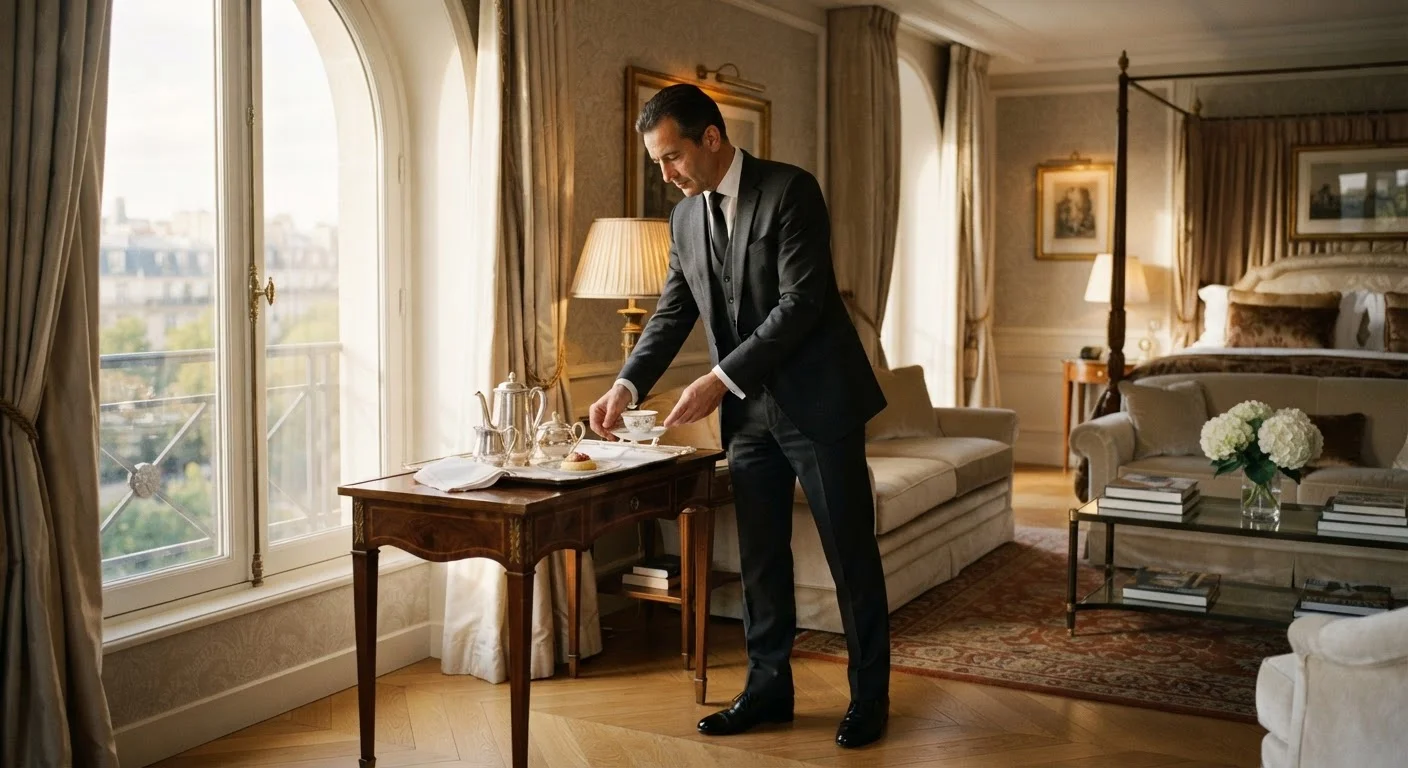
Butler service appears on hotel websites as a hallmark of luxury, often alongside phrases like "dedicated personal attendant" or "around-the-clock service." For many guests, the mental image is cinematic: a white-gloved figure on call for every whim. The reality is more nuanced - and actually more useful once properly understood.
Most misunderstandings stem from conflating the symbolic value of butler service with its functional purpose. As we explore in what luxury in travel actually means, the most meaningful aspects of a high-end stay are rarely the ones most prominently marketed. Butler service is a strong case in point.
Myth
Your butler is available exclusively for you, at any hour, for any request.
Fact
Most butlers manage multiple suites concurrently and work within defined shift structures.
Even at premium properties, a butler team typically rotates across several rooms. True dedicated, single-guest assignment is reserved for the most exclusive suite categories or private villa products. Understanding this removes the frustration of expecting instant, solitary attention and helps guests frame requests more effectively - with some lead time where possible.
Myth
Butler service is essentially a fancy term for room service delivery.
Fact
Butler service is a coordination and liaison function that spans the entire stay, not a single task.
Room service handles food delivery. Butler service operates at a different layer: managing pre-arrival logistics, acting as a single point of contact across departments, handling itinerary planning, coordinating special arrangements, and anticipating needs before guests articulate them. The two services often overlap in practice, but conflating them understates what a well-executed butler program actually provides.
Myth
You shouldn't bother your butler with small requests - it seems demanding.
Fact
Small, specific requests are exactly what butlers are trained to handle efficiently and graciously.
Reluctance to engage is one of the most common ways guests diminish their own stay. Properties offering butler service build the cost of that staffing into the room rate; the service has already been paid for. More importantly, butlers are professionally trained to field requests without judgment - part of their expertise is making even minor interactions feel effortless. Guests who communicate freely tend to receive a noticeably more personalised experience throughout their stay.
Myth
All luxury hotels offering butler service deliver a comparable standard.
Fact
Butler program quality varies enormously between properties, and the label alone guarantees nothing.
Some hotels deploy the term loosely to describe an enhanced concierge function with limited scope. Others maintain rigorous training programs with dedicated staff ratios and pre-stay personalisation protocols. Before assuming equivalence, it's worth investigating what the program specifically covers - how many suites each butler handles, what hours they operate, and whether pre-arrival communication is offered. This is part of a broader pattern of prestige terminology obscuring real differences, explored further in assumptions that lead travellers to the wrong luxury resort.
Myth
Requesting unpacking or packing assistance is intrusive and unusual.
Fact
Luggage assistance is a standard, expected component of full butler service at most luxury properties.
Unpacking and repacking are among the most common butler functions at properties offering comprehensive programs. Butlers who assist with this also gain useful context about a guest's belongings and preferences that helps them deliver better service throughout the stay. Guests who decline out of discomfort are passing up a legitimately useful service - and one that is offered, not imposed.
How Butler Programs Actually Work
Butler service at most luxury properties operates on a tiered model. A single butler may be responsible for several suites simultaneously, rotating between guests based on scheduled needs and real-time requests. At ultra-luxury properties - particularly private island resorts and palace-style hotels - the ratio approaches one-to-one, but this is the exception rather than the standard.
1:6
Typical butler-to-suite ratio at luxury properties
Industry hospitality training resources generally indicate that most five-star hotels assign one butler to between four and eight suites during peak occupancy.
~60%
Guests who never contact their butler proactively
Hospitality service trainers and property managers widely report that the majority of guests with butler access never initiate contact before or during their stay.
The practical scope typically covers: pre-arrival coordination (dietary preferences, room configuration, transport logistics), in-room setup and unpacking assistance, dining reservations and itinerary support, and a single point of contact for any request that might otherwise require multiple calls to different departments. Think of the role as a skilled intermediary between the guest and the full hotel operation.
If you want to understand the full vocabulary around these services before booking, the language of luxury decoded offers a clear breakdown of terms used across high-end properties worldwide.
Getting the Most From the Service
The single greatest predictor of a positive butler experience is early, specific communication. Guests who contact their butler before arrival - even a brief message about travel times or preferences - give the property the runway to personalise meaningfully. Last-minute requests can often be accommodated, but the deeper customisation happens in the hours and days before check-in.
Not All Butler Programs Are Created Equal
When evaluating a property's butler offering, look beyond the label. Ask specifically about the butler-to-guest ratio in your room category, what hours service is available, and whether pre-arrival coordination is included. A property where 'butler service' means a dedicated phone line staffed by rotating junior concierge staff is a fundamentally different product from a true dedicated attendant program. Clarifying this before booking avoids one of the most common sources of unmet expectations in luxury travel.
Seasoned travelers also understand that butlers are not replacements for all other hotel staff. Housekeeping, concierge, and food service teams remain involved in a stay; the butler's role is to coordinate and advocate within that system, not to absorb it entirely. For a fuller picture of what a high-end stay involves operationally, a walkthrough of the luxury resort experience maps the journey from pre-arrival contact through checkout.
Guests who feel awkward requesting help tend to leave significant value on the table. Butlers at well-run properties are trained specifically to make these interactions feel natural - asking is not an imposition, it is precisely what the role exists for. This broader pattern of under-utilising hotel services is covered in what seasoned travelers know that first-timers often don't.