
The Core Distinction: Immersion vs. Elevation
Luxury accommodation is often reduced to a list of amenities - the pool, the thread count, the butler service. But overwater bungalows and clifftop villas reveal that the most consequential differences in high-end stays are philosophical. They represent two fundamentally different relationships with landscape.
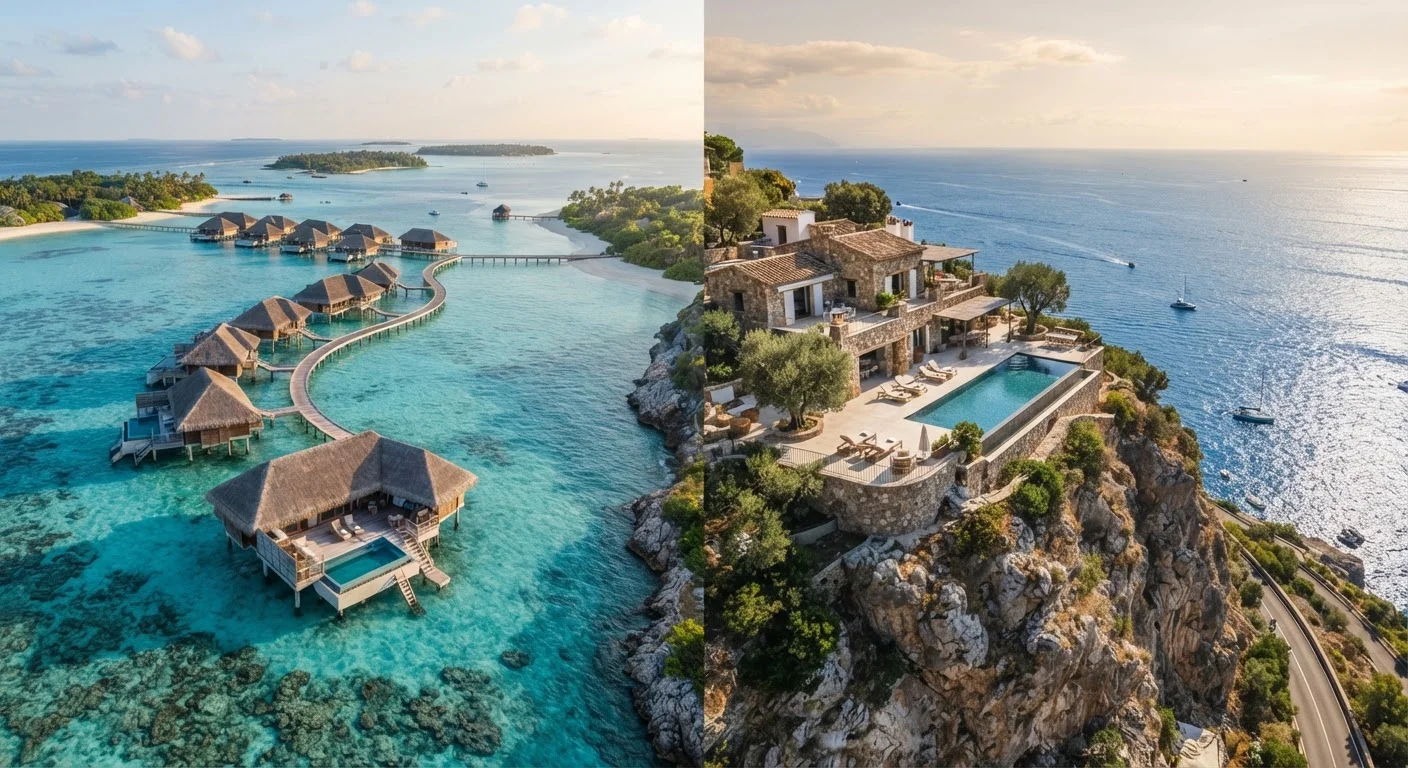
An overwater bungalow places you at the surface of the sea. The structure sits on stilts above a shallow lagoon, typically in the Indian Ocean or South Pacific, and the defining sensation is one of floating within the environment rather than observing it. The water is not a view - it is the floor beneath your feet, audible through the glass panels that characterise the format, and accessible via a ladder directly from your deck. This is accommodation as immersion.
A clifftop villa inverts that logic entirely. Perched above a coastline - most famously on the Greek islands, the Amalfi Coast, or the rugged shores of southwestern Portugal - these properties trade proximity for perspective. The sea becomes a canvas stretched below you. The experience is one of elevation and command, a quality that has drawn travelers to clifftop architecture for centuries. This is accommodation as vantage point.
Understanding which philosophy resonates with you is a more useful exercise than comparing price tiers. As our editorial team explores in luxury beyond the beach resort, the most meaningful distinction in high-end stays is often environmental, not material.
Privacy, Access, and Practical Realities
Both formats promise seclusion, but they deliver it differently - and each comes with trade-offs that rarely appear in the photography.
Overwater bungalows achieve privacy through physical separation. Surrounded by open water and connected to shore by a single jetty walkway, the structure is naturally isolated. However, the same jetty that delivers your breakfast also connects you to neighboring units, and sound carries easily across calm lagoons. The logistics of the format also demand engagement: getting to your bungalow typically involves a boat transfer from a regional airport, sometimes requiring a seaplane connection. This is not incidental - it is part of the experience, and the remoteness is genuine.
Clifftop villas tend to achieve privacy through landscape and spatial planning rather than water barriers. A well-positioned villa on a rocky promontory can feel profoundly isolated even if a village sits below. The physical terrain - cliffs, rocky outcroppings, dense vegetation - does much of the screening work. Access is usually by road, which makes day trips and cultural exploration more straightforward, but also means the boundary between retreat and the outside world is more porous.
| Criterion | Overwater Bungalow | Clifftop Villa |
|---|---|---|
| Landscape relationship | Immersed within the environment | Elevated above the environment |
| Primary view | Lagoon, reef, horizon at eye level | Panoramic coastline or valley below |
| Water access | Direct, from private deck | Typically via path or steps to beach |
| Typical location | Indian Ocean, South Pacific atolls | Mediterranean, Atlantic coasts, cliff regions |
| Transfer logistics | Boat or seaplane required | Usually road-accessible |
| Cultural access | Limited; resort-contained | Often near towns and local life |
| Privacy mechanism | Water separation from other guests | Terrain, landscaping, spatial planning |
| Mobility considerations | Elevated walkways above open water | Steps and steep terrain common |
Mobility and accessibility deserve careful consideration. The walkways of overwater bungalows are elevated above water and may be narrow or exposed to weather. Clifftop properties often involve significant steps or steep paths to reach the best rooms or viewpoints. Neither format is inherently inaccessible, but both reward direct inquiry with a property before booking.
For travelers navigating accommodation tiers more broadly, our analysis of all-inclusive versus room-only luxury hotels covers how the structure of a stay shapes its character as much as the room itself does.
Choosing the Experience That Suits You
The overwater bungalow is among the most imitated stay formats in luxury travel, partly because it photographs extraordinarily well and partly because it genuinely delivers something no other category replicates: the sensation of sleeping above a living reef ecosystem. That said, it is a format that rewards travelers who are comfortable with a certain degree of contained remoteness. There is typically limited walking space, the surrounding environment is aquatic rather than terrestrial, and excursions beyond the lagoon require planning.
Clifftop villas attract a different traveler - one drawn to the relationship between built space and dramatic natural topography. The experience of watching weather systems move across a wide bay, or of seeing the sun set behind a distant headland from a terrace that seems suspended in air, is qualitatively distinct from anything experienced at sea level. These properties also tend to sit within a richer cultural context: many of the world's great clifftop destinations - Santorini, Positano, Sintra - have histories, cuisines, and local traditions that reward exploration.
65%+
Of overwater bungalow guests citing marine access as primary draw
Guest satisfaction surveys across Indian Ocean properties consistently highlight direct water access as the defining feature of the overwater format.
3-6 hrs
Average total transfer time to reach a Maldivian overwater resort
Including international flights, domestic connections, and seaplane or speedboat transfers - a logistical reality that shapes the entire trip dynamic.
Neither format holds a monopoly on luxury. The most honest framing is that each offers a specific kind of immersion - one literal, one experiential - and the right choice is the one that matches how you want to feel during those days, not which option signals more prestige to others. For travelers curious about how other distinctive stay formats define themselves against landscape and culture, distinctive stay formats around the world offers a broader lens on the full spectrum of possibilities.