

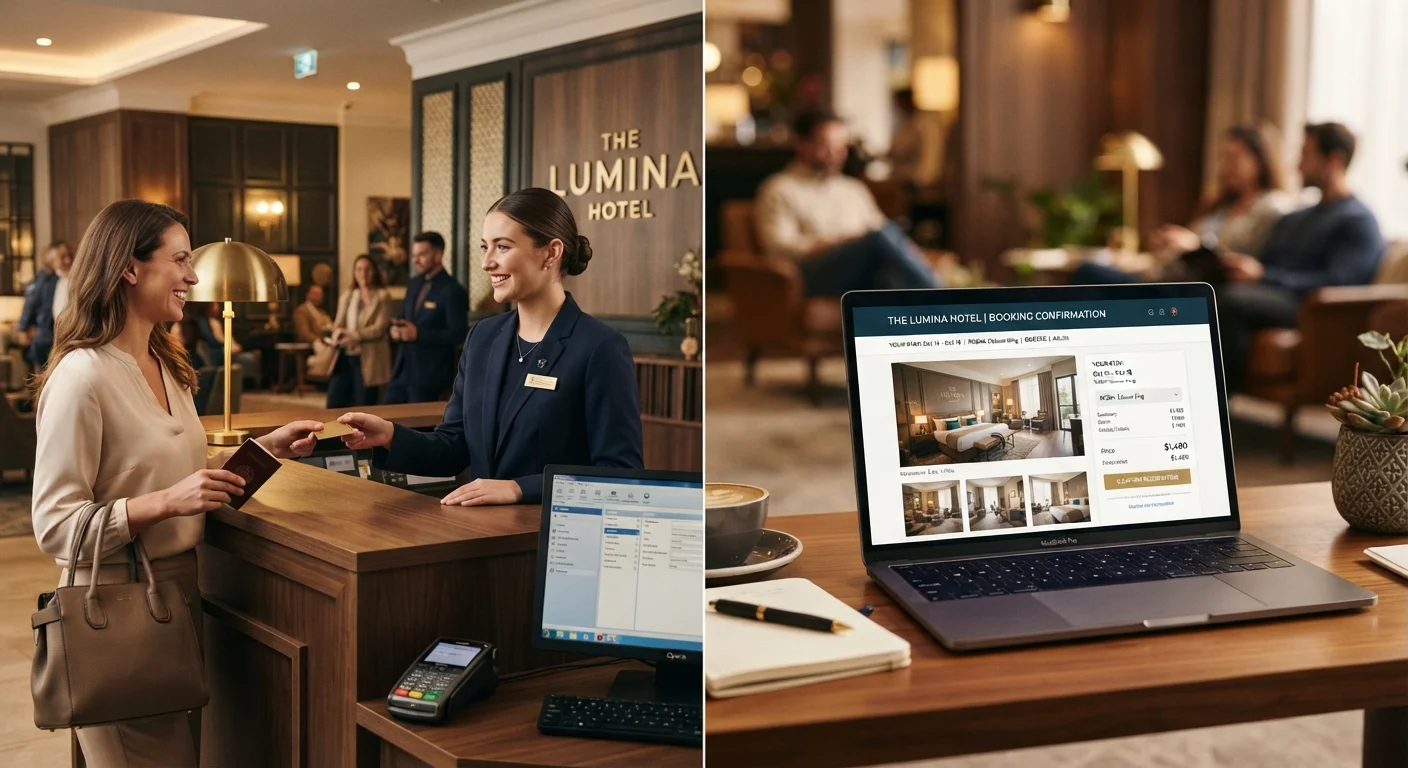
The Relationship You're Actually Buying
When you book a hotel room, you're not just purchasing a night's sleep - you're establishing a relationship with a property, and how you initiate that relationship matters more than most travelers realize. A direct reservation creates a contractual link between you and the hotel. A third-party booking inserts a platform into that chain, and hotels are acutely aware of the distinction.
Front-desk teams and reservation managers can typically identify at a glance how a guest booked. That information shapes, consciously or not, how discretionary decisions get made: which floor your room lands on, whether a complimentary upgrade is offered, how quickly a complaint escalates. Hotels pay commission rates of roughly 15-25% on third-party bookings - revenue they'd rather retain - and that economic reality influences how direct guests are treated as a deliberate retention strategy.
For context on how these dynamics play out across other booking categories, our broader look at direct vs. third-party travel booking covers the full picture beyond hotels alone.
What Actually Differs: A Side-by-Side View
Price gets most of the attention, but the more meaningful differences play out across service, flexibility, and accountability. Rate parity agreements - rules that historically required hotels to publish identical rates across channels - have loosened in many markets, so rates may or may not converge depending on the property and region. What rarely converges are the non-rate elements.
| Criterion | Booking Direct | Third-Party Sites |
|---|---|---|
| Loyalty points earned | Yes, for eligible programs | Typically excluded |
| Room upgrade potential | Higher - hotel has incentive | Lower - pooled inventory |
| Cancellation flexibility | One point of contact | Two-layer approval often required |
| Special requests honored | More reliably communicated | Notes may not reach front desk |
| Price comparison ease | Single property at a time | Dozens of properties at once |
| Complaint resolution speed | Hotel has full authority | Platform intermediary involved |
| Welcome amenities / credits | Often included or offered | Rarely extended |
Room assignment is one area that consistently rewards direct bookers. Hotels allocate their inventory by reservation type, and third-party blocks tend to receive rooms from a less selective pool. Specific requests - a high floor, a quiet courtyard-facing room, a connecting room for families - carry more weight when communicated directly to the property rather than through a platform's notes field that staff may not see until check-in.
Loyalty, Perks, and What You Forfeit
Loyalty program eligibility is perhaps the starkest structural difference. Major hotel groups explicitly exclude third-party bookings from earning points, elite night credits, or status-qualifying stays. For frequent travelers, that gap compounds quickly - a handful of trips per year can represent meaningful progress toward elite tiers that unlock suite upgrades, guaranteed late checkout, and lounge access.
15-25%
Commission hotels pay on OTA bookings
Industry estimates consistently place online travel agency commissions in this range, a cost hotels offset through direct booking incentive programs.
~50%
Loyalty members who lose points on OTA stays
Most major hotel loyalty programs explicitly exclude third-party bookings from earning qualifying nights or points, affecting roughly half of program members who occasionally book via aggregators.
Beyond points, many properties extend what the industry calls "direct booking benefits" - a welcome amenity, a food and beverage credit, complimentary Wi-Fi that might otherwise appear as a resort fee line item. Understanding which fees are waived or included for direct bookers is worth examining carefully; our breakdown of hotel ancillary charges explains which fees most frequently catch travelers off guard regardless of booking channel.
The calculus for loyalty-agnostic travelers is more nuanced. If you rarely return to the same brand and have no interest in status, the perks argument weakens - and a third-party platform's filtering tools and consolidated trip history have genuine utility.
When Things Go Wrong: The Accountability Gap
Service failures are where booking channel choice has its most consequential impact. A direct booking means the hotel owns your reservation entirely and has both the authority and the motivation to resolve issues immediately. A third-party booking creates ambiguity: the platform holds the payment, the hotel holds the room, and each party may defer to the other when a problem needs solving.
Cancellation and modification requests illustrate this clearly. Direct reservations can often be adjusted with a single call, and hotels have latitude to waive fees for genuine circumstances. Third-party changes typically require approval from the platform, adherence to the platform's own policy layer on top of the hotel's policy, and occasionally holding times that can stretch into hours during high-demand periods.
Travelers weighing similar trade-offs in air travel will find the dynamic familiar - the risks of split-ticket flight booking follow comparable logic about who bears responsibility when disruptions occur.
For anyone with a complex itinerary or non-refundable downstream travel, the reduced friction of direct contact with the property is a meaningful operational advantage, not merely a comfort preference.
This article is for general informational purposes. Rates, policies, and loyalty program terms vary by property and are subject to change; always verify directly with the hotel or platform before booking.