
Why North Macedonia Still Flies Under the Radar
Ask a well-traveled friend where they'd go in the Balkans and the answer almost always involves Croatia's coast, Montenegro's bays, or perhaps Slovenia's lakes. North Macedonia - landlocked, small, and still navigating the identity complexities of a country that only settled its international name in 2019 - rarely gets mentioned. That oversight is, for the curious traveler, an opportunity.
Part of what keeps the country off mainstream itineraries is perception. The Balkans broadly carry unearned reputations that travel myths continue to perpetuate, keeping visitors from discovering just how navigable, affordable, and historically rich the region actually is. North Macedonia is no exception: its infrastructure is functional, its people are accustomed to visitors, and its headline attraction - Lake Ohrid - is a UNESCO World Heritage Site that would be mobbed if it sat an hour from Vienna.
UNESCO Dual Heritage
A designation given by UNESCO when a site qualifies for both World Heritage cultural recognition (for human-made significance) and natural heritage recognition (for ecological or geological importance) simultaneously. Lake Ohrid holds both.
Byzantine architecture
A style of building and decoration developed in the Eastern Roman (Byzantine) Empire, roughly 4th-15th centuries CE, characterized by domed churches, elaborate mosaic and fresco interiors, and stone construction.
Endemic species
Plants or animals found naturally in one specific location and nowhere else on Earth. Lake Ohrid's great age and isolation have produced dozens of endemic species, including unique fish and invertebrates.
Macedonian denar (MKD)
The official currency of North Macedonia. It is not part of the eurozone, so visitors from EU countries will need to exchange currency on arrival or in advance.
Old town (čaršija)
The historic commercial and residential core of a Balkan town, typically featuring Ottoman-era or medieval streetscapes, craft workshops, and traditional architecture - often pedestrianized or restricted to foot traffic.
Ohrid: The City That History Built on a Lakeshore
Ohrid is one of those rare places where the layers of history feel physically close. Walking the cobblestone streets of the old town - stacked on a hillside above the lake's clear blue water - you move through Byzantine, Ottoman, and early Christian eras within a few hundred meters. The Church of Sveta Sofija, a cathedral dating to the 11th century, still holds its painted walls. Samuel's Fortress, the remains of a medieval Bulgarian empire stronghold, crowns the hill with wide views over the lake and into Albania on clear days.
The old town is compact enough to explore on foot over a morning, but absorbing enough to justify two or three days at minimum. The waterfront promenade fills in the evenings with locals as much as tourists - a sign that Ohrid retains genuine civic life rather than existing solely for visitors. For travelers who have found Europe's overlooked places to be the most rewarding stops, Ohrid feels exactly like that kind of discovery.
Arrive Before 10am at Sveti Jovan at Kaneo
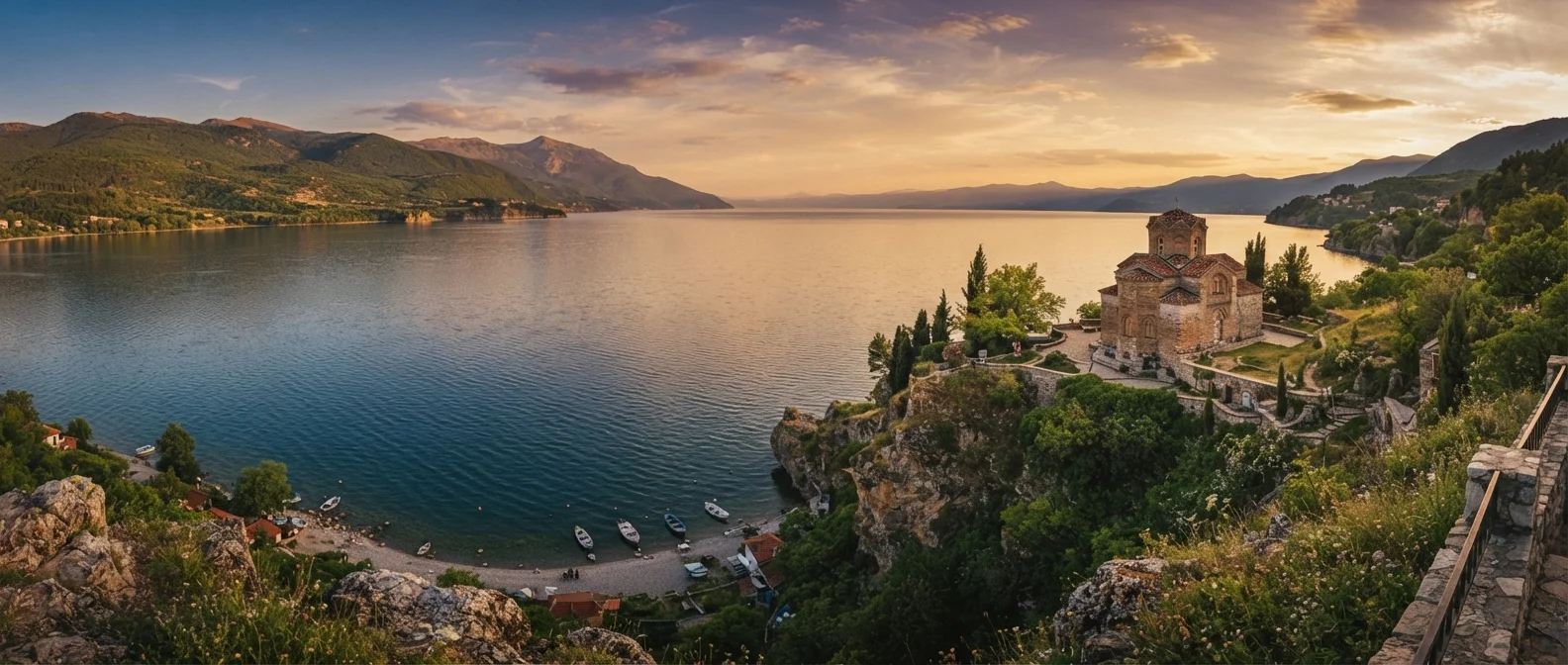
The cliff-side church of Sveti Jovan at Kaneo is most atmospheric in the early morning, before tour groups arrive from Ohrid's old town. The 15-minute walk from the upper old town takes you along a lakeside path with minimal signage - ask locally or use an offline map to find the right trail. Early risers often have the promontory almost entirely to themselves.
The Monasteries: Stone, Fresco, and Silence
The landscape around Lake Ohrid is dotted with monasteries, many of them perched on cliffs or tucked into coves where the water turns from turquoise to deep indigo. The most visited is the Monastery of Sveti Naum, located at the southern tip of the lake near the Albanian border. Founded in the 10th century by the scholar and missionary Naum of Ohrid, it sits inside a nature reserve where the Black Drim river springs from the lakebed - an eerie and beautiful phenomenon visible by small rowboat.
Equally affecting is the Church of Sveti Jovan at Kaneo, a 13th-century Byzantine chapel that juts out on a rocky promontory above the lake's edge. It has appeared in so many photographs that some visitors expect it to feel overrun - yet the approach along a walking path from the old town remains quiet outside of midsummer. Inside, surviving fragments of fresco convey how richly decorated these spaces once were.
For travelers drawn to this kind of stone-and-silence atmosphere, the experience shares something with southern Italy's ancient built heritage - a sense of encountering history before the tourist infrastructure fully catches up.
Living the Lake: Water, Villages, and Getting Around
Lake Ohrid is approximately 30 kilometers long and up to 289 meters deep, making it one of the deepest lakes in Europe. Its age - estimated at over three million years - has produced a remarkable degree of endemic species, a fact that underpins its UNESCO natural heritage designation alongside the cultural one. Swimming is common and the water is exceptionally clear, particularly along the rocky shoreline away from town beaches.
The villages along the North Macedonian shore - Struga at the northern end, Trpejca tucked into a small bay to the south - each have their own character. Trpejca in particular is worth the short drive or boat ride from Ohrid town: a quiet fishing settlement with a pebble beach and a handful of small guesthouses where life moves at a pace that feels genuinely unhurried.
The Albanian side of the lake, anchored by the town of Pogradec, extends the journey naturally for those with flexibility. The cross-border dimension mirrors what travelers discover along the Albanian Riviera - a neighbor that rewards curiosity but requires some logistical planning. Within North Macedonia, renting a car or hiring a driver for day trips gives far more flexibility than relying on infrequent local buses.
North Macedonia Tourism Portal
The country's official tourism information resource covers regional highlights, cultural sites, and practical visitor guidance for Ohrid and beyond.
UNESCO World Heritage - Natural and Cultural Heritage of the Ohrid Region
UNESCO's official listing page for the Ohrid region details the criteria behind its dual cultural and natural designation and provides background on the site's significance.
Rome2rio - Skopje to Ohrid Route Planner
A multi-modal journey planner useful for comparing bus, private transfer, and driving options between Skopje and Ohrid, with approximate journey times and operator listings.
Practical Matters: Entry, Timing, and What to Expect
North Macedonia uses the Macedonian denar, and while card payments are increasingly common in Ohrid, carrying local currency remains advisable for smaller guesthouses, village markets, and monastery entry fees. The cost of accommodation, food, and transport runs considerably lower than Western European equivalents, making the destination accessible even for longer stays.
The airport near Ohrid - St. Paul the Apostle Airport - handles some seasonal European flights, though many travelers arrive via Skopje and complete the three-hour overland journey by bus or transfer. Skopje itself merits a day's exploration: the old bazaar district, one of the largest in the Balkans, is a destination in its own right.
Timing matters. July and August bring domestic tourists in numbers that can strain Ohrid's old town accommodation. May, June, September, and October hit a better balance of warmth and calm. Winters are cold and many smaller businesses close, though the town takes on a different, quieter character that some travelers actively seek out.
For entry requirements, visa rules, and any travel advisories, always consult your government's official foreign affairs or travel portal before booking - conditions and regulations change, and official sources are the only reliable reference point.
Verify Entry Requirements Before You Travel
North Macedonia's visa policies, as well as those of neighboring Albania if you plan a cross-border extension, can change with little notice. Do not rely on traveler forums or this article as a substitute for checking your government's official travel advisory and the North Macedonian embassy or consulate guidance. This is especially important for passport holders from countries with complex entry arrangements in the western Balkans.