
Why the Deep South Keeps Getting Overlooked
Most Italy itineraries follow a familiar corridor: Rome, Florence, Venice, maybe a dash to the Amalfi Coast. The heel and instep of the Italian boot - Basilicata and Puglia - sit just below that corridor, yet most travelers treat them as too far, too unfamiliar, or simply unknown. That unfamiliarity is exactly the point.
Southern Italy's mezzogiorno has long carried an undeserved reputation for being difficult to navigate or underdeveloped for tourism. The reality is different. Regional airports serve Bari and Brindisi from much of Europe. A hire car connects villages that no train line reaches. And the accommodation landscape, built around family-run masserie (fortified farmhouses) and cave-hotel conversions, is often more characterful than anything on offer in Italy's north. For the frequent traveler who already knows why overlooked villages reward the curious, this region delivers that reward at a grand, geological scale.
Timing Your Visit to the Sassi
Matera's cave districts are busiest between late June and August, when guided tour groups concentrate in the late morning hours. Arriving before 8 a.m. or staying into the early evening gives you the narrow lanes largely to yourself. April, May, and late September offer a strong balance of good light, open businesses, and manageable visitor numbers.
Seven Ways to Go Deeper into Basilicata and Puglia
Sleep inside the Sassi of Matera
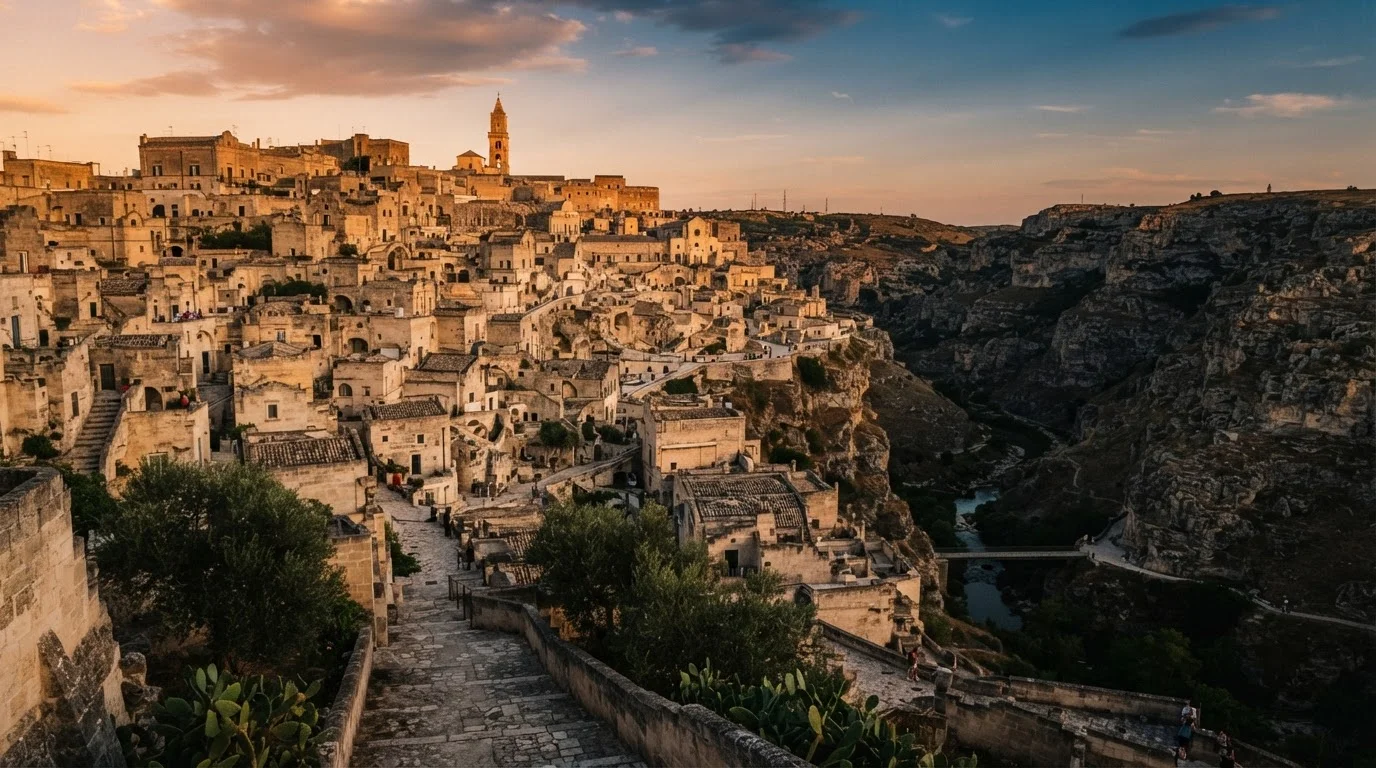
Matera's sassi - two ancient districts called Sasso Caveoso and Sasso Barisano - are among the oldest continuously inhabited settlements on earth, carved directly into the Gravina ravine's limestone. The city was named a European Capital of Culture in 2019 and holds UNESCO World Heritage status, yet outside summer it remains remarkably uncrowded before 9 a.m. and after 7 p.m.
Several former cave dwellings have been carefully converted into small hotels and guesthouses, allowing guests to sleep in rooms that follow the contours of the rock. Staying here rather than day-tripping from Bari transforms the experience: after tour groups depart in the late afternoon, the lantern-lit lanes of the sassi settle into an almost cinematic quiet. Walk the Strada dell'Obelisco at dusk, looking across the ravine toward the rupestrian churches carved into the opposite cliff face, and the city reveals an entirely different character.
After tour groups leave at dusk, Matera's lantern-lit lanes settle into an almost cinematic quiet.
Explore the Rupestrian Churches of the Murgia Plateau
Directly across the Gravina gorge from Matera's city centre, the Murgia Plateau forms a windswept tableland scattered with rock-cut Byzantine churches, some decorated with fading medieval frescoes. The Parco della Murgia Materana protects this landscape, and guided walks lead across the ravine via the Ponte Tibetano - a suspension bridge that hangs dramatically over the gorge.
Churches like Madonna delle Virtù and San Nicola dei Greci, stacked in a cave complex above the sassi, offer a concentrated survey of rupestrian (rock-cut) religious art. These are not reconstructed heritage sites; they are raw, atmospheric spaces where the stone itself is the architecture. A local guide familiar with the plateau's geography is worth engaging - trails can be unmarked, and some churches require advance arrangement to access.
The Murgia's rock-cut churches are raw, atmospheric spaces where the stone itself is the architecture.
Spend a Morning in Alberobello's Trulli - Then Leave the Centre
Alberobello's iconic trulli - conical-roofed limestone dwellings unique to the Valle d'Itria - are justifiably famous, but the UNESCO-listed Rione Monti and Aia Piccola districts are crowded with souvenir shops by mid-morning in high season. The answer is not to skip Alberobello, but to arrive at opening time and then push further into the valley.
The surrounding countryside holds isolated trulli in various states of preservation, integrated into working farms and olive groves. The road between Alberobello and Locorotondo - a whitewashed hilltop town that sees a fraction of its neighbour's traffic - passes through a landscape of dry-stone walls and ancient carob trees that feels genuinely unhurried. Locorotondo's circular centro storico, all pale limestone and geranium-draped balconies, warrants at minimum a long lunch.
Push past Alberobello into the Valle d'Itria countryside for isolated trulli and genuinely unhurried landscapes.
Find the Forgotten Hilltowns of Basilicata's Interior
Most visitors who reach Basilicata stop at Matera and consider the region covered. The province's interior tells a different story. Pisticci, built in dramatic terraced layers above clay ravines called calanchi, is one of southern Italy's most visually striking towns and appears on almost no traveler's itinerary. Tricarico, further north, holds a well-preserved Arab-Norman quarter and a weekly market that draws farmers from across the surrounding plateau.
Craco, abandoned after a 1963 landslide and now a protected ghost town, has become a quietly famous film location - it appeared in several Italian productions over the decades - but remains largely unmanaged and requires careful, respectful exploration from a distance. The roads connecting these towns are slow, often single-lane, and rewarding in direct proportion to the patience you bring to them.
Pisticci's dramatic terraced layers above clay ravines make it one of southern Italy's most visually striking overlooked towns.
Follow the Salento Peninsula to Its Tip
Puglia's Salento - the thin heel of Italy's boot - is better known than Basilicata's interior but still sits well outside the mainstream itinerary. Lecce, the region's baroque capital, is increasingly visited and deserves its reputation for ornate golden-stone architecture. South of Lecce, however, the peninsula thins and quietens. Otranto sits on the Adriatic with a cathedral containing Europe's largest medieval mosaic floor, covering the entire nave in a twelfth-century vision of history and mythology.
The cape at Santa Maria di Leuca, where the Ionian and Adriatic seas technically meet, is both geographically significant and genuinely anticlimactic in the best possible way - a lighthouse, a small basilica, fishing boats, and almost nobody. The coastal road north along the Ionian side passes sea stacks, sea caves, and small lidos that are fully functional in summer and completely empty by October.
Santa Maria di Leuca - where the Ionian and Adriatic meet - is geographically significant and genuinely, beautifully anticlimactic.
Eat in Agriturismi Rather Than Tourist Restaurants
The agriturismo model - working farms legally permitted to serve meals and offer accommodation - is more deeply embedded in Basilicata and Puglia than almost anywhere else in Italy. A meal at a rural agriturismo near Matera or in the olive groves outside Fasano is likely to involve ingredients produced on site: ricotta made that morning, preserved vegetables from the summer harvest, lamb from animals grazing within sight of the table.
Menus at these establishments are often fixed and short - sometimes a single choice communicated verbally at the door - and the experience is less a restaurant visit than an invitation into a working household. Booking is usually essential and often done by phone; having a basic phrase in Italian goes a long way. This is where the real flavour of cucina lucana and cucina pugliese lives, well away from the laminated menus near any UNESCO marker.
A meal at a rural agriturismo is less a restaurant visit than an invitation into a working household.
Take the Slow Train Where the Rail Line Still Runs
Southern Italy's rail network is thinner than the north's, but several smaller operators run routes of genuine scenic interest. The Ferrovie Appulo Lucane (FAL) operates a narrow-gauge line connecting Bari with Matera, winding through the Murgia plateau in a journey that takes longer than driving but offers views across the ravine landscape that no road matches. The same network reaches Altamura, whose cathedral and ancient town centre are worth the detour.
In Puglia, the Ferrovie del Sud Est (FSE) network threads through the Valle d'Itria, stopping at Alberobello, Locorotondo, and Martina Franca - allowing a car-free loop through the trulli heartland. Services can be infrequent outside summer, so timetable planning is essential. This kind of slower, ground-level travel through southern Italy has something in common with the experience described in our piece on navigating Slovenia end to end: the journey itself becomes part of what the destination offers.
The narrow-gauge Ferrovie Appulo Lucane offers views across the Murgia plateau that no road can match.
Getting Around Without a Car
While a hire car dramatically expands what's accessible in Basilicata and Puglia, it is not strictly necessary for a focused itinerary. Matera is reachable by the FAL rail and bus connections from Bari, and the FSE rail network covers much of the Valle d'Itria. That said, the most rewarding smaller towns - Pisticci, Tricarico, and much of the Salento's wild coastline - have limited or no public transport links. Factor this into your planning, and consult regional transit operators directly for current timetables.
Planning Your Journey South
Spring (April to early June) and autumn (September to October) offer the most comfortable conditions for exploring the region - temperatures are manageable, seasonal restaurants are open, and the worst of summer's tour-group traffic has not yet arrived or has already passed. The rhythms of off-season travel in secret Europe apply here too: some rural agriturismi close in winter, and a handful of smaller museums keep limited hours outside peak months, so it pays to check ahead.
Travelers sometimes hesitate over southern Italy due to assumptions about infrastructure or safety - misconceptions that commonly keep visitors away from Europe's best-kept secrets. In practice, Matera and the surrounding region are as navigable as any Italian destination, and the welcome in smaller towns is genuinely warm. Always consult your government's official travel advisory and verify entry requirements with relevant authorities before departure.