
Why Slovenia Belongs on Your Radar
Slovenia is the rare place that confounds expectations simply by existing. Travelers who stumble into it - often en route to Croatia or Austria - tend to rearrange their entire itinerary once they grasp what the country actually contains: a chain of Julian Alps peaks punctuated by turquoise rivers, an underworld of karst caves that rank among the most extraordinary in Europe, a capital city that genuinely earns the word charming without apology, and a strip of Adriatic coastline barely 47 kilometers long that manages to feel authentically Mediterranean.
At roughly the size of New Jersey, Slovenia has mastered the art of geographic compression. It shares borders with Italy, Austria, Hungary, and Croatia - an intersection of cultures that makes Slovenian cuisine, architecture, and language feel like a palimpsest of Central European influences. Yet the country has developed a distinctive identity entirely its own.
For the frequent traveler already familiar with the marquee names of European tourism, Slovenia offers something increasingly rare: the sensation of genuine discovery. As Europe's overlooked villages demonstrate time and again, the continent's most memorable experiences tend to live just one border crossing beyond where the crowd stops.
20,273 km²
Total area of Slovenia
For comparison, Switzerland covers approximately 41,285 km² - making Slovenia roughly half the size while packing comparable landscape variety.
47 km
Length of Slovenia's Adriatic coastline
Despite its brevity, the coast contains three distinct historic towns with strong Venetian architectural heritage.
24 km
Total length of Postojna Cave system
Postojna is among the largest cave systems in Europe and has been a documented tourist destination since the early 19th century.
~2 hours
Drive from Soča Valley to Piran coast
Slovenia's compact geography means travelers can move between drastically different landscapes within a single afternoon.
The Julian Alps: Beyond Lake Bled
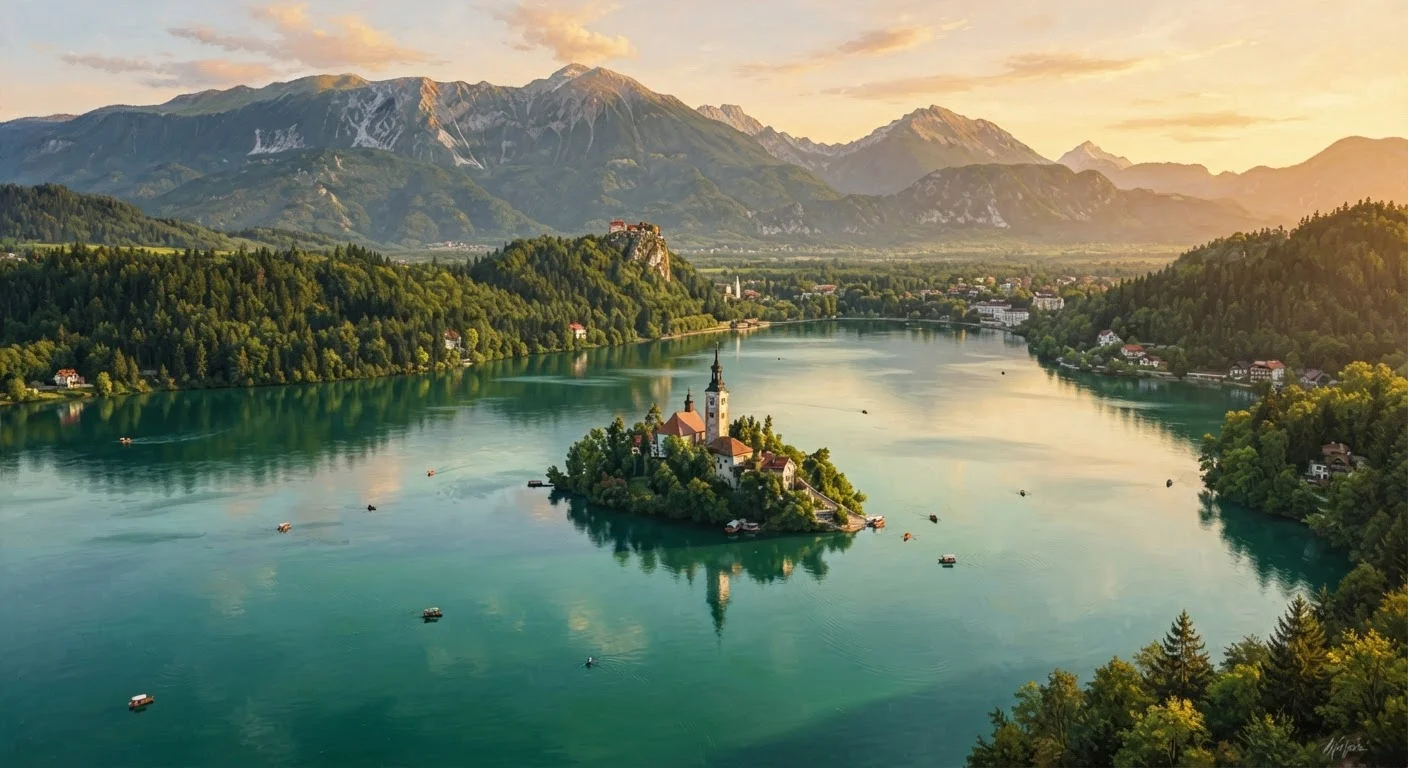
Lake Bled earns every photograph. The island church rising from emerald water, the medieval castle clinging to the cliff above - it delivers. But limiting yourself to Bled alone is a navigational mistake in a country this compact.
Triglav National Park, which encompasses most of the Slovenian Alps, is where the landscape shifts from picturesque to genuinely wild. The Soča River - an almost implausibly vivid shade of glacier-fed blue-green - runs through the western reaches of the park, passing through the town of Bovec, which serves as the practical base for rafting, kayaking, and hiking. The Soča front's World War I history layers the valley with additional weight; remnants of trenches and the Kobarid Museum document one of the war's lesser-known western theaters.
Northeast of Bled, the village of Kranjska Gora sits at the foot of the Vršič Pass - a mountain road of 50 hairpin bends that crests at 1,611 meters and connects the Alpine north to the Soča Valley below. In summer, it's driveable and extraordinary. The pass closes in winter, but the surrounding ski area remains accessible from the valley floor.
Drive the Vršič Pass in the direction of south to north - from Trenta village up toward Kranjska Gora - to keep the most dramatic drops on the valley side rather than the cliff face, making the views easier to appreciate safely.
The pass's 50 hairpin bends are numbered, and the approach from the Soča side provides a more gradual climb before the vertiginous descent into the Sava watershed - better for orientation and photography stops.
Book Škocjan Caves entrance in advance during peak summer months; the guided tour group sizes are deliberately limited and slots can fill several days out.
UNESCO site regulations at Škocjan restrict visitor numbers to protect the cave ecosystem - a policy that benefits the experience but requires planning.
For those drawn to the quieter end of Alpine Slovenia, the Logarska Dolina (Logar Valley) in the Kamnik-Savinja Alps offers a glacially carved cirque with virtually none of Bled's foot traffic and some of the country's most traditional farmhouse accommodation.
Underground Slovenia: Postojna and Škocjan
Slovenia sits atop a vast karst plateau, and what centuries of water have carved beneath it rivals anything visible above ground. Two cave systems dominate - and they are emphatically not interchangeable.
Postojna Cave is one of Europe's largest cave systems, extending roughly 24 kilometers. Visitors travel the first two kilometers by miniature train before continuing on foot through chambers of stalactites, stalagmites, and the famous white calcite formations. The cave is also home to the Proteus anguinus, a blind cave-dwelling salamander endemic to Dinaric karst - an eerie, pale creature that Slovenians call the human fish for its skin tone. Postojna is genuinely spectacular and genuinely popular; visiting early in the morning or on weekdays moderates the crowds somewhat.
Cave Temperatures Stay Cool Year-Round
Both Postojna and Škocjan maintain interior temperatures around 8-12°C regardless of outside conditions. A light jacket or layer is essential even in midsummer - many visitors underestimate this and find the extended tours uncomfortable without one. Sturdy footwear with grip is also advisable on wet cave walkways.
Škocjan Caves, a UNESCO World Heritage Site located about 30 kilometers southwest of Postojna, offers a different proposition entirely. Where Postojna impresses with scale and geology, Škocjan unsettles with drama: a subterranean canyon carved by the Reka River, with walkways suspended over a gorge that drops 163 meters. The formations are less ornate but the spatial experience is more visceral. Visiting both in the same trip is entirely feasible and highly recommended - they are genuinely distinct.
Between the two cave systems lies Predjama Castle, a medieval fortress built into a cliff face above a cave mouth. It functions as a complementary stop between Postojna and Škocjan and is worth the short detour.
Ljubljana: A Capital Scaled for Humans
Ljubljana (pronounced lyoo-BLYAH-nah) is a capital city that has somehow retained the navigability of a small town. The historic core is largely pedestrianized; the Ljubljanica River, lined with café terraces and arched bridges, runs through the center; and the castle on the hill above is reachable by cable car or a fifteen-minute walk.
The covered Central Market - architect Jože Plečnik's masterwork of open-air arcades - operates every morning except Sunday and offers one of the most complete pictures of Slovenian food culture in a single space: aged Karst cheese, smoked Carniolan sausage, buckwheat products from the northeast, local honey in every variety. Plečnik's influence on the city is pervasive; the Ljubljana born architect reshaped much of the city center between the wars, and his idiosyncratic neoclassical-meets-vernacular style is distinctive enough to constitute a walking tour of its own.
“Ljubljana is a city that has managed to be cosmopolitan without becoming anonymous. The scale keeps it honest.”
— Alicia Buller, Travel writer and Central Europe correspondent
The Metelkova district, a former military barracks turned arts compound, represents a different layer of the city - one that tends to operate after dark. It sits near the National Museum of Slovenia, which houses finds spanning prehistoric lake-dweller settlements to Roman-era artifacts and is one of the country's more undervalued cultural institutions.
The Adriatic Sliver: Piran and the Slovenian Coast
Most travelers, even those who know something of the Balkans, are surprised to learn that Slovenia has an Adriatic coast at all. Its 47-kilometer strip - between the Italian border town of Muggia and the Croatian border - contains three main towns: Koper, Izola, and Piran.
Piran is the one worth arranging time around. Built on a narrow peninsula, the town is a remarkably intact example of Venetian Gothic architecture, complete with a central square named after the violinist Giuseppe Tartini who was born here in 1692. Cars are restricted from the old town's interior; the only way to experience it is on foot through cobbled lanes that terminate abruptly at the sea wall.
The Slovenian coast shares the Adriatic with Croatia's Istrian peninsula just to the south - and the towns are architecturally related, shaped by centuries of Venetian rule. Travelers who have visited southern Italy's cave cities and vernacular architecture or Albania's developing Riviera will find the Slovenian coast a more polished but still uncrowded complement to the broader Adriatic experience.
The local salt pans at Sečovlje, now a nature reserve and ethnological museum, document a salt-harvesting tradition stretching back to the 14th century and support a significant population of migratory birds.
Practicalities: Getting Around and When to Go
Ljubljana's Jože Pučnik Airport receives direct flights from a growing list of European cities, and the capital is also accessible by overnight train from Vienna and Munich. For travelers already in the region, entry by car from Italy, Austria, or Croatia is straightforward - Slovenia is a Schengen member, so EU and many other passport holders cross without border formalities.
Within the country, a rental car is the single most effective decision a visitor can make. The road network is excellent, distances are short - driving from the Soča Valley to Piran takes under two hours - and the rural Slovenia that trains skip (wine roads of the Vipava Valley, medieval Škofja Loka, the forested Kočevski Rog) becomes fully accessible.
Time Your Soča Valley Visit for Early Autumn
The Soča River runs its most vivid blue-green during late summer and early autumn when glacial melt has slowed and river levels stabilize. September also brings fewer visitors to Bovec and surrounding trailheads, and the beech forests above the valley begin to turn color by mid-October.
Late May through June and September through mid-October represent the practical sweet spots. Summer school holidays push Bled and Postojna to their visitor peaks; spring and autumn bring lower occupancy, more moderate temperatures for hiking, and the particular quality of light that makes the Soča Valley's colors most vivid. Winter is viable in the alpine areas for skiing, but the caves and coast are best avoided in the colder months when services thin out considerably.
For entry requirements, health documentation, and travel advisories relevant to your nationality, consult your government's official travel guidance before booking. Conditions and requirements change, and official sources remain the authoritative reference.
Slovenia rewards travelers who approach it without agenda - who are willing to follow the Vršič road over the pass not knowing exactly what the view will be, or to stop in Štanjel, a fortified village in the Karst region, simply because it appeared on the map. For those hungry for what lies genuinely beyond the brochure, this is a country that consistently delivers.
Slovenia Tourism Official Portal
The Slovenian Tourist Board's official site provides regional itinerary guides, accessibility information, and up-to-date details on national parks and protected areas - a reliable starting point for trip planning.
Triglav National Park Visitor Information
The national park's official resources cover trail conditions, entry rules for protected zones, and hut-to-hut hiking logistics - essential reading before heading into the Julian Alps backcountry.
Škocjan Caves Park Authority
The UNESCO-designated Škocjan Caves Park publishes official tour schedules, booking procedures, and conservation context that helps visitors understand the site's significance before arriving.