
The Ship Is Bigger Than Most Passengers Realize
On embarkation day, most passengers follow the same instincts: drop bags, find the buffet, claim a pool lounger. Within two hours, a mental map forms - and for many, it barely shifts for the rest of the voyage. The atrium, the main pool, the buffet, the theater. These are the landmarks that dominate the experience for the majority of guests aboard any large contemporary ship.
What that map misses is substantial. Modern cruise ships - particularly those carrying 3,000 passengers or more - are layered with secondary spaces that serve genuine functions but rarely appear in the glossy marketing imagery. Some exist for operational reasons. Others were designed as quiet retreats but simply never found their audience. A handful are open to all passengers and sit virtually empty throughout the sailing.
The cruisers who discover these spaces tend to be repeat sailors who learned, voyage by voyage, that the ship rewards those who wander. If you want to shortcut that learning curve, the list below is a good starting point. And if you're still building your pre-boarding research habits, the details experienced cruisers check before booking a new ship include exactly this kind of layout knowledge.
The forward observation lounge
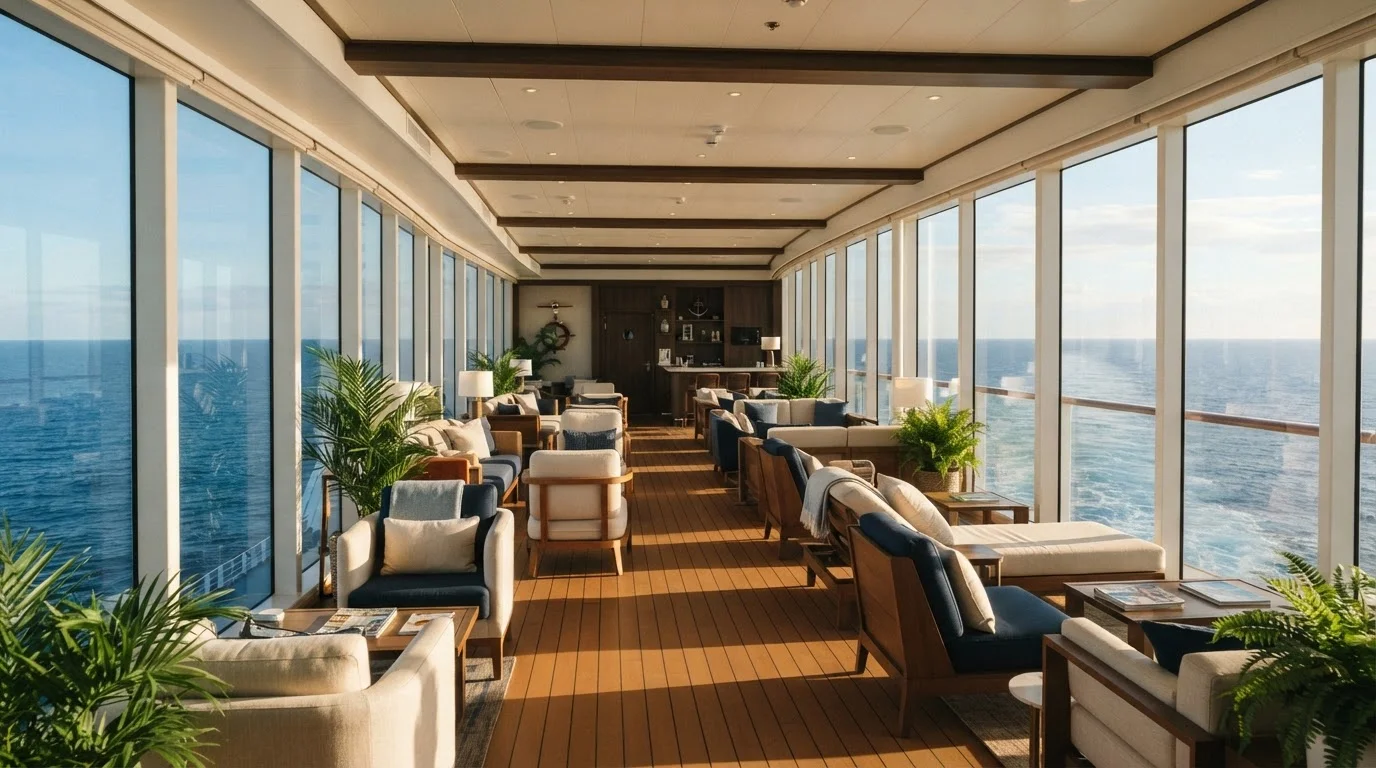
Many mid-to-large ships include a forward-facing observation lounge, typically positioned on one of the higher decks at the ship's bow. On sea days it offers unobstructed views of the horizon - and on port-arrival mornings, it provides a front-row perspective as the ship glides into harbor that no pool deck can replicate.
These rooms are often used for trivia or lectures on certain evenings, but outside scheduled programming they sit empty for hours. Bring a book, a coffee, and arrive before 8 a.m. on a port morning for a genuinely memorable arrival experience.
A forward observation lounge at dawn offers a port-arrival view no pool deck can match.
The stern upper decks during sail-away
While everyone crowds the main pool deck for sail-away, the aft section of upper decks - particularly Decks 14 through 16 on most large ships - is often nearly empty. The wake view from the stern is arguably more dramatic than the departing skyline, and there's room to breathe.
Some ships have a small aft bar or seating area at these levels that sees minimal traffic except during peak afternoon hours. Getting familiar with the aft layout on Day 1 pays dividends for the rest of the sailing.
The stern's upper decks during sail-away offer wake views and breathing room the pool deck never will.
The ship's library or card room
Cruise ship libraries have declined in size on newer vessels, but they haven't disappeared. On ships that retain a dedicated library or adjoining card room, these spaces are among the quietest on the ship - reliably so, because they attract only passengers who sought them out intentionally.
Even on ships where the library is a single bookshelf tucked into a corridor alcove, the surrounding seating tends to be calm. These areas are especially useful on sea days when the pool deck becomes congested and the main atrium fills with activity noise.
A ship's library is one of the last truly quiet spaces left on a large modern vessel.
The main dining room at breakfast
Almost universally, the main dining room (MDR) opens for breakfast on sea days - and almost universally, passengers don't realize it. The assumption that the MDR is only for assigned dinner seatings leads the majority of guests straight to the buffet, where wait times, congestion, and noise peak between 8 and 10 a.m.
Breakfast in the MDR is served from a menu, plated at the table, and typically takes no longer than the buffet alternative. The atmosphere is noticeably calmer. For a fuller comparison of onboard dining options, the tradeoffs between each venue are worth understanding before you sail.
MDR breakfast is one of cruising's best-kept secrets - calm, plated, and rarely crowded.
The adults-only solarium on port days
On ships that include an adults-only solarium - an enclosed or semi-enclosed pool and lounge area - the space is well-known but strategically underused. Most passengers who intend to use it gravitate there on sea days, creating moderate competition for the best loungers.
Port days, however, are a different story. When the majority of passengers disembark for excursions, the solarium becomes one of the most peaceful spots on the ship. For passengers who occasionally prefer a quiet day aboard over a busy port visit, timing a solarium morning to coincide with a less-compelling port call is a well-practiced strategy among repeat cruisers.
Port days transform the solarium into one of the quietest, most comfortable spots on the entire ship.
The upper-deck walking track in the early morning
Most large ships include a walking or jogging track on an upper open deck - typically an unobstructed loop around Deck 7 or higher. Between 6 and 7:30 a.m., these tracks see very little traffic, and the sea air and horizon views at that hour are distinctly different from midday conditions.
Beyond the exercise benefit, the upper walking track at dawn offers one of the clearest, most unobstructed perspectives of the ship's surroundings available to passengers without access to a private balcony. It's a straightforward way to experience the ocean crossing in a way that most passengers sleeping in will miss entirely.
The upper walking track before 7 a.m. offers some of the best unobstructed ocean views on any deck.
Making the Most of What You Find
Discovering a quiet space is one thing; integrating it into your daily rhythm is another. Sea days - particularly on longer or repositioning itineraries - are when these spaces earn their keep. With no port excursions to structure the day, the ship's full geography becomes available, and the contrast between crowded and uncrowded zones becomes most apparent.
Review the Deck Plan Before You Board
Most cruise lines publish full, interactive deck plans on their websites and apps. Spending 15 minutes with the deck plan before embarkation day lets you identify secondary lounges, observation areas, and dining alternatives before the crowds settle into their routines. Look specifically for spaces labeled 'lounge,' 'observation,' 'card room,' or 'library' - these are the low-traffic zones worth finding early.
It's also worth noting that the dining picture extends beyond the spaces covered here. If you haven't already mapped your onboard food options, the full breakdown of ship dining venues covers the tradeoffs between specialty restaurants, the main dining room, and the buffet - including timing strategies that reduce wait times considerably.
The underlying principle across all of these tips is the same: the ship is a shared environment, and the passengers who enjoy it most are generally those who treat the deck plan as a resource to be explored, not a background detail. That approach pays dividends on every sailing - and it costs nothing.