
What You're Actually Choosing Between
The decision between a solo wellness retreat and a group program isn't simply about preference for company - it's about understanding which environment is most likely to support genuine restoration given your current state. Both formats are legitimate. Both carry real benefits. And both carry trade-offs that brochures tend to smooth over.
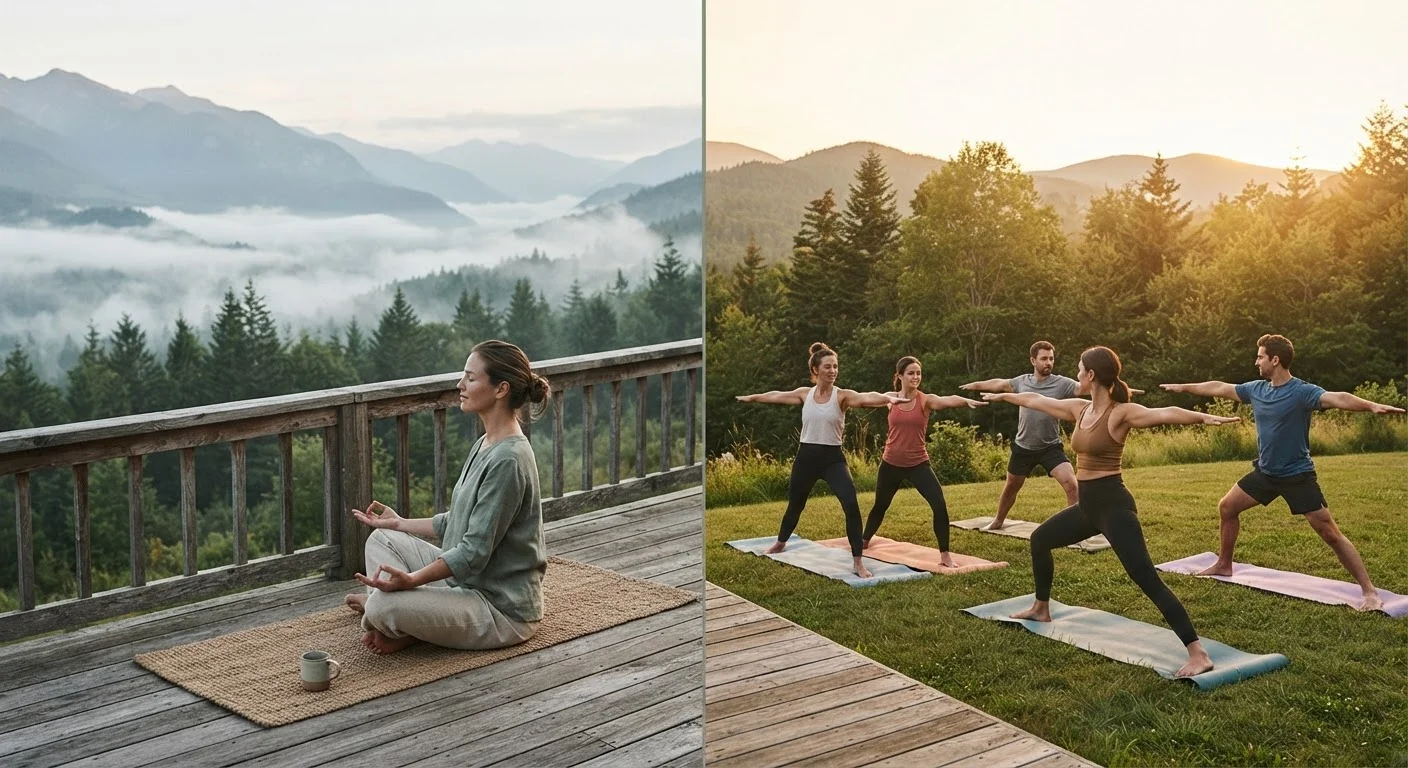
A solo retreat typically means private accommodation, a schedule you build (or don't), and an absence of social obligation. You may still be at a larger property with staff and practitioners, but your day is fundamentally your own. A group wellness program, by contrast, is built around a cohort: shared meals, communal sessions, facilitated workshops, and the relational texture that comes with spending concentrated time among strangers working toward similar goals.
Before you choose, it helps to be honest about where you're starting from - not where you'd like to be. What wellness retreats rarely tell you upfront is that the wrong social format can undermine even the most thoughtfully designed program.
| Criterion | Solo Wellness Retreat | Group Wellness Program |
|---|---|---|
| Schedule control | Fully self-directed | Mostly facilitated |
| Social interaction | Minimal to none | Daily, structured |
| Accountability support | Self-generated only | Built-in peer and facilitator |
| Best emotional baseline | Overwhelmed, overstimulated | Isolated, unmotivated |
| Facilitation quality | On-demand, optional | Core to the experience |
| Privacy | High | Moderate |
| Habit-building support | Weak without structure | Strong through group norms |
| Ideal traveler | Introverted, self-aware | Motivated by community |
The Case for Solitude: When Going Alone Restores More
Solo wellness travel is often misread as isolating. In practice, intentional solitude - particularly in a setting designed for it - creates conditions that busy social environments simply cannot: uninterrupted interiority, permission to be unproductive, and freedom from the subtle performance that group dynamics invite.
Research in environmental psychology consistently links access to natural solitude with reduced cortisol and improved mood regulation, though individual responses vary considerably. For those navigating burnout, grief, or a major identity shift, the absence of social expectation can itself be deeply therapeutic - though anyone using a retreat as part of a mental health recovery plan should first discuss the format with a qualified professional.
Solo retreats also suit travelers whose daily lives are saturated with caregiving, management, or high-volume social interaction. If your exhaustion comes partly from people, adding more of them - even well-intentioned fellow wellness seekers - may simply extend your depletion.
71%
Travelers citing mental rest as primary retreat goal
According to the Global Wellness Institute's wellness tourism trend analysis, mental restoration consistently ranks as travelers' top stated motivation for wellness travel.
2-3x
Greater habit retention with peer accountability
Behavioral science research generally finds that social accountability structures improve follow-through on new health behaviors by two to three times compared to solo intention-setting.
That said, unstructured solo time requires self-awareness. Without facilitation, it's easy to spend a supposed retreat scrolling, ruminating, or simply replicating home habits in a prettier location. Digital detox retreats offer one model for creating genuine disconnection - even when traveling alone.
The Case for Community: What Groups Offer That Solitude Cannot
Group wellness programs carry their own distinct and well-documented advantages - particularly for people whose recovery goals involve behavioral change, social reconnection, or learning new practices from scratch.
Peer accountability is among the most reliable predictors of habit formation. When a group commits to morning movement, breathwork, or reflective journaling together, individual follow-through measurably improves. The social mirror effect - seeing others navigate similar struggles openly - can also reduce shame and normalize difficulty in ways that private introspection sometimes cannot.
Facilitated group programs are particularly well-suited to travelers who feel adrift without structure, or who find that open time tends to collapse into anxiety rather than rest. A skilled facilitator can also surface emotional material that solo travelers might unconsciously avoid. Planning a wellness journey that holds up beyond the trip often starts with the accountability structures formed in group settings.
Hybrid Formats Are Increasingly Common
Many retreat centers now offer programs that blend private accommodation and solo morning time with optional group sessions in the afternoon. This middle-ground model can suit travelers who want community without saturation. When researching programs, ask specifically about the ratio of structured group time to free personal time - the answer reveals more about program philosophy than any marketing copy.
It's worth noting that group programs vary enormously in tone, size, and facilitation quality. A cohort of six in a small forest retreat is a fundamentally different social environment than a 40-person luxury resort program. Scrutinize group size and facilitation credentials as carefully as the program content itself. See what separates genuine rest from aesthetic packaging for practical guidance on evaluating programs.