
Origins: War Paths Turned Adventure Routes
Via ferrata routes have a surprisingly martial origin. During World War I, Italian and Austro-Hungarian military engineers bolted iron rungs and cables into the sheer Dolomite faces of northeastern Italy to move troops, ammunition, and supplies across otherwise impassable terrain. The most famous surviving example, the Via Ferrata Cesare Battisti near Monte Pasubio, dates directly to this period. After the war, alpine clubs began adapting and expanding these military installations for civilian mountaineering, transforming relics of conflict into corridors of exploration.
By the late twentieth century, via ferrata had evolved from a niche Italian pursuit into a continent-wide phenomenon. Austria's Tyrol region, the Swiss Alps, France's Écrins massif, and Slovenia's Julian Alps all developed extensive networks. Today, dedicated guidebooks map thousands of routes across Europe, each catalogued by length, elevation gain, grade, and key hazards.
“The via ferrata is not merely a climbing route - it is a corridor through history, a path that makes the vertical world habitable for those willing to step beyond the horizontal comfort of the valley floor.”
— Reinhold Messner, Legendary Dolomite-born mountaineer and alpine author
How the Hardware Works
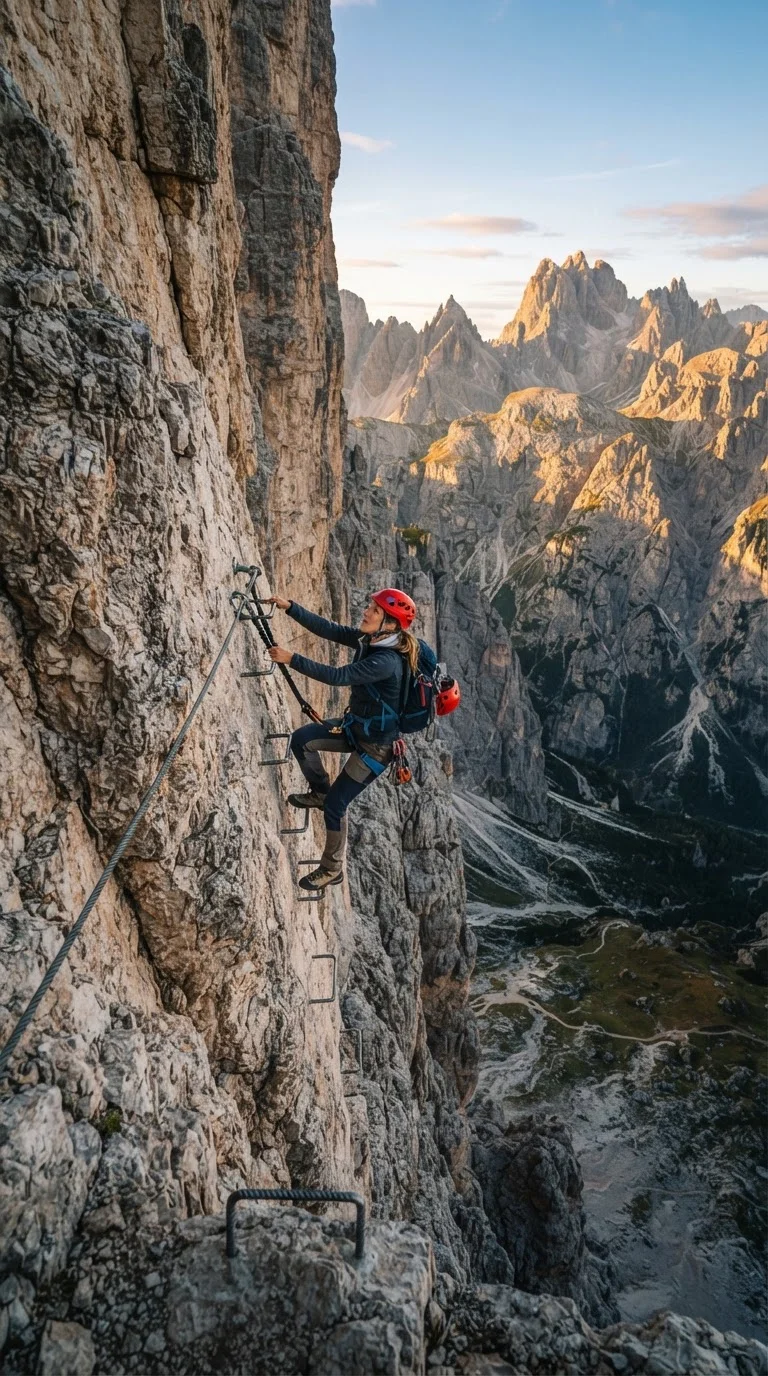
The defining feature of any via ferrata is its fixed protection system: a continuous steel cable anchored at intervals into the rock with expansion bolts. Iron rungs (called staples or pitons depending on the region) provide hand- and footholds where the natural rock offers insufficient purchase. Where routes cross voids or traverse cliff bands, suspension bridges - sometimes dozens of meters long - span the gaps.
The participant's connection to all this hardware is a Y-shaped via ferrata lanyard, typically with a built-in energy absorber that deploys in a controlled tear to limit the force transmitted to the body during a fall. Each arm of the Y ends in a carabiner; you clip one ahead as you move and unclip the trailing one only after the first is secure. This leapfrog system means you are never fully unattached to the mountain.
Rent Before You Buy on Your First Route
Via ferrata kits - harness, helmet, and Y-lanyard - are available for hire at most trailhead equipment shops near established routes across the Alps. Renting for a first outing lets you experience the system fully before committing to purchasing specialized gear. Ensure any rental lanyard carries a current CE certification and an integral energy absorber; a standard climbing quickdraw lanyard is not a safe substitute.
Grades, Fitness, and Who Should Attempt What
Via ferrata grades are not purely technical - they also reflect sustained physical effort and psychological exposure. A Grade 1 or A/B route typically involves moderate inclines, good footholds, and little vertiginous exposure; these are well suited to confident hikers trying via ferrata for the first time. A Grade 3 or C/D route demands strong arms, comfort with sustained vertical climbing, and a genuine tolerance for steep drop-offs. Grade 5 and above is territory for experienced mountaineers who train specifically for it.
2,000+
Via ferrata routes documented across Europe
Estimates compiled from major European alpine clubs and guidebook publishers indicate thousands of catalogued routes, with Italy and Austria hosting the largest concentrations.
1915-1917
Peak period of original Dolomite military route construction
Military engineers from both sides of WWI's Italian Front installed the earliest iron-road systems to enable troop movement across the Dolomite massif.
Grade 1-6
Standard European via ferrata difficulty range
The Italian grading scale - widely adopted across guidebooks - classifies routes from beginner-friendly (1) to extreme expert-only terrain (6), though national scales vary.
Physical conditioning is often underestimated. Forearm endurance, grip strength, and core stability matter considerably on longer routes. A route rated moderate can still involve two to four hours of continuous climbing - arriving fatigued halfway up a cliff band is a serious hazard. Most European alpine clubs recommend a fitness baseline that includes regular hiking with elevation gain before attempting any via ferrata.
Where to Find Europe's Signature Routes
The Dolomites of northern Italy remain the spiritual home of via ferrata, with routes ranging from family-friendly walks with iron handholds to technically demanding ascents of dramatic limestone towers. The Inntal and Ötztal valleys in Austria's Tyrol offer some of the longest continuous routes in the Alps, while Slovenia's Triglav National Park hosts routes accessible enough to attract hikers crossing into mountain climbing for the first time.
Beyond the Alps, Spain's Montserrat near Barcelona and the Gorges du Verdon in southern France present via ferrata in striking Mediterranean landscapes - warmer, drier, and considerably less crowded than peak-season Dolomite routes. For travelers drawn to cultural depth alongside physical challenge, these destinations layer compelling history and scenery with the vertical experience.
Seasonal and Weather Considerations
Most via ferrata routes are accessible between late June and early October in the European Alps, depending on snow clearance and thunderstorm frequency. Summer afternoon thunderstorms are a serious hazard on exposed metal hardware - plan to be descending by early afternoon. Always check the local mountain weather forecast from services such as MeteoMont or the Austrian Central Institute for Meteorology and Geodynamics before setting out.
Regardless of destination, consult the relevant national alpine club - Club Alpino Italiano, Österreichischer Alpenverein, or equivalent - for current route conditions, seasonal closures, and up-to-date safety guidance before travel.