
A City Built at the Edge of Everything
Most travelers who book a flight to Tbilisi expect something like Prague with warmer weather - cobblestones, baroque churches, a photogenic river. What they find instead is a city whose architectural bones were laid by Persian rulers, reshaped by Russian tsars, and then compressed into Soviet apartment blocks, all while its residents continued pressing wine in clay vessels buried underground, exactly as their ancestors did thousands of years before Christ.
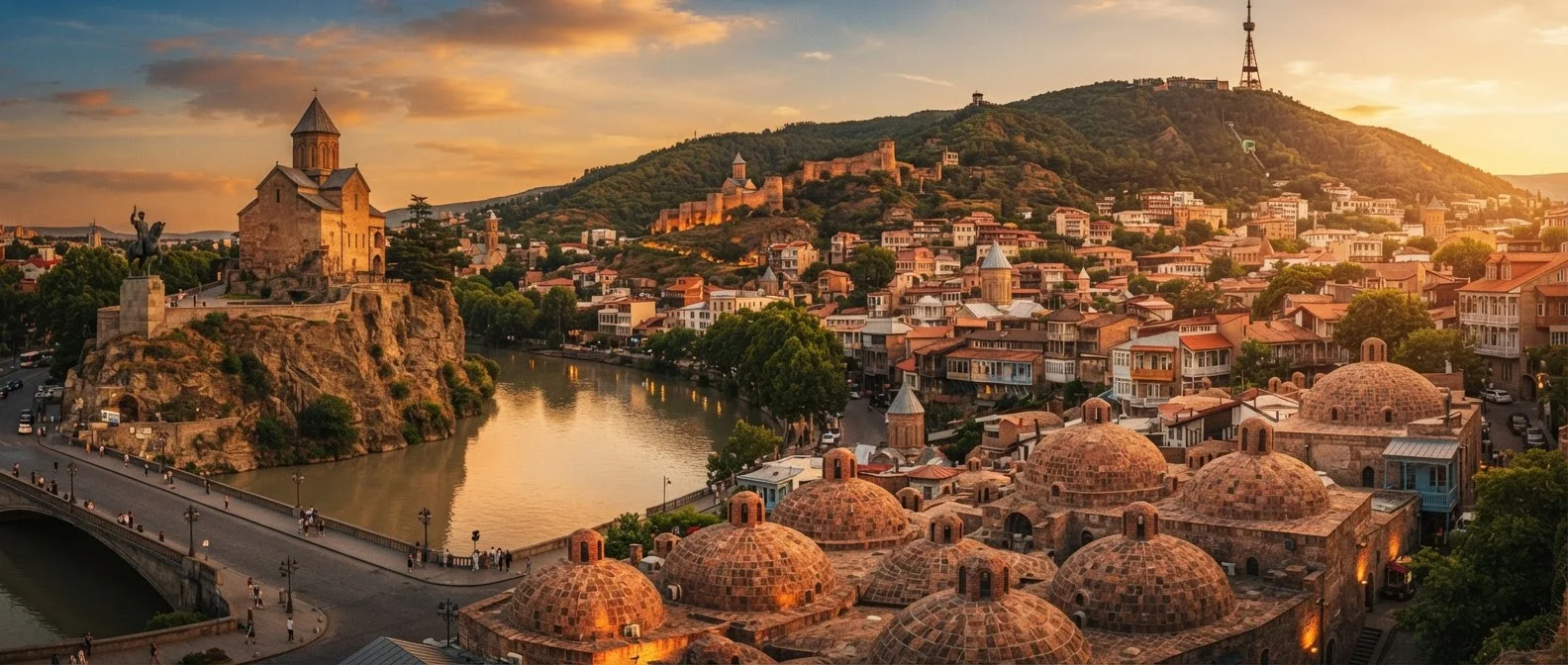
The old town district of Kala unfolds along the Mtkvari River in a tangle of wooden balconies, carved grape-vine reliefs, and domed bathhouses venting sulfur into the narrow lanes below. This is the Abanotubani quarter, where thermal springs that drew the city's founding - legend attributes this to King Vakhtang I Gorgasali in the 5th century - still feed hammams that have operated in some form ever since. Walking through at dusk, with steam rising from the domes and the Narikala fortress silhouetted against the hill above, travelers often describe a disorienting beauty - the feeling that the city refuses to resolve into a single, legible identity.
“The Caucasus sits at the boundary of the known and the imagined - a place where travelers arrive with a map and leave with a different understanding of where Europe ends.”
— Rory MacLean, British travel writer and author of works on Eastern Europe and the former Soviet sphere
Wine Older Than Rome, Food Unlike Anything Nearby
Georgia's claim to being the birthplace of wine is not marketing hyperbole. Archaeological evidence from sites in the Kvemo Kartli region points to grape cultivation and winemaking dating back approximately 8,000 years, predating both Roman viticulture and the vineyards of the Fertile Crescent. The traditional method - fermenting juice with grape skins, seeds, and stems in large clay vessels called qvevri, which are sealed with beeswax and buried underground - is now recognized by UNESCO as an Intangible Cultural Heritage practice.
In Tbilisi, this tradition is visible at any wine bar in the Marjanishvili district, where amber-hued qvevri wines are poured alongside dishes that share almost no DNA with neighboring cuisines. Georgian food occupies its own culinary universe: khinkali (soup dumplings crimped at the top and eaten with fingers), pkhali (cold vegetable rolls bound with walnut paste and pomegranate), and the city's edible mascot, khachapuri - a bread boat filled with cheese, butter, and a raw egg stirred tableside. The combination of walnut, fenugreek, and marigold petals as a flavor base appears across dozens of dishes and has no true parallel in either Middle Eastern or European cooking.
8,000 years
Estimated age of Georgian winemaking tradition
Archaeological evidence from the Kvemo Kartli region, published by researchers including those at the University of Toronto, places grape cultivation and fermentation in Georgia among the oldest documented in the world.
~1.5M
Population of Tbilisi metropolitan area
Tbilisi remains a mid-sized capital by European standards, contributing to the walkable, neighborhood-distinct character that frequent travelers often cite as a key draw.
UNESCO listed
Georgian qvevri winemaking method
UNESCO added the traditional Georgian method of making wine in clay qvevri vessels to its Intangible Cultural Heritage list in 2013, recognizing it as a living cultural practice.
How to Navigate Tbilisi Beyond the Obvious
The city rewards walkers who stray from the Rustaveli Avenue corridor. The Fabrika complex - a repurposed Soviet sewing factory - has become a gathering point for the creative economy: small studios, independent roasters, and vinyl shops occupy what were once industrial workrooms, while a courtyard fills with locals on warm evenings. A short metro ride away, the Vake neighborhood offers a calmer, residential Tbilisi of tree-lined streets and independent wine shops where the clientele skews heavily local.
For travelers who want to extend their time in the country, day trips from the capital reach striking range. The cave city of Uplistsikhe, carved into rock above the Mtkvari Valley, is roughly an hour and a half by car. The Kakheti wine region - home to the town of Sighnaghi, a walled hilltop settlement with long views toward the Alazani Valley - is reachable in two to three hours and makes a natural overnight. Those planning a broader regional loop might compare notes with travelers exploring the Albanian Riviera, another corner of the continent still finding its tourist infrastructure footing.
Arrive Without Too Fixed a Itinerary
Tbilisi's most memorable experiences - a spontaneous supra (traditional feast) hosted by a local family, an impromptu polyphonic choir rehearsal in a church courtyard - are not schedulable. Building in unstructured afternoon time in the old town almost always pays off. The city's compact core also means a single day on foot can cover surprising ground.
Travel conditions, visa requirements, and safety advisories for Georgia can change; always verify current information with your government's official travel advisory service before making plans.