
A Landscape That Earned Its Mythology
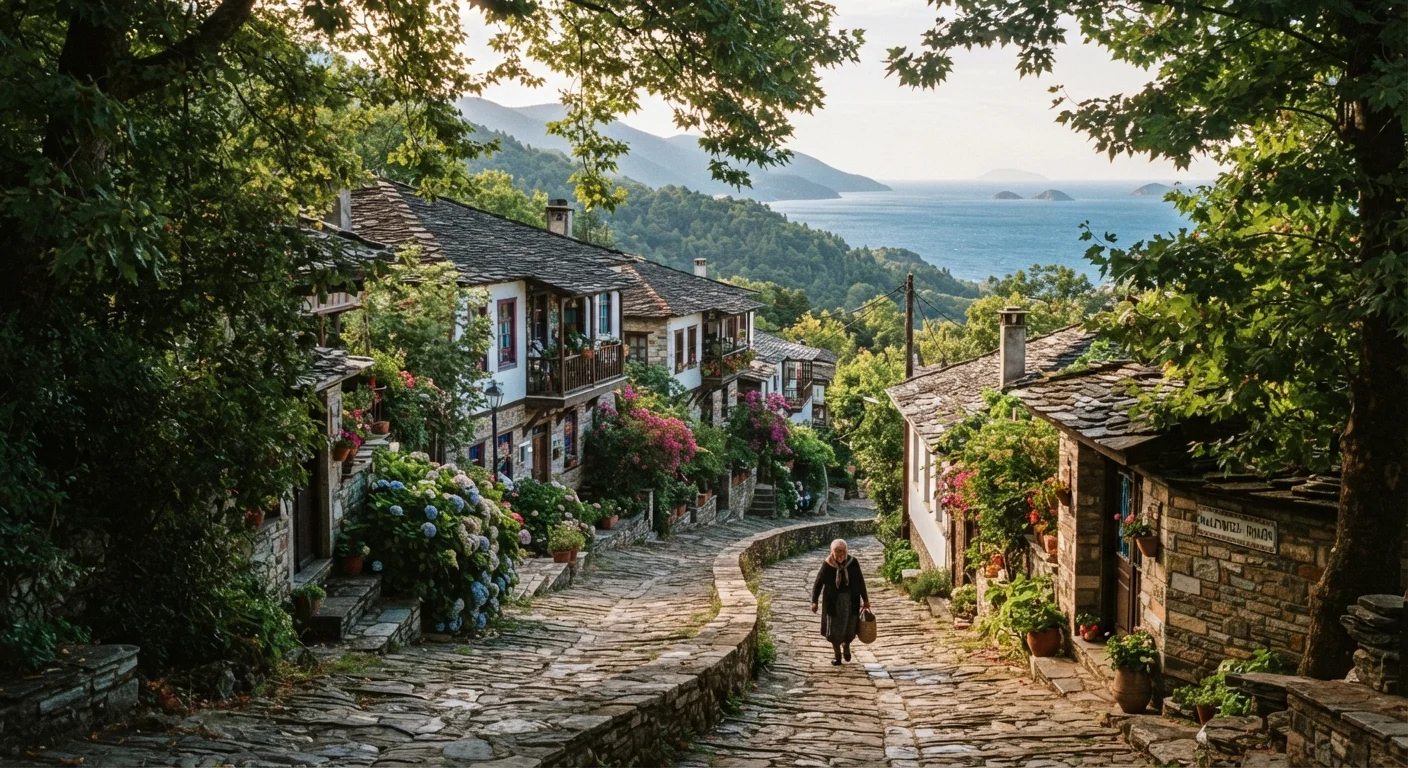
Stand at the edge of Makrinitsa on a clear morning and you can watch cargo ships move across the Pagasetic Gulf far below while, behind you, the forest closes in with the hush of something genuinely ancient. This is the quality that made Pelion mythologically irresistible to the ancient Greeks: a landscape that simultaneously faces the sea and retreats into deep shadow. The centaurs who supposedly roamed here were creatures of that same duality - civilized enough to teach heroes, wild enough to belong nowhere else.
Mount Pelion rises to around 1,600 meters and intercepts moisture-laden winds off the Aegean, feeding forests of chestnut, oak, and beech that have no obvious Greek-island parallel. The mountain runs roughly north to south, with the western slopes dropping gently to the warm, calm Pagasetic Gulf and the eastern flank falling steeply to the open Aegean in a series of dramatic gorges and cove beaches. This geography creates two entirely different coastal experiences separated by a single ridge - a fact that rewards travelers who take the time to cross from one side to the other.
“Pelion is one of those places in Greece where the mythology doesn't feel like an overlay added for tourists - the landscape itself makes you understand why the ancient Greeks placed their most complex creatures here, in the forest, at the edge of the sea.”
— Katerina Sarri, Greek travel writer and Thessaly cultural guide
The Village Architecture: Stone, Slate, and Surviving Ottoman Craft
Pelion's villages are its most immediately striking feature for travelers arriving from the bleached-white geometry of the Cyclades. Here, the vernacular is stone: thick-walled archontika (mansions) built by prosperous silk and textile merchants during the 18th and early 19th centuries, their overhanging upper floors cantilevered over narrow lanes, their interiors decorated with carved wooden ceilings. The Ottoman administrative period paradoxically granted Pelion significant autonomy and wealth, and the architectural legacy of that era is unusually intact.
Vizitsa and Mouresi are among the villages where this heritage is most coherent - arriving on foot via a kalderimi rather than by road amplifies the sense of temporal displacement. The kalderimia themselves are a form of infrastructure worth considering: some sections date back centuries, hand-laid with flat river stones in patterns designed to channel rainwater away from the path surface. Walking them connects the traveler physically to the same routes that mule teams and merchants once used.
Walk the Kalderimia Between Villages
Rather than driving every connection, identify at least one kalderimi section to walk between neighboring villages - the Portaria-to-Makrinitsa path and the Tsagarada-to-Mylopotamos descent are among the most rewarding. Allow more time than the distance suggests: the stone paths are uneven and the scenery encourages frequent stops. Wear sturdy footwear with ankle support.
Coastline, Coves, and the Eastern Aegean Shore
The beaches of Pelion's eastern coast occupy a different register from anything on the tourist-circuit Greek islands. Mylopotamos, reached by a long descent from Tsagarada through forested ravine, arrives without fanfare - a pebble cove where the water runs between shades of green and deep blue depending on depth and cloud cover. Damouchari, a tiny fishing harbor that briefly served as a film location, retains a working-village character that larger destinations have largely traded away.
The western Pagasetic shore, by contrast, is calmer and shallower - better for families and less dramatic in scenery, but warmer and more sheltered. Understanding this coastal duality is practical: travelers seeking striking scenery and energetic swimming tend toward the east; those preferring calm water and easier beach access often prefer the west.
~1,600 m
Peak elevation of Mount Pelion
The mountain's height is sufficient to generate a distinct forest microclimate, producing conditions rare elsewhere in mainland Greece.
24+
Traditional villages on the peninsula
Pelion is home to more than two dozen historically significant stone-built settlements, many connected by the ancient kalderimia path network.
3.5 hrs
Train journey from Athens to Volos
Intercity rail services connect Athens's Larissa station to Volos, making the peninsula accessible without flying or driving the full distance.
Volos, the industrial port city at the peninsula's base, is underrated as a destination in its own right. Its waterfront tsipouradika - small restaurants traditionally serving the local spirit tsipouro alongside small plates of seafood - represent a dining culture specific to this corner of Greece and largely unknown outside it.
Getting There, Getting Around, and What to Expect
Pelion is not a destination that rewards the traveler looking for convenience-first logistics. That is also precisely its appeal. Volos is the gateway: served by frequent intercity trains from Athens and by regional buses, it sits at the base of the peninsula and functions as the natural starting point. From Volos, the road into the mountains is scenic and winding, and most visitors find that a rental car is the most practical way to move between villages - public bus services exist but run on limited schedules, particularly in smaller settlements.
Accommodation tends toward the traditional guesthouse model: stone-built mansions converted into small, family-run inns. The experience varies considerably, and it is worth researching individual properties carefully and communicating directly to confirm room specifics, including accessibility and parking. The peninsula has no major international hotel chains, which is both a feature and a consideration depending on the traveler's expectations.
Pelion in Winter: A Different Experience
The ski area near Agriolefkes (known locally as Pelion Ski Centre) makes the mountain a genuine winter destination for Greek travelers, and several villages see snow from December through February. The combination of a snow-dusted stone village and an Aegean view is unusual in European winter travel. Road access to higher elevations can be restricted during heavy snowfall, so checking local conditions before travel is essential.
Visitors should always check current entry requirements, road conditions, and any relevant travel advisories through official government sources before departure, as conditions can change. Pelion's mountain roads, while generally well-maintained, can be narrow and require careful driving, particularly in winter when snow affects higher elevations.